
Online
Today
Skip to main content

CDR Australia Engineer

CDR Australia Engineer Header

Chartered Engineer vs Professional Engineer in Australia: Which Path Fits Your Career?

Consider a civil engineer relocating from overseas to Brisbane. A colleague advises becoming “chartered” before applying for senior roles. Another insists that professional engineer registration is the requirement. Elsewhere, CPEng, RPEQ, NER, and standard Engineers Australia membership all surface in the same conversations, leaving many to assume Chartered Engineer vs Professional Engineer is simply two labels for the same credential. They are not.

Chartered status is a professional credential awarded by Engineers Australia, recognising a demonstrated level of competence and experience. Professional engineer registration, by contrast, is a legal requirement under certain state and territory legislation, applying to specific categories of engineering work. Which credential or registration applies depends on the jurisdiction in which the engineer practices and the nature of the engineering services provided.

This distinction is directly relevant to engineers migrating to Australia, relocating between states, taking on responsibility for design sign-off, or planning their next professional milestone.

Benefits of getting Chartered Engineer vs Professional Engineer, right

  • Know exactly which pathway your work requires
  • Avoid the CPEng-RPEQ mix-up
  • Build a clearer registration roadmap
  • Cut unnecessary assessment costs
  • Move through applications faster
  • Track CPD and renewal requirements separately
  • Sort migration versus registration confusion sooner
  • Reduce back-and-forth with regulators
chartered engineer vs professional engineer

What Is a Chartered Engineer in Australia?

Chartered Professional Engineer (CPEng) is the chartered credential of Engineers Australia for engineers in the Professional Engineer occupational category. It signals that an engineer can work independently on technically and professionally risky work. This distinguishes it from standard membership, which doesn’t carry the same independent-practice signal.

Engineers Australia assesses chartered applicants against the competency requirements for independent practice. It has also endorsed the National Competency Standard for Engineering (NCSE) 2026, effective from 2027, while NCSE 2012 remains in use during the transition. Applicants currently preparing an application should confirm which standard applies to their timeline.

The standard pathway requires 5–15 years of postgraduate engineering experience. Engineers with 15+ years can use a streamlined interview pathway instead. Either route still requires documented evidence, not just years on the job.

Chartered status is not a state engineering license created by an act of parliament. CPEng is a professional qualification awarded by Engineers Australia, and it does not meet the requirements for state registration. An engineer can hold CPEng and still need separate registration to legally practice in a given state.

What Is a Professional Engineer?

“Professional Engineer” has two distinct meanings in Australia.

First, Engineers Australia uses it as one of its three main occupational categories, alongside “Engineering Technologist” and “Engineering Associate.” This category is used in accreditation, competency assessment, and some migration skills assessments.

Second, individual states and territories regulate certain professional engineering work through their own legislation:

Queensland regulates professional engineering services under the Professional Engineers Act 2002 (Qld), prohibiting unregistered practice except in permitted circumstances like direct supervision. The regulator is BPEQ, and practicing registration leads to RPEQ status.

Victoria operates under the Professional Engineers Registration Act 2019 (Vic), requiring registration for prescribed areas, administered through the Business Licensing Authority.

NSW uses the Design and Building Practitioners Act 2020 (NSW) for registration tied to specified regulated buildings and engineering classes, administered through Building Commission NSW.

So “Professional Engineer” isn’t one Australia-wide license with a single fee or regulator—and this is exactly where Chartered Engineer vs Professional Engineer confusion usually starts: it’s a patchwork of state-based schemes sharing a title, not a single national credential like CPEng

The Legal Difference

The distinction that prevents the most expensive misunderstanding is simple, and it’s the crux of Chartered Engineer vs Professional Engineer: CPEng is a professional credential, while state registration is a legal requirement wherever legislation mandates it.

A CPEng-holding engineer based in Queensland can still need RPEQ registration to practise regulated professional engineering services there. Equally, another engineer might need state registration for a particular role without ever having obtained CPEng.

NSW illustrates the same separation. A registered professional engineer can provide engineering advice within their class of registration, but preparing design documents and making engineering declarations of design compliance requires the appropriate design-practitioner class registration instead.

So the real question in the Chartered Engineer vs Professional Engineer debate was never “Which title is better?” It’s this: what engineering work will I be doing, where will I be doing it, and does that jurisdiction require registration for that specific work?

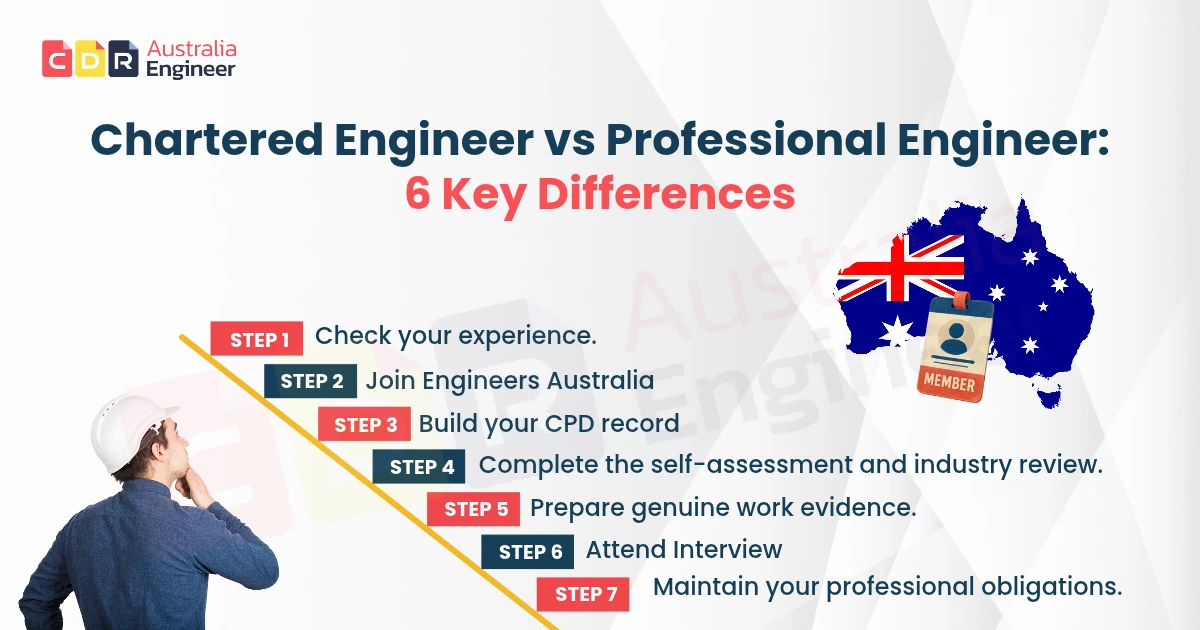
How to Get Chartered, Step by Step

Chartered Engineer vs Professional Engineer_ 6 Key Differences

Check your experience.

Engineers Australia’s standard Chartered pathway currently requires 5–15 years of postgraduate engineering experience. Applicants with 15+ years may use the streamlined interview pathway.

Join Engineers Australia

Membership is required before you can apply for chartered status. This is a prerequisite step, not part of the assessment itself.

Build your CPD record

The standard pathway currently requires evidence of at least 150 hours of CPD over the previous three years. Start logging this early rather than reconstructing it later.

Complete the self-assessment and industry review.

Identify your occupational category and area of practice, assess your capability, and gather evidence from your engineering work.

Prepare genuine work evidence.

This can include reports, drawings, calculations, risk assessments, and project documentation to protect confidential employer information and obtain permission where required.

Attend Interview

The professional assessment interview is where you discuss your engineering work. It’s used to demonstrate the relevant competencies directly.

Maintain your professional obligations.

Chartered status is linked to ongoing CPD and continuing Engineers Australia requirements. Letting either lapse puts your registration at risk.

Engineers Australia notes that applicants with less than five years of experience aren’t yet eligible for the standard chartered application but can work toward the required experience and evidence in the meantime.

Chartered Engineer vs Professional Engineer: Scope, Status, and Cost

Factor

Chartered Professional Engineer (CPEng)

Professional engineer / state registration

Scope

Professional credential demonstrating independent-practice competence

Legal registration for specified engineering work where state legislation requires it

Legal status

Engineers Australia credential; not itself a state license

Statutory registration where required by state or territory law

Governing body

Engineers Australia

Varies by jurisdiction—e.g., BPEQ, Business Licensing Authority (Vic), or Building Commission NSW

Cost

Chartered application: $2,170 incl. GST: Engineers Australia membership is additional.

Varies by state, registration class, and duration

Renewal / CPD

Ongoing Chartered and Engineers Australia CPD obligations

Renewal and CPD requirements set by the relevant regulator

Geographic recognition

National and international professional recognition

Primarily tied to the jurisdiction and work covered, subject to recognition arrangements

Prices may vary; check before applying. Professional Engineer membership is currently $640 per year, plus a chartered application fee of $2,170 (GST included) as listed by Engineers Australia. By comparison, the fee BPEQ publishes for practicing the registration of RPEQ is $273.10, with a $74.05 application fee. NSW charges various fees for 2026-27 registration, depending on the length of the registration and whether the applicant is a registered member of an engineering body that is recognised by NSW.

These are not the same type of fees: chartered is a professional credential assessment; statutory registrations, such as RPEQ, are for a different legal purpose altogether.

Have Any Question?

CDR australiaengineer specialises in high-quality CDR, RPL and VETASSESS reports for engineers. We offer low-cost, customized and reliable services in diverse engineering disciplines.

Where Engineers Commonly Get Stuck

Treating CPEng as a universal engineering license.

CPEng demonstrates professional competence, but it doesn’t automatically satisfy every statutory registration requirement. Always check the regulator for your state and type of work.

Assuming "Professional Engineer" means one national registration.

Australia has no single professional-engineer scheme covering every engineering activity in every state; the legal trigger differs by jurisdiction.

Getting CPEng when the immediate requirement is RPEQ.

If your role requires you to legally provide professional engineering services in Queensland, investigate RPEQ requirements first. CPEng can be relevant to a registration pathway, but it isn’t the same registration. Engineers Australia is one of BPEQ’s approved assessment entities.

Confusing membership with registration.

Being an Engineers Australia Member or Fellow is not the same as being registered under a state engineering law.

Ignoring the actual work.

Registration requirements can depend on the engineering service and project, not just your job title. Building design, compliance work, and similar regulated activities can trigger additional requirements.

Assuming interstate registration automatically solves everything.

Mutual recognition and other pathways can help, but they don’t make every registration interchangeable for every type of work. Check the destination regulator before starting regulated work.

Are you ready to begin your Australian Migration Journey?

Our expert consultants will assess your profile and recommend the best pathway for your Australian migration goals.

CDR Australia Engineers | Expert CDR Report Writing Services

Salary and Cost Reality Check

Don’t treat CPEng as a means to a salary increase—this is one of the most persistent myths in the Chartered Engineer vs Professional Engineer conversation. No absolute rule exists that a chartered engineer is guaranteed to earn a specific percentage higher than one without CPEng salary depends on discipline, location, industry, experience, responsibility, employer, and type of project.

The same goes for cost. A low statutory registration fee isn’t necessarily an indication of low total pathway cost once membership, assessment, documentation, CPD, insurance, and employer costs are factored in.

The Engineers Australia Chartered application fee is $2,170 (plus applicable GST), before membership fees. The published RPEQ fees for Queensland are lower, but that comparison misses the point of Chartered Engineer vs Professional Engineer entirely: RPEQ is a legal registration with its own competency and ongoing requirements, not a cheaper version of the same product.

Beyond Chartered Engineer vs Professional Engineer

CPEng vs RPEQ. CPEng is an Engineers Australia chartered credential. RPEQ is Queensland’s statutory registration under the Professional Engineers Act 2002. An engineer can hold both, and the two pathways can interact, since Engineers Australia is an approved BPEQ assessment entity.

Migration skills assessment. This is a different process again. Engineers Australia uses entry-to-practice competency assessments for certain migration skills assessments, but a migration assessment doesn’t automatically make you chartered or grant you state registration.

Which Pathway Should You Look At First?

Look at Chartered first if:

  • You have around five or more years of relevant postgraduate engineering experience.
  • You want a nationally recognized professional credential demonstrating independent practice.
  • You’re building toward senior technical or leadership responsibilities.
  • Your immediate work doesn’t depend on a specific state registration requirement.

Look at state professional registration first if:

  • Your planned engineering work is regulated in the state where you’ll practice.
  • You need legal authority to provide professional engineering services.
  • Your role involves regulated building design or compliance work.
  • You’re moving interstate and need to check whether your existing registration is recognized.

For many experienced engineers, both are relevant: chartered status demonstrates professional competence, while statutory registration satisfies the legal requirements for particular work.

No. In the Chartered Engineer vs Professional Engineer distinction, “Chartered” is an Engineers Australia credential, while “Professional Engineer” refers to either an occupational category or a state-registered engineer, depending on context.

No, not nationally. Some engineering work requires statutory registration under state legislation, but that legal requirement comes from the jurisdiction, not from CPEng.

Not automatically. RPEQ is Queensland’s separate legal registration. Engineers Australia is an approved BPEQ assessment entity, so CPEng can support the pathway, but it doesn’t replace it.

Yes, nationally as a credential—but it’s not a substitute for state registration. This is a core part of the Chartered Engineer vs Professional Engineer confusion, since legal requirements stay jurisdiction-specific.

Not necessarily. Migration skills assessments and chartered assessments serve different purposes—confirm your visa requirements before applying for either.

Ready to start your CDR?

Start with a free consultation. We assess your profile at no cost and guide you every step of the way.

Connect With Our Assessment Experts

Scan the QR code to connect with our expert CDR consultants and get professional guidance for your Engineers Australia assessment process. 
→ Fast response, trusted support, and complete assistance for successful approval.
Need Support? ↑

 Scan to Connect With Our Experts ⤴︎