
Online

It’s rare for ANMAC applicants to be rejected for lack of qualifications. More commonly, applicants experience long processing times (of months) due to missing or defective documents. This checklist is to assist you in avoiding an adversarial relationship with ANMAC. You have likely arrived at this webpage to find the ANMAC assessment documents checklist (in PDF format) or the ANMAC skills assessment checklist. You may also need to determine the pathway to be taken (direct or modified care). All of these are addressed herein.
First, let’s verify where you’re headed. There are multiple assessment pathways with varying document checklists. Understand the pathways below to avoid collecting unnecessary or insufficient documents.
Pathway 1: You must have your relevant qualifications and registration documents. You are required to show that you have been practicing as a nurse for at least the past 2 years.
Pathway 2: You must show that you are an enrolled nurse and have relevant registration documents. You must have a minimum of 4 years post-registration (within the last 6 years) of employment as an EN.
The Australian Nursing and Midwifery Accreditation Council (ANMAC) is the authority that evaluates the nursing and midwifery professionals, as well as other allied healthcare professionals seeking migration to Australia.
Almost every applicant gets confused about the following: A positive skills assessment by ANMAC does not result in your professional registration to practice in Australia. Only assessment by ANMAC does not qualify you to practice nursing in Australia. This is determined by the Nursing and Midwifery Board of Australia (NMBA) and the Australian Health Practitioner Regulation Agency (Ahpra) of Australia. Therefore, you should consider them as two independent processes that you will need to complete to be qualified and registered to practice nursing in Australia.
ANMAC runs three main pathways, and which one you’re on determines your checklist. Knowing your pathway before you start collecting documents will save you from preparing paperwork you don’t actually need.
Set up folders before you start Identity, Education, Registration, English, Employment, Translations, and Additional. Here’s exactly what goes in each.
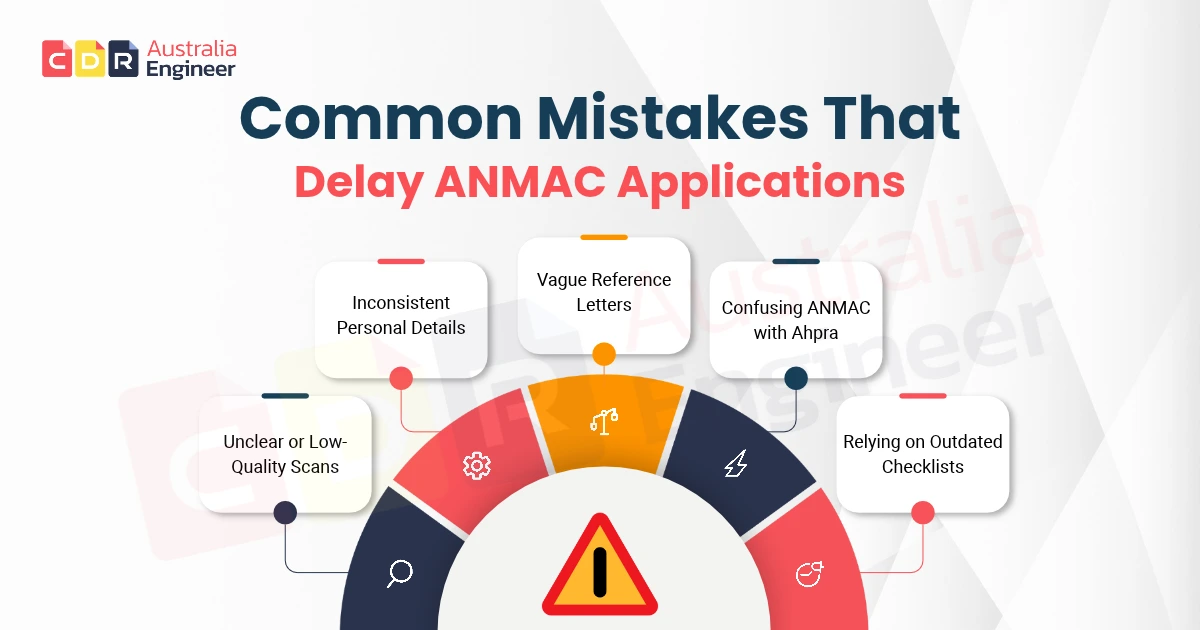
Every document you submit needs to show a consistent name, date of birth, and personal details; this single issue causes more delays than almost anything else on this list.
Non-English documents need the original plus a certified English translation, never a translation alone.
Some pathways require your registering body to send verification straight to ANMAC. Check your specific instructions before requesting anything so you don’t have to ask twice.
A weak reference letter is the single most common reason applicants get an additional document request. Every letter should include:
Generic letters (“worked as a nurse from 2019–2022”) get flagged. Specific ones don’t.
If any document isn’t in English:
Depending on your circumstances: extra qualification verification, third-party consent forms, or anything ANMAC specifically requests during assessment. Check your pathway’s official application page for anything not covered above.
Searching for the ANMAC skill assessment for the aged care worker pathway specifically? First confirm your occupation actually falls under an ANMAC-assessed category; not every aged care role does. If it does, your employment references need to go further than the standard checklist: they must clearly detail direct resident-care duties, supervision level, and the specific clinical or personal care tasks you performed day to day.
The Modified Skills Assessment is for candidates who have demonstrated recognized registration or qualifications via an accepted pathway. Examples of documents needed are proof of identity, a recent photo, qualification and registration, and critically clear color copies of originals, rather than a full document load as in the Full Skills Assessment.
A complete ANMAC assessment documents checklist should not be used for a modified application. Each one is unique in their own right, and while it is not a good practice to not submit any documents, it may also be a bad practice to submit irrelevant documents, as it can slow down your file as much as under-submitting.
The Direct Care Skills Assessment pathway is a separate pathway with eligibility requirements related to the occupation(s) you are nominated for and is designed for direct patient/resident service workers and is not the traditional nursing/midwifery pathway. The requirements in the document may be quite different from the Full Skills Assessment and may place a greater focus on the hands-on experience of caring for others rather than academic qualifications.
Before getting to putting together paperwork, make sure that your occupation really fits into this route. It is one of the most common and preventable methods of losing time applying to the wrong one or sending a complete assessment document set for a direct care application.
CDR australiaengineer specialises in high-quality CDR, RPL and VETASSESS reports for engineers. We offer low-cost, customized and reliable services in diverse engineering disciplines.
Our expert consultants will assess your profile and recommend the best pathway for your Australian migration goals.

The ANMAC assessment documents checklist isn’t complicated; it’s just unforgiving of small mistakes. Most applications aren’t delayed because of missing qualifications or ineligibility—they’re delayed because of a blurry scan, an inconsistent name, or a reference letter that doesn’t say enough. Get your documents specific, consistent, and certified, and you eliminate the two or three issues that cause the vast majority of delays for applicants at every experience level.
At CDR Australia Engineer, we help applicants navigate skills assessment documentation with exactly this level of precision—reviewing your paperwork against current requirements before it ever reaches ANMAC. A clean submission the first time is always faster, less stressful, and more cost-effective than a correction the second time.
It depends on your pathway, but generally: identity proof, qualification records, registration evidence, employment references, and English test results where applicable.
No, the ANMAC skills assessment can typically be completed before you apply for a visa, and a positive outcome is often used as supporting evidence in your visa application.
No, full skills assessments require it; modified and direct care assessments may not, though your visa or registration might separately.
ANMAC handles skills assessment for migration. Ahpra manages professional registration through the National Boards. Passing one doesn’t automatically complete the other.
Through their official contact page, phone and email details are listed there and are the most reliable source, since they can update over time.
Start with a free consultation. We assess your profile at no cost and guide you every step of the way.

Scan to Connect With Our Experts ⤴︎