
Online
Today
Skip to main content

CDR Australia Engineer

CDR Australia Engineer Header

Construction Engineering in Australia: Jobs, Skills & Visa Guide

Construction engineering in Australia offers steady demand, large infrastructure pipelines, and clear pathways for skilled overseas engineers. But getting there takes more than a strong CV. You need your qualification recognized, your experience matched to the right occupation, and a visa route that fits your situation. This article will explain the roles, requirements, and steps so you can plan before you spend money or resign from a job.

Picture three engineers with similar experience on road, bridge, and building projects overseas. The first assumes her degree will be accepted as it is. The second applies for a visa without checking which occupation his duties actually match. The third starts her Engineers Australia assessment early, confirms her occupation code, and speaks to regional employers while the paperwork is still in progress. The third engineer is usually the one who moves fastest, and the difference is planning, not talent.

Benefits of Understanding Construction Engineering in Australia for Engineers

  • Know which roles match your experience
  • Start your Engineers Australia assessment early
  • Understand the occupation and assessing authority rules
  • Compare visa routes that suit your situation
  • Avoid common mistakes that delay applications
  • Prepare your CDR and documents with confidence
construction engineering in australia

What Is Construction Engineering in Australia?

Construction engineering is the part of engineering that turns designs into finished structures. It covers planning, scheduling, site methods, safety, quality, cost control, and coordination between designers, contractors, and regulators.

In Australia, the work sits across several recognized occupations rather than one neat title. A person doing construction engineering may be classed as a civil engineer, a structural engineer, a construction project manager, or an engineering manager, depending on what the role actually involves. This matters, because migration and skills assessment both depend on the occupation you nominate, not on the job title printed on your contract.


Common Construction Engineering Roles

These are the occupations overseas engineers most often nominate. Codes are ANZSCO codes, so confirm each one on the current Home Affairs list before you rely on it.

Role

ANZSCO code

Typical focus

Civil Engineer

233211

Roads, bridges, drainage, infrastructure

Structural Engineer

233214

Structural design and assessment of buildings and structures

Construction Project Manager

133111

Delivering projects on time, on budget and safely

Engineering Manager

133211

Leading engineering teams and project delivery

Civil Engineering Technician

312212

Technical support, surveying data, testing and site work

The assessing authority is not always the same. Engineers Australia assesses most engineering occupations, but some management occupations, such as construction project manager, are assessed by other bodies. Check the correct authority for your code before you start.

Have Any Question?

CDR australiaengineer specialises in high-quality CDR, RPL and VETASSESS reports for engineers. We offer low-cost, customized and reliable services in diverse engineering disciplines.

Where the Demand Is

Demand for construction engineers follows the project pipeline. Employers regularly recruit in:

  • Transport and road infrastructure
  • Rail and metro projects
  • Water, wastewater, and utilities
  • Energy and renewables
  • Commercial and residential building
  • Mining services and industrial construction
  • Regional projects, where employers often struggle to fill roles

Regional demand deserves special attention. If you have a genuine job offer from a regional employer, the Skilled Employer Sponsored Regional visa may suit you better than a points-tested route. Our guide to the 494 visa requirements explains how it works.

Skills and Qualifications Employers Expect

Australian employers look for technical ability, but they also look for how you work. Typically that means

  • A recognized engineering degree in civil, structural, or a related field
  • Knowledge of Australian standards and codes, or the willingness to learn them quickly
  • A strong safety mindset, because work health and safety is taken seriously on Australian sites
  • Experience with design or project software, such as AutoCAD, Revit, Civil 3D, Primavera, or MS Project
  • Clear written and spoken English for reports, tenders, site meetings, and client communication
  • Project experience you can describe with specifics: your role, your decisions, and your results

If your experience is mostly overseas, plan how you will present it. Employers and assessors both respond better to concrete project detail than to general claims.

Engineers Australia Skills Assessment and the CDR

For most overseas engineers, the Engineers Australia skills assessment is the gateway. It confirms that your qualification and experience meet Australian standards for your occupational category: professional engineer, engineering technologist, or engineering associate.

There are two main ways to be assessed:

  1. Accredited qualification. If your degree is recognized under an international accord such as the Washington, Sydney, or Dublin Accord, you may be assessed on that basis.
  2. Competency Demonstration Report (CDR). If your qualification is not accredited, you prove your competence through a CDR.

A CDR is made up of three parts:

  • Career Episodes: three written accounts of engineering work you personally carried out
  • Summary Statement: a table linking your career episodes to the competency elements
  • CPD list: a record of your continuing professional development

The most common problem is not a lack of experience. It is writing that is generic, copied, or not clearly about your own contribution. Engineers Australia checks for plagiarism and expects original work, so every career episode should describe real projects in your own words, with your own responsibilities and outcomes.

Start early. The skills assessment must be in place before most skilled visa applications, and it is one of the steps most likely to cause delays.

Visa Options for Construction Engineers

The right visa depends on your points, your employer situation, your age, and where you want to live. This table gives a simple overview. Rules, lists, and fees change, so confirm everything on the Home Affairs website.

Visa

Points test

Who backs you?

Notes

189 Skilled Independent

Yes

No sponsor needed

Permanent visa, usually requires high points and an invitation

190 Skilled Nominated

Yes

State or territory

Permanent visa with a commitment to the nominating state

491 Skilled Work Regional

Yes

State or territory, or eligible family member

Provisional visa for regional areas, with a path to the 191

494 Skilled Employer Sponsored Regional

No

Regional employer

Provisional visa, up to five years, with a path to the 191

482 Skills in Demand

No

Approved employer

Temporary visa, not limited to regional areas

186 Employer Nomination Scheme

No

Employer

Permanent employer-sponsored visa

If you have a high points score, a points-tested visa may give you more freedom. If you have a job offer, an employer-sponsored visa can be more direct. Many construction engineers compare more than one route before deciding.

Two checks apply across almost every option. First, your occupation must appear on the list that applies to your chosen visa. Second, for employer-sponsored visas, your salary must meet the income threshold and the market salary rate for the role. The threshold alone is not enough.

Salary: What Affects What You Earn

Construction engineering pay in Australia varies widely, so a single figure can mislead. The main factors are

  • Your seniority and years of Australian experience
  • The state or territory and whether the role is regional
  • The sector, such as infrastructure, commercial building, or mining services
  • Whether the role carries registration, supervision, or project leadership duties
  • Employee size and project value

If you are sponsored, your salary also has to meet the minimum rules for the visa. Use official sources and recent job advertisements for comparable roles, rather than relying on averages from random websites.

Are you ready to begin your Australian Migration Journey?

Our expert consultants will assess your profile and recommend the best pathway for your Australian migration goals.

CDR Australia Engineers | Expert CDR Report Writing Services

Licensing and Registration

Having your skills assessed is not the same as being registered to practice. Some Australian states regulate who can carry out or supervise certain engineering work. Queensland, for example, has professional engineer registration, and Victoria and New South Wales also have registration requirements for certain types of engineering and design work.

Whether you need registration depends on the state and the work you will do. Check the rules for the state where you plan to work, and ask potential employers what they expect.

How to Find Construction Engineering Jobs

Overseas applicants often wait until their visa is approved before looking for work. A better approach is to build your network early.

  • Search major job sites and LinkedIn for roles that mention visa sponsorship
  • Contact engineering consultancies, contractors, and regional employers directly
  • Work with specialist engineering recruiters
  • Look at graduate and early-career programs if you are newly qualified
  • Tailor your CV to Australian style: results-focused, concise, and clear about your own role

When you contact employers, mention sponsorship early and be ready to explain how it works. Many regional businesses have never sponsored anyone, and a clear, calm explanation makes it easier for them to say yes.

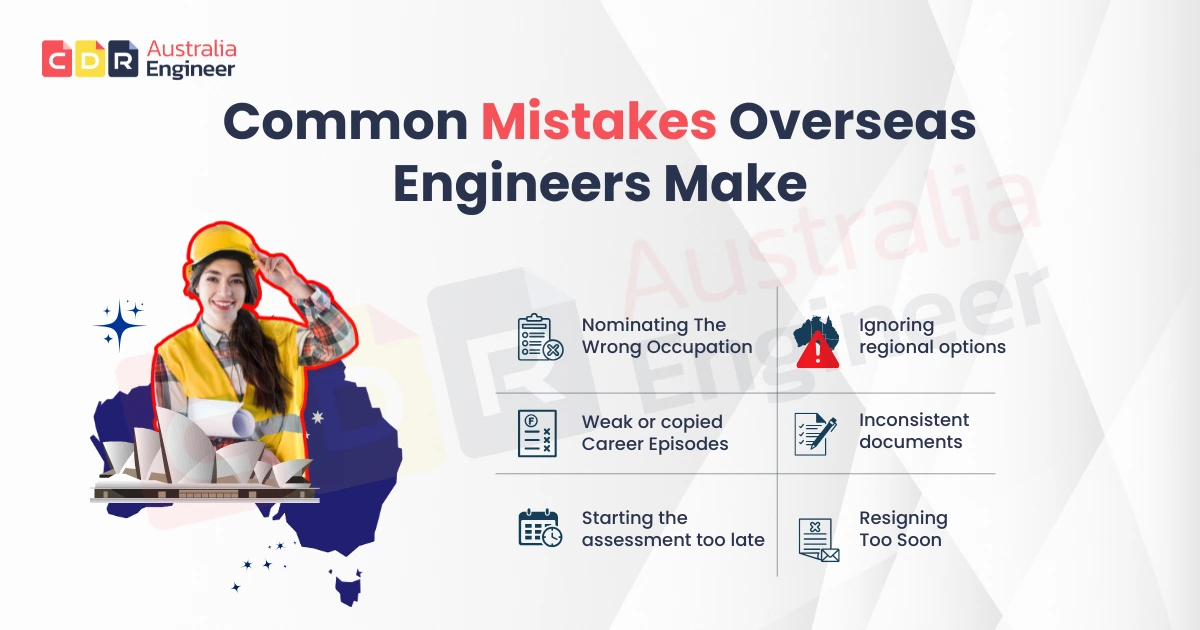
Common Mistakes Overseas Engineers Make

construction engineering in australia

Most problems are quiet ones. They do not look like mistakes until an assessment is negative or a visa is delayed.

  • Nominating the wrong occupation: Your duties must match the occupation, not just your job title.
  • Weak or copied Career Episodes: Generic text and reused content can lead to a negative outcome.
  • Starting the assessment too late: It can hold up the whole process.
  • Ignoring regional options: Regional employers and regional visas can be a real route in.
  • Inconsistent documents: Different dates, titles, or spellings across your CV, references, and forms invite questions.
  • Resigning too soon: Do not leave your current job until your visa is granted.

A Simple Roadmap for Construction Engineers

These are steps, not dates, because timing depends on your assessment, your employer, and Home Affairs.

  1. Match your duties to an occupation and check the code on the current list.
  2. Confirm the right assessing authority and what it requires.
  3. Prepare your assessment: accredited qualification or CDR.
  4. Book your English test and keep the result valid.
  5. Collect your evidence: references, payslips, tax records, and contracts.
  6. Compare visa options and check your points score or employer route.
  7. Look for employers who sponsor, especially in regional areas.
  8. Lodge your application and complete health and character checks.
  9. Keep your records organized, since they matter again if you later apply for permanent residence.

Take the First Step: Get Your CDR Right

Construction engineering in Australia can be a rewarding move, but it rewards preparation. Choose the right occupation, build a strong and original skills assessment, understand the salary and visa rules, and give employers a reason to take a chance on you.

If you are preparing a CDR or planning your Engineers Australia assessment, our team can help you present your experience clearly and authentically.

Demand is strong in many sectors, especially infrastructure, energy, housing, and regional projects. Demand varies by state and over time, so check current job listings and official occupation lists.

Yes, if they have the right visa and work rights. Many overseas engineers also need a skills assessment from Engineers Australia or another assessing authority for some occupations.

You generally need a CDR if your qualification is not accredited under an international accord. If your degree is accredited, you may be assessed without one.

It depends on your points, age, English, and whether you have an employer. Points-tested visas suit high scorers, while the 494 or 482 may suit someone with a job offer.

They overlap but are not identical. In migration terms, what matters is which occupation your actual duties match.

Ready to start your CDR?

Start with a free consultation. We assess your profile at no cost and guide you every step of the way.

Connect With Our Assessment Experts

Scan the QR code to connect with our expert CDR consultants and get professional guidance for your Engineers Australia assessment process. 
→ Fast response, trusted support, and complete assistance for successful approval.
Need Support? ↑

 Scan to Connect With Our Experts ⤴︎