
Online

Naval architecture is one of Australia’s most strategically important engineering disciplines in 2026, and it is not hard to see why. The AUKUS nuclear-powered submarine program, the Hunter-class frigate build under BAE Systems, and Austal’s aluminium vessel exports have created a sustained demand for qualified naval architects that Australia’s domestic graduate pipeline cannot fill alone.
Naval architects ANZSCO 233916 also appear on the Medium and Long-term Strategic Skills List (MLTSSL) of eligible ANZSCO skill levels to skilled migrate. This opens up opportunities to apply for a whole range of Australian visa programs such as the Subclass 189 visa. The assessing authority is Engineers Australia, which requires a Competency Demonstration Report (CDR) for applicants without an accredited Australian qualification.

Naval architecture is the engineering field concerned with the design, construction, modification, and repair of maritime and floating installations. As defined in ANZSCO 233916, in Australia a Naval architect will: 1. Design ships, submarines, offshore platforms, and leisure boats and to ensure their structural integrity and performance (such as stability, hydrodynamics and integration of systems).
This is a position sitting at the nexus of structural engineering, fluids, materials, and mechanical systems. By 2026 the scope will have grown substantially in green propulsion, given the IMO 2050 target that drives Australian ship yards towards electric, hydrogen and ammonia fuelled systems.
Core duties under ANZSCO 233916 include:
Before submitting a CDR or lodging an Expression of Interest, confirming you are under the correct ANZSCO code is essential. ANZSCO 233916 covers Naval Architect in Australia and Marine Designer in New Zealand.
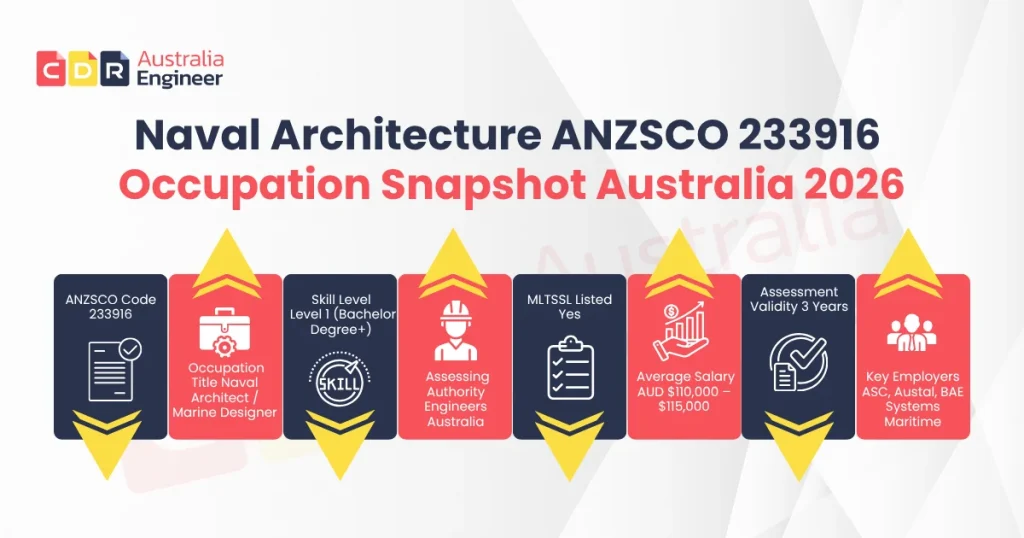
Detail | Information |
ANZSCO Code | 233916 |
Occupation Title | Naval Architect (Australia) / Marine Designer (New Zealand) |
Skill Level | Level 1 – Bachelor’s degree or higher qualification required |
Assessing Authority | Engineers Australia (EA) |
MLTSSL Listed | Yes – qualifies for Subclass 189, 190, 491, 482 and 186 |
Average Salary (2026) | AUD $110,000 – $115,000 per year (SEEK, June 2026) |
Assessment Validity | 3 years from the date of the outcome letter |
Key Employers | ASC, Austal, BAE Systems Maritime, Navantia Australia, Thales Australia |
Note: ANZSCO v2022 applies to Subclass 482 and 186 applications, while ANZSCO v1.2 applies to Subclasses 189, 190, 491, 485, and 494. Both versions list Naval Architect under code 233916.
Three major programmes are driving demand for naval architecture professionals in Australia in 2026, each running across decades and generating consistent workforce requirements that the domestic market alone cannot satisfy.
The AUKUS agreement between Australia, the United Kingdom, and the United States includes the construction of at least eight nuclear-powered submarines at the Osborne Naval Shipyard in South Australia. ASC’s SSN-AUKUS Build Program is actively advertising naval architecture and structural engineering roles in Adelaide as of mid-2026. This programme will sustain demand for qualified naval architects well into the 2040s.
BAE Systems Maritime Australia is building nine Hunter-class frigates under a AUD $45.6 billion contract. Ship design, systems engineering, and life-of-type management roles, all within the naval architecture scope, are being filled by a combination of Australian graduates and overseas-qualified engineers. Henderson in Western Australia and Osborne in South Australia are the primary locations.
Beyond defence, offshore wind farm infrastructure and green vessel design are expanding rapidly. The Federal Government’s Offshore Electricity Infrastructure framework has opened new marine structure design opportunities. 2026 the following naval architects with hybrid propulsion, structural analysis and offshore platform design expertise in commercial marine are most in demand.
CDR australiaengineer specialises in high-quality CDR, RPL and VETASSESS reports for engineers. We offer low-cost, customized and reliable services in diverse engineering disciplines.
Naval architect salaries in Australia vary by experience, employer, and location. Based on verified 2026 data from SEEK, Indeed, Glassdoor, and Jora, here is how naval architecture salaries break down:
Experience Level | Avg. Annual Salary (AUD) | Typical Employer |
Graduate (0–2 years) | $75,000 – $90,000 | Consulting firms, small shipyards |
Mid-Level (3–7 years) | $95,000 – $120,000 | ASC, Austal, BAE Systems Maritime |
Senior (8–15 years) | $120,000 – $150,000 | Defence programmes, Navantia Australia |
Principal / Lead | $150,000 – $180,000+ | AUKUS, Hunter-class programme leads |
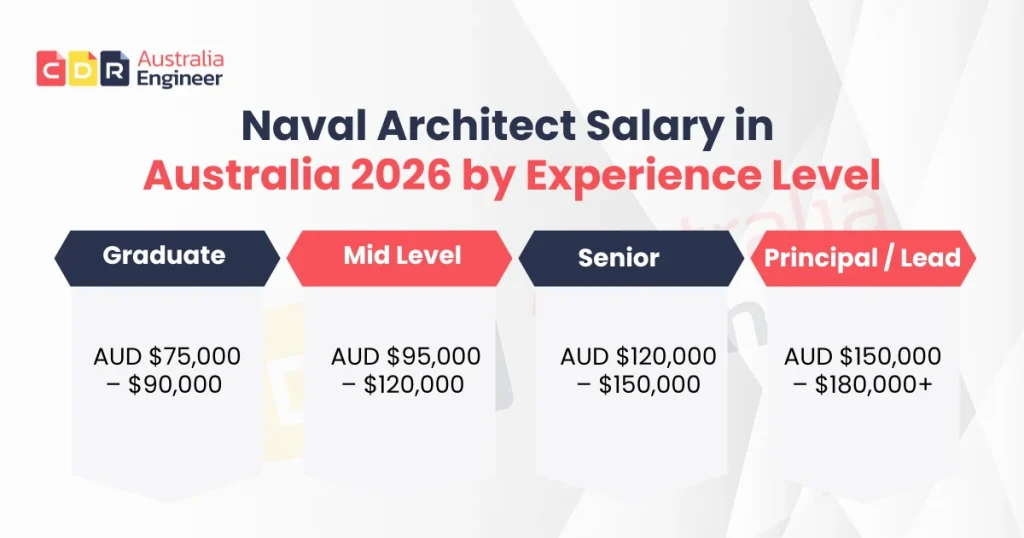
Source: SEEK (June 2026), Indeed (February 2026), Glassdoor (June 2026), Jora (2026). Average mid-career salary confirmed at AUD $110,000–$115,000 by SEEK. Defence sector and AUKUS-linked roles attract a 15–25% premium above commercial maritime rates.
For 2026 mid-year job opportunities for naval architects are concentrated in Australia’s two primary industrialised states, with sporadic opportunities throughout the country, derived from their present employment growth trends, job search results in seeking and state nominations.
State | Key Locations | Major Employers | Specialisation |
South Australia | Osborne, Adelaide CBD | ASC, BAE Systems Maritime, Navantia Australia | AUKUS submarines, Hunter-class frigates, naval defence |
Western Australia | Henderson, Fremantle, Perth | Austal, ASC, Department of Defence | Aluminium vessels, naval support, offshore structures |
New South Wales | Sydney CBD, Newcastle | Thales Australia, BMT, INTECSEA | Commercial marine, offshore oil and gas, consulting |
Victoria | Melbourne CBD | MMD, IMC, Lloyd’s Register | Marine consulting, classification, vessel surveying |
Tasmania | Hobart, Launceston | Incat, various marine contractors | High-speed aluminium ferries, regional maritime |
South Australia and Western Australia dominate active vacancies in 2026. ASC’s SSN-AUKUS Build Program is advertising structural and naval architecture roles across both Osborne in Adelaide and Henderson in Perth, with long-term workforce commitments running across the next two decades. For overseas engineers on a Subclass 491 regional visa, Tasmania is a particularly strong option, Naval Architect appears on the Tasmanian Onshore Skilled Occupation List (TOSOL), making professionals eligible for nomination after just three months of employment in the state.
Engineers Australia assesses all naval architecture migration applications under ANZSCO 233916. Applicants without an accredited Australian qualification must submit a Competency Demonstration Report (CDR), a document that demonstrates your engineering competencies through real project experience rather than just academic credentials.
A complete CDR for naval architecture consists of four components:
From 1 July 2026, Engineers Australia increased its migration skills assessment fees by 3–4% in line with CPI and the wage price index. Always verify the current fee on the Engineers Australia website before submitting, as fees update annually.
Engineers Australia offers six assessment pathways for ANZSCO 233916. The correct pathway depends on where and how you obtained your engineering qualification.
Pathway | Who It Applies To |
Pathway A | Accredited Australian qualification, or qualification from Washington, Sydney, or Dublin Accord signatory countries, fastest pathway, no CDR required |
Pathway B | Non-accredited overseas qualification, full CDR with three career episodes and summary statement required |
Pathway C | No formal qualification, extensive work experience evidence required in lieu of academic credentials |
Pathway D | IPENZ (New Zealand) members, assessed via mutual recognition arrangement |
Pathway E | Experienced engineers with significant post-graduate professional experience, abridged assessment process |
Pathway F | Former EA members applying for re-assessment, simplified evidence requirements |
Most overseas naval architects apply under Pathway B, the non-accredited overseas qualification route, which requires a full CDR. Applicants from Washington Accord countries (including the UK, USA, Canada, India, and South Korea) may qualify for Pathway A, which significantly reduces the documentation burden.
ANZSCO 233916 is listed on the MLTSSL, giving naval architecture professionals access to the full range of Australian skilled migration visas. The table below outlines the main pathways available in 2026.
Visa Subclass | Type | Key Requirement |
Subclass 189 | Permanent – Skilled Independent | Points-tested, no employer or nomination needed |
Subclass 190 | Permanent – Skilled Nominated | State nomination + 5 bonus points |
Subclass 491 | Provisional – Skilled Regional | Regional nomination + 15 bonus points → PR via 191 |
Subclass 482 | Temporary – Skills in Demand | Employer-sponsored, no points test |
Permanent – Employer Nomination | Direct entry or TRT after 2 years on 482 |
South Australia is particularly active in nominating naval architecture professionals under Subclass 190 and 491 due to the AUKUS and Hunter-class programmes based in Osborne. Western Australia nominates naval architects for Henderson-based shipbuilding roles. Tasmania also lists Naval Architect on its TOSOL, eligible for nomination after just 3 months of employment.
Our expert consultants will assess your profile and recommend the best pathway for your Australian migration goals.
The CDR is the most consequential document in your naval architecture migration application. A well-structured CDR that accurately maps your vessel design, structural analysis, or defence programme experience to Engineers Australia’s competency framework is what separates a positive outcome from a not-suitable result, regardless of how technically strong your actual experience is.
CDR Australia Engineer provides complete CDR documentation support for naval architects and marine designers, covering career episode writing, summary statement mapping, CPD compilation, and full application review. Our team works exclusively with engineering migration documents and understands exactly what Engineers Australia assessors look for under ANZSCO 233916.
The ANZSCO code for Naval Architect in Australia is 233916. Under ANZSCO v2022, this occupation is listed as Naval Architect. It sits on the MLTSSL and is assessed by Engineers Australia for skilled migration purposes.
Yes, unless you hold a qualification from a Washington, Sydney, or Dublin Accord signatory country. Most overseas naval architects apply under Pathway B, which requires a full CDR with three career episodes, a summary statement, and a CPD list submitted to Engineers Australia.
SEEK has revealed the average naval architect salary Australia currently is AUD$110,000- $115,000. Defence jobs associated with the AUKUS and Hunter class program in SA and WA get a 15-25 per cent loading to the base salary.
In 2026 South Australia (Osborne) and Western Australia (Henderson/Fremantle) lead employment in Naval Architecture employment, supported by the AUKUS submarine programme and Hunter Class Frigate build. Both states actively nominate naval architects under Subclass 190 and 491.
Engineers Australia processes complete CDR applications in 8–12 weeks from the date all documents are received. Incomplete applications, missing transcripts, employment references, or English test results are placed on hold until deficiencies are resolved.
Start with a free consultation. We assess your profile at no cost and guide you every step of the way.

Scan to Connect With Our Experts ⤴︎