
Online

How much do engineers earn in Australia is one of the most searched career questions from overseas engineers planning migration. The short answer in 2026: between AUD $100,000 and AUD $120,000 on average, according to SEEK salary data published in July 2026. But averages only tell part of the story. A graduate civil engineer in Canberra earns significantly less than a senior petroleum engineer on FIFO in the Pilbara. Discipline, experience, state, and industry all move the number, sometimes by AUD $50,000 to $100,000+.
For overseas engineers targeting Australian migration, understanding how much do engineers earn in Australia matters beyond salary planning. The Core Skills Income Threshold (CSIT) of AUD $79,499 from 1 July 2026 is the minimum salary for employer-sponsored visa nominations. Many engineers planning their migration strategy need to verify that roles in their discipline meet this threshold before pursuing a Subclass 482 employer sponsorship pathway. This guide covers verified salary data by discipline, experience level, and state, with migration context throughout.

The overall average engineer salary in Australia in 2026 sits between AUD $100,000 and AUD $120,000 per year according to SEEK. Mining, Resources and Energy is the highest-paying engineering industry at AUD $147,990 per year on average, followed by ICT at AUD $137,496. Construction and infrastructure engineering roles average AUD $110,000–$130,000 for experienced practitioners.
Experience Level | Avg. Annual Salary (AUD) | Typical Role |
Graduate (0–2 years) | $65,000 – $85,000 | Junior Engineer, Graduate Engineer |
Early Career (2–4 years) | $85,000 – $105,000 | Engineer, Project Engineer |
Mid-Level (4–8 years) | $105,000 – $135,000 | Senior Engineer, Principal Engineer |
Senior (8–15 years) | $135,000 – $170,000 | Lead Engineer, Engineering Manager |
Principal / Lead (15+ years) | $170,000 – $250,000+ | Director of Engineering, Chief Engineer |
Source: SEEK salary data July 2026, Hays Salary Guide FY25/26, SEEK GradConnection 2026. According to Engineers Australia, the engineering sector received a 3.9% increase in wages for 2024 which is significantly higher than the national average, and salary increases will only climb in 2026 thanks to infrastructure development projects and demand for engineers.
Not all engineering disciplines pay the same. Salary ranges vary significantly by field, largely driven by skills shortage intensity, industry demand, and project scale. Here is how the major engineering disciplines compare in 2026.
Engineering Discipline | ANZSCO | Avg. Salary Range (AUD) | Demand Level |
Petroleum Engineer | 233612 | $140,000 – $250,000+ | Very High |
Mining Engineer | 233611 | $150,000 – $223,000 | Very High |
Engineering Manager | 133211 | $165,000 – $190,000 | High |
Data Engineer | 263111 | $127,000 – $160,000 | Very High |
Software Engineer (Senior) | 261313 | $105,000 – $160,000 | Very High |
Electrical Engineer | 233311 | $90,000 – $152,000 | High |
Chemical Engineer | 233111 | $100,000 – $150,000 | Medium |
Civil Engineer | 233211 | $95,000 – $140,000 | High |
233512 | $90,000 – $130,000 | Medium-High | |
Structural Engineer | 233214 | $95,000 – $135,000 | High |
Naval Architect | 233916 | $110,000 – $180,000+ | High – AUKUS driven |

Source: SEEK salary data (Dec 2025–July 2026), Hays Salary Guide FY25/26, Jobs and Skills Australia 2026. Mining engineering graduate salaries average AUD $91,000–$109,000 – AUD $30,000+ above most other engineering disciplines at entry level.
Engineering salaries across Australia: Where engineers earn the most Location is a key factor, and in terms of engineering pay, FIFO (fly-in/fly-out), LNG opportunities, and heavy demand from WA’s mining sectors mean engineers here command the top rate in the country. Here’s the state-by-state breakdown for 2026:
State | Avg. Engineer Salary (AUD) | Key Driver |
Western Australia | $140,000 – $210,000+ | Mining, LNG, FIFO premium, 20–50% above national average |
$130,000 – $210,000 | Resources corridor, 2032 Olympics infrastructure pipeline | |
New South Wales | $99,947 – $150,000 | Infrastructure, tech sector, major urban construction |
Victoria | $96,318 – $145,000 | Metro Tunnel, North East Link, urban development |
South Australia | $90,000 – $130,000 | AUKUS submarine programme, OPV shipbuilding, defence |
Tasmania | $82,000 – $130,000 | Renewable energy, civil, regional infrastructure |
ACT | $95,000 – $135,000 | Federal government projects, defence engineering, ICT |
Northern Territory | $90,000 – $140,000 | Remote infrastructure, resources, government projects |
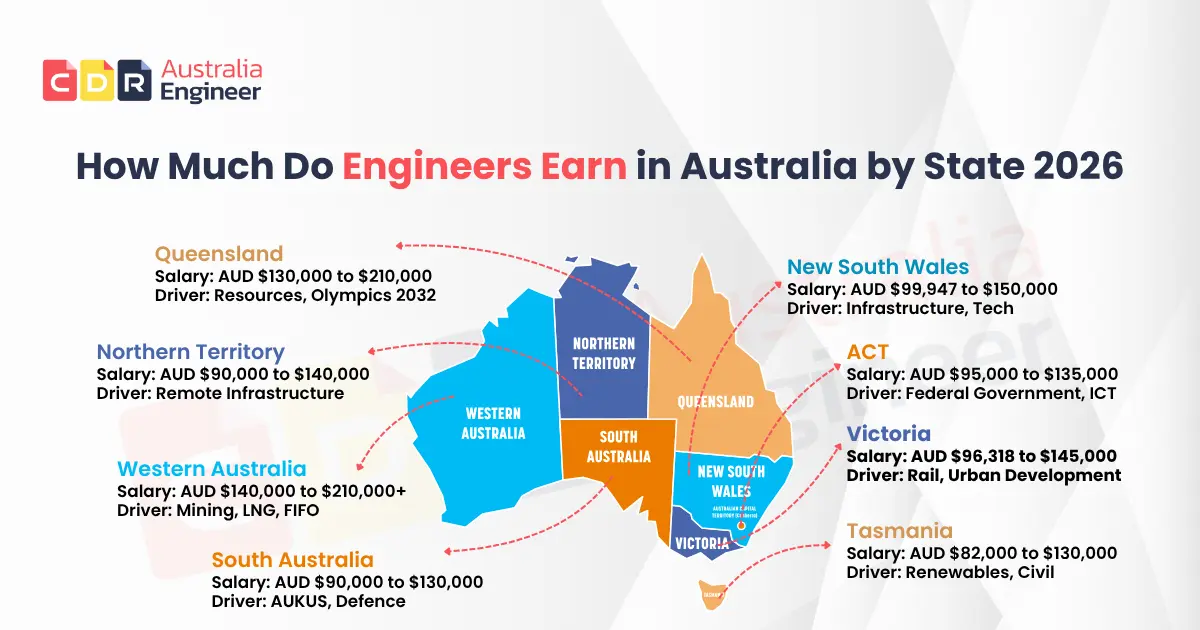
Western Australia mining engineers in Perth average AUD $180,000+, significantly above the national average. For overseas engineers on a Subclass 491 regional visa, Queensland, South Australia, and Tasmania actively nominate engineers with competitive salary packages attached to genuine vacancies.
Salary figures are only meaningful when you understand what drives them. Six factors consistently determine where an individual engineer sits within a pay range, and understanding them helps overseas engineers target the right roles.
Engineers Australia recorded a 3.9% wage increase across the engineering sector in 2024, well above the national average. Infrastructure investment, AUKUS defence commitments, and critical minerals demand are maintaining this growth trajectory into 2026.
CDR australiaengineer specialises in high-quality CDR, RPL and VETASSESS reports for engineers. We offer low-cost, customized and reliable services in diverse engineering disciplines.
Pay Graduate earnings are perhaps the first stop on the list in evaluating migration to Australia as a qualified engineer from an overseas country. In doing so, it allows for realistic expectation, to assess migration around theCSIT threshold of $AUD 79,499 for employer-sponsored visas from 01 July 2026.
Engineering Field | Graduate Starting Salary (AUD) | Note |
Mining Engineering | $91,000 – $109,000 | AUD $30,000+ above average grad salary nationally |
Petroleum Engineering | $80,000 – $100,000 | WA rates at upper end; FIFO roles add further |
Software Engineering | $90,000 – $120,000 | Strong in Sydney and Melbourne tech hubs |
Data Engineering | $85,000 – $110,000 | High demand across finance, tech, and government |
Civil Engineering | $70,000 – $90,000 | NSW and QLD infrastructure projects pay higher |
$70,000 – $88,000 | Energy sector and renewables drive demand | |
Mechanical Engineering | $70,000 – $85,000 | Mining sector roles push toward upper end |
Chemical Engineering | $68,000 – $85,000 | Process and pharmaceutical sectors pay more |
Source: SEEK GradConnection 2026, Hays Graduate Guide FY25/26, Prosple salary data 2026. Most graduate engineering roles sit above the CSIT of AUD $79,499, confirming that even entry-level engineers in most disciplines qualify for employer-sponsored visa pathways from day one of Australian employment.
As with most careers, engineering salaries tend to follow predictable paths, though engineer earnings growth are increasingly influenced by the engineer’s own drive for development, becoming Charterered and making effective career decisions.
For overseas engineers entering Australia mid-career with 5–10 years of experience, the expectation of stepping in at AUD $90,000–$120,000 is realistic in most disciplines, provided the skills assessment confirms qualification equivalency and the employment reference letters accurately reflect duties and seniority.
For overseas engineers, the answer to how much do engineers earn in Australia starts long before their first Australian payslip. It starts with the skills assessment outcome, because without a positive Engineers Australia or ACS result, the engineering qualifications and experience an overseas professional brings cannot be formally recognised by Australian employers in regulated engineering roles.
The skills assessment determines your ANZSCO code, which determines your visa pathway, which determines whether you can work in your field from day one. Engineers who arrive without a positive assessment often find themselves working below their skill level until their documentation is resolved, losing salary ground that can take years to recover.
From 1 July 2026, Engineers Australia assessment fees increased by 3–4%. A correct and well-prepared CDR is what separates a positive outcome, and access to AUD $100,000+ Australian engineering salaries, from months of delays and reapplication costs.
Our expert consultants will assess your profile and recommend the best pathway for your Australian migration goals.
Understanding how much engineers earn in Australia is the starting point, but accessing those salaries as an overseas engineer requires a positive skills assessment that accurately reflects your qualifications and experience. A well-prepared CDR or ACS RPL report is what unlocks the engineering salary ranges in this guide for international professionals.
CDR Australia Engineer provides complete documentation support for Engineers Australia CDR reports, ACS RPL assessments, and VETASSESS skills reports. Get your assessment right the first time and enter the Australian engineering job market at the salary level your experience deserves.
2026 engineer salary (Australia) average Engineer salary is predicted to be between AUD $100,000 and $120,000 in Australia annually. 2026 Salary guides indicate Mining, Resources and Energy are highest paying industries with an average of AUD $147,990 followed by the ICT sector at average $137,496.00.
Petroleum Engineering ($140,000 to $250,000 plus), mining engineering ($150,000 to $223,000) and engineering manager ($165,000 to $190,000). 2. Mining engineering graduates have the biggest initial paypackets at $91,000 to $109,000 – the average national starting graduate salary is about $30,000 less.
Western Australia pays the most, with mining engineers in Perth averaging AUD $180,000+, 20–50% above national averages. Queensland follows due to its resources corridor and 2032 Olympics infrastructure pipeline. FIFO arrangements in remote WA and QLD regions add AUD $20,000–$50,000 on top of base salary.
Yes, for most overseas engineers in regulated roles. Engineers Australia requires a CDR for applicants without a Washington Accord accredited qualification. Without a positive skills assessment, overseas engineers cannot be formally recognised in regulated engineering roles, limiting their access to competitive salary packages.
Effective 1 July 2026 CSIT is the minimum salary the employer will guaranteed pay the applicant. The vast majority of mid level and senior engineering roles easily meet this salary benchmark, while graduate roles the employer will need to agree to reach the CSIT in order to be eligible for the visa.
Start with a free consultation. We assess your profile at no cost and guide you every step of the way.

Scan to Connect With Our Experts ⤴︎