Online
Today
Skip to main content

CDR Australia Engineer

CDR Australia Engineer Header

Visa for Electrical Engineers 2026: Best Pathways to Australia

Finding the right visa for electrical engineers can feel complicated, because Australia offers several routes, and each one has different rules. Electrical Engineer (ANZSCO 233311) is on the skilled occupation lists, so employers can sponsor you, states can nominate you, and you can also apply for points. The best option depends on your age, English, experience, and whether you already have a job offer.

Whether you are an electrical engineer overseas, a recent graduate in Australia, or already working here, choosing the right visa for electrical engineers early saves time and money. The first step for almost every route is the same: a positive skills assessment from Engineers Australia. Visa rules and thresholds change, so confirm the details with the Department of Home Affairs or a registered migration agent before you apply.

Benefits of Understanding the Visa for Electrical Engineers

  • Know which visa routes suit your situation
  • Plan your Engineers Australia skills assessment early
  • Compare employer-sponsored and points-tested options
  • Understand how age, English, and experience affect your chances
  • Avoid common mistakes that delay applications
  • Prepare your documents without delays
  • Understand how the occupation list and thresholds affect you
visa for electrical engineers

Is Electrical Engineering on Australia’s Skilled Occupation Lists?

Yes. Electrical Engineer (ANZSCO 233311) appears on the Core Skills Occupation List used for the Skills in Demand visa. According to the Home Affairs occupation lists, it is also eligible for the 189, 190, and 491 points-tested visas, the 186 and 494 employer-sponsored visas, and the 485 graduate visa. Occupation lists change over time, so check the current list before you choose a pathway. Registration or licensing may also apply to some roles, depending on the state and the type of work.

Visa for Electrical Engineers at a Glance

Each visa for electrical engineers works differently, so start with this overview:

  • 482 Skills in Demand: a temporary employer-sponsored visa that needs an approved sponsor
  • 186 Employer Nomination Scheme: permanent residence through an employer
  • 494 Skilled Employer Sponsored Regional: a five-year provisional visa for regional employers, with a pathway to the 191
  • 189 Skilled Independent: permanent, points-tested, with no sponsor or nomination
  • 190 Skilled Nominated: permanent, points-tested, with state or territory nomination
  • 491 Skilled Work Regional: provisional, points-tested, with regional nomination or eligible family sponsorship
  • 485 Temporary Graduate: a temporary visa for eligible graduates of Australian courses

Have Any Question?

CDR australiaengineer specialises in high-quality CDR, RPL and VETASSESS reports for engineers. We offer low-cost, customized and reliable services in diverse engineering disciplines.

Your Engineers Australia Skills Assessment

Engineers Australia is the assessing authority for electrical engineers, and nearly every skilled route needs a positive assessment before the visa stage. If your degree is from an accredited program, your assessment may be simpler. If not, you will usually prove your skills with a Competency Demonstration Report (CDR), which includes a CPD record, three career episodes, and a summary statement. A strong CDR takes time to write, so start early and make sure each career episode shows your own engineering work.

Employer-Sponsored Visa for Electrical Engineers

If you have a job offer from an Australian employer, an employer-sponsored visa for electrical engineers is often the most direct route. Under the Skills in Demand (subclass 482) visa, an approved sponsor can nominate you in the Core Skills stream, provided your salary meets the Core Skills Income Threshold. For 2026–27, that threshold is AUD 79,423, and it is indexed each year. If your role pays AUD 146,576 or more, you may instead qualify for the Specialist Skills stream, which has no occupation list.

For permanent residence, your employer can nominate you through the 186 visa. If the role is in a designated regional area, the 494 visa offers a stay of up to five years and may lead to the 191 permanent visa after three years.

Each pathway has its own requirements for experience, English, and your skills assessment, so confirm them before your employer lodges the nomination.

Points-Tested Visa for Electrical Engineers: 189, 190, and 491

If you do not have an employer, the points-tested visa for electrical engineers lets you apply through SkillSelect. You submit an Expression of Interest, and the Department invites the highest-scoring applicants. The 189 visa gives permanent residence without sponsorship, and the minimum score is 65 points, although invited scores may be much higher. The 190 visa adds state or territory nomination, which gives 5 extra points. The 491 visa is a provisional regional visa, and state or family sponsorship adds 15 points. Each state sets its own criteria for electrical engineers, so check the nomination rules for your target state.

What Improves Your Chances of Getting a Visa for Electrical Engineers

Whichever route you choose, the same factors keep appearing. Younger applicants generally score higher on points tests, and stronger English adds more points and widens your options. Relevant skilled work experience, in Australia or overseas, also adds points, as do extras such as a professional year in engineering. For employer routes, your salary offer, experience, and a clean skills assessment matter most. A positive assessment from Engineers Australia, supported by a well-written CDR where needed, is the common thread. Improving even one of these areas before you apply can make your visa for electrical engineering applications stronger.

Are you ready to begin your Australian Migration Journey?

Our expert consultants will assess your profile and recommend the best pathway for your Australian migration goals.

CDR Australia Engineers | Expert CDR Report Writing Services

Visa for Electrical Engineers Who Studied in Australia

If you finished an eligible Australian degree, the 485 Temporary Graduate visa gives you time to work and gain local experience. A bachelor’s degree in electrical engineering usually falls under the post-higher education work stream, which does not normally require a skills assessment. Use that period to build Australian work experience, complete your Engineers Australia assessment, and plan your next visa. Age, the six-month application window, and study requirements apply, so read our guide to the 485 visa requirements before you lodge.

Which Visa for Electrical Engineers Is Best?

There is no single best visa for electrical engineers, because the right choice depends on your situation. If you have a job offer, an employer-sponsored route such as the 482, 186, or 494 is usually the starting point. If you have no sponsor and a strong points score, the 189 may suit you. If you need extra points or are open to living in a particular state or region, the 190 or 491 may be better. If you recently graduated in Australia, the 485 can bridge the gap while you gain experience. This is general information, so speak to a registered migration agent about your own case.

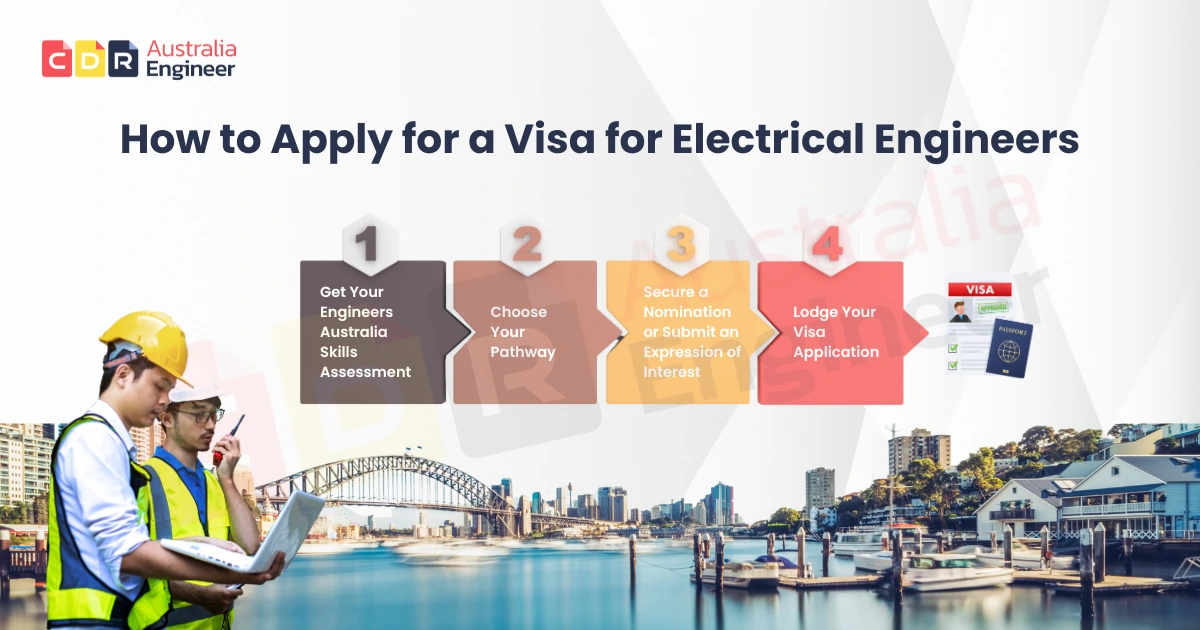
How to Apply for a Visa for Electrical Engineers:

Applying for a visa for electrical engineers follows the same four stages for most routes, though the order can differ slightly between employer-sponsored and points-tested visas.

visa for electrical engineers

Step 1: Get Your Engineers Australia Skills Assessment

Almost every skilled route needs a positive outcome from Engineers Australia first. If your degree is not from an accredited program, you will usually need a Competency Demonstration Report (CDR). Start here, because the assessment can take time, and later steps depend on it.

Step 2: Choose Your Pathway

Check the current occupation list, then compare your options. If you have a job offer, look at the 482, 186, or 494. If you do not, compare the 189, 190, and 491 against your points score. Confirm the thresholds and requirements on the Department of Home Affairs website.

Step 3: Secure a Nomination or Submit an Expression of Interest

For employer-sponsored visas, your employer lodges the nomination for your position. For points-tested visas, you submit an Expression of Interest in SkillSelect and wait for an invitation, with state nomination added for the 190 and 491 where applicable.

Step 4: Lodge Your Visa Application

Once your nomination is approved or you receive an invitation, lodge your application with your passport, assessment outcome, English test result, employment evidence, and character documents. Keep names, dates, and job titles consistent across every document, and respond promptly to any request from Home Affairs.

Common Mistakes That Delay

  • Skipping or delaying the Engineers Australia assessment
  • Writing career episodes that do not show your own engineering work
  • Choosing a pathway without checking the current occupation list
  • Overlooking the age limit and how it affects your points
  • Missing the English score needed for your pathway
  • Ignoring state nomination rules before applying

Key Takeaways

The right visa for electrical engineers depends on your job offer, points score, and location. Start with your Engineers Australia skills assessment, check the current occupation list, and compare employer-sponsored and points-tested routes. If you need help with your CDR or skills assessment, CDR Australia Engineer is ready to guide you.

It depends on your situation. Employer-sponsored visas suit people with a job offer, and points-tested visas suit those without one. Check your age, English, and experience first.

Yes, Electrical Engineer (ANZSCO 233311) is on the Core Skills Occupation List and is eligible for several visas, but lists change, so check the current version.

For almost every skilled visa route, yes. Engineers Australia assesses electrical engineers using an accredited qualification or a Competency Demonstration Report.

Yes, through routes such as the 189, 190, or 186, or through the 491 or 494 followed by the 191, if you meet each visa’s requirements.

Yes, through the points-tested 189, 190, and 491 visas, which do not need an employer. The 190 and 491 do need state nomination or, for the 491, eligible family sponsorship.

Ready to start your CDR?

Start with a free consultation. We assess your profile at no cost and guide you every step of the way.

Connect With Our Assessment Experts

Scan the QR code to connect with our expert CDR consultants and get professional guidance for your Engineers Australia assessment process. 
→ Fast response, trusted support, and complete assistance for successful approval.
Need Support? ↑

 Scan to Connect With Our Experts ⤴︎