
Online

RPEQ registration is not optional for engineers working in Queensland, it is a legal requirement. The Professional Engineers Act 2002 makes it clear: any engineer providing professional engineering services in or for Queensland must either hold RPEQ registration or work under the direct supervision of someone who does. There are no industry-specific carve-outs for most approved engineering areas, and the rule applies even if the services are being delivered from interstate or overseas.
More than 37,000 engineers have held the legally protected title of RPEQ since the registration system was established nearly a century ago. In 2026, BPEQ’s responsibility covers over 23,000 actively registered practitioners, a figure that continues to rise with Queensland’s evolving resources and infrastructure industry. For overseas engineers planning to work in Queensland, RPEQ registration is the professional endpoint that follows a positive Engineers Australia skills assessment.
RPEQ stands for Registered Professional Engineer of Queensland. It is a legally protected title administered by the Board of Professional Engineers of Queensland (BPEQ) under the Professional Engineers Act 2002. Unlike professional memberships in other states, which are largely voluntary, RPEQ registration is mandatory for engineers who provide professional engineering services in Queensland or for Queensland projects, regardless of where they are physically based.
The registration applies to approved areas of engineering, including civil, structural, electrical, mechanical, chemical, and other disciplines. The Act applies extraterritorially, meaning an engineer based in Sydney or overseas still requires RPEQ registration if their work is destined for a Queensland project.
You need RPEQ registration if:
You do not need RPEQ registration if you work under the direct supervision of a currently registered RPEQ who takes professional responsibility for the services provided. This exception covers many junior and mid-level engineering roles, but it does not apply to engineers working independently or signing off on engineering documents.
Engineers new to Australian professional registration often confuse three separate credentials: RPEQ, CPEng, and NER. They are related but serve different purposes, and understanding the difference saves significant time when planning your registration pathway.
Credential | Full Name | Administered By | Mandatory? | Scope |
RPEQ | Registered Professional Engineer of Queensland | BPEQ | Yes, legally required in QLD | Queensland only |
CPEng | Chartered Professional Engineer | Engineers Australia | No, voluntary | Australia-wide recognition |
NER | National Engineering Register | Engineers Australia | No, voluntary | Australia-wide recognition |
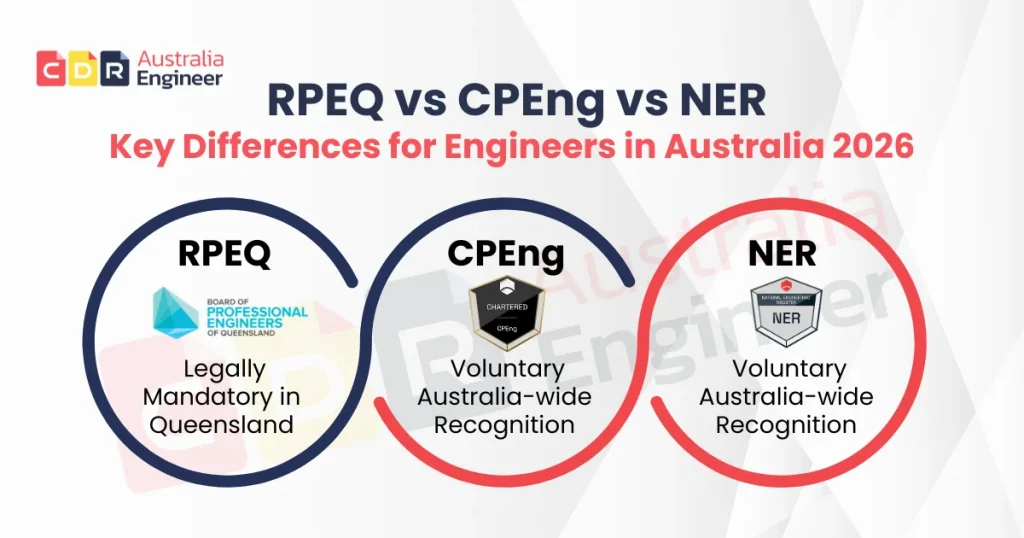
The fundamental difference is legal standing. RPEQ registration is legally compulsory by law, in that any engineer performing professional engineering work in, or for Queensland, must be registered with Queensland’s statutory board; CPEng and NER registration is a professional standard of assessment and career development.
For overseas engineers, the most practical sequence is CDR assessment first, then NER registration, then RPEQ application. CPEng can be pursued alongside or after NER, but it is not a prerequisite for RPEQ.
BPEQ sets clear eligibility requirements for RPEQ registration. Meeting all three criteria below is necessary before your application can progress to assessment.
Requirement | Detail |
Academic Qualification | A relevant Washington Accord recognised engineering degree (or equivalent). Engineers Australia is the accredited authority in Australia to assess equivalency for non-accredited overseas qualifications |
Work Experience | Minimum 5 years of relevant engineering experience in the past 10 years, with at least 4 years post-graduation. Experience must demonstrate gradual responsibility, independent professional judgment, and practical technical application |
Competency Assessment | Must be assessed by a BPEQ-approved assessment entity, Engineers Australia (NER or Chartered pathway), AusIMM, IChemE, CIBSE, or other BPEQ-approved body depending on engineering discipline |
Not all assessment entities assess all areas of engineering. When selecting your assessment entity, check that they cover your specific engineering discipline, BPEQ publishes a categorised list on its website. Engineers Australia is the most commonly used assessment entity and covers the broadest range of engineering disciplines.
CDR australiaengineer specialises in high-quality CDR, RPL and VETASSESS reports for engineers. We offer low-cost, customized and reliable services in diverse engineering disciplines.
RPEQ registration follows a structured four-step process from qualification to registration. Each step builds on the last, and skipping or rushing any step delays the overall timeline.
Check whether your engineering degree is accredited under the Washington Accord. If it is, you proceed directly to competency assessment. If not, you must first apply for an Entry to Practice (Stage 1) assessment through Engineers Australia to have your qualification assessed as equivalent.
Approach an engineering-focused BPEQ registered assessment body near you, submit you degree certificate/qualification, CV, work experience papers and your referee contacts, go to an interview, the assessors question your engineering work experience, judgment and education.
Once your application has been assessed, if successful you will be issued with a letter stating the engineering discipline/s you are eligible to register in as an RPEQ. For those who used the Engineers Australia NER or Chartered pathway, this letter is available directly via the Engineers Australia member portal on the Registration tab and is valid for 12 months.
Submit your application to BPEQ with your completed Form 2, assessment letter, certified qualification and identity documents, CPD evidence, and declaration of fitness to practice. BPEQ takes approximately 4 to 6 weeks to process complete applications. Successful applicants receive their RPEQ registration certificate.
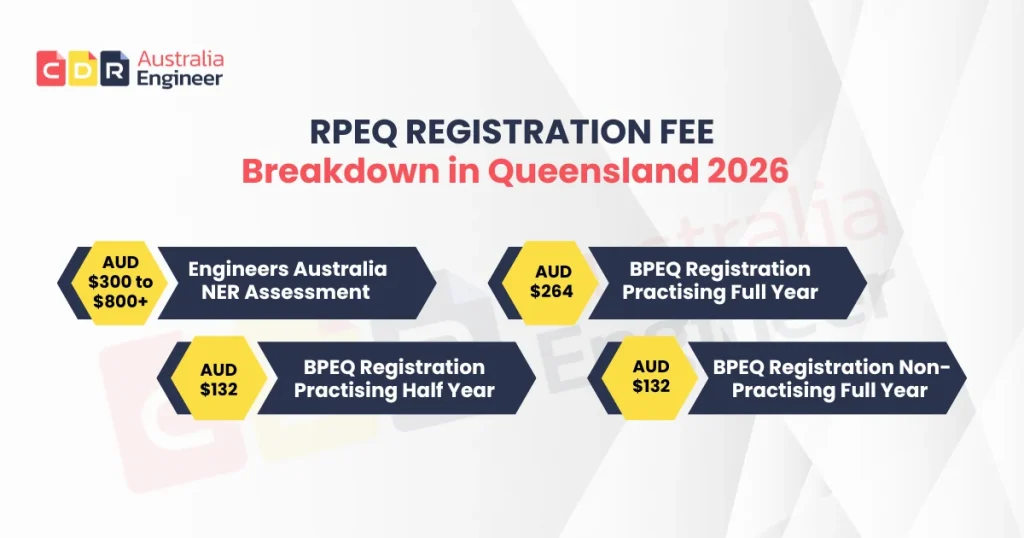
RPEQ registration involves costs at two stages, the competency assessment and the BPEQ registration itself. A full schedule of fees as of 1 July 2026 is published by BPEQ. Always verify current figures on the official BPEQ website before submitting, as fees are updated annually.
Fee Component | Approximate Cost (AUD) | Payable To |
Engineers Australia NER Assessment | AUD $300 – $800+ | Engineers Australia |
BPEQ Registration (Practising – Full Year) | AUD $264 | BPEQ |
BPEQ Registration (Practising – Half Year) | AUD $132 | BPEQ |
BPEQ Registration (Non-Practising – Full Year) | AUD $132 | BPEQ |
Annual Renewal (via BPEQ Portal) | Paid at renewal, verify on BPEQ website | BPEQ |
CPD Audit (Non-Members of APEA) | AUD $250 (voluntary, not mandatory) | APEA |
Registration is valid for 12 months expiring on 30 June each year. The annual renewal period runs from 1 April to 31 May – in 2026, this ran from 1 April to 31 May 2026. RPEQs who miss the renewal window risk lapsing, which affects their legal ability to provide professional engineering services. Renewal is completed online via the RPEQ portal and requires a declaration of fitness to practice and confirmation of CPD compliance.
For internationally qualified engineers, the path to RPEQ registration runs through Engineers Australia. Most overseas engineers do not hold a qualification that is directly Washington Accord accredited, which means they need an equivalency assessment before they can proceed to RPEQ competency assessment.
The typical pathway for an overseas engineer is:
This process is undertaken through Engineers Australia’s State Registration Eligibility (QLD) assessment and a formal guideline for this process is also available (v1.0, updated Jan 2026). Engineers on the NER or holding Chartered status who are not registered in another Australian state are considered to have already met the competency requirements and can access their RPEQ Assessment Letter directly without further assessment.
BPEQ approves registration across multiple engineering disciplines. Not every area of engineering requires RPEQ, but the list covers the most common professional engineering practice areas in Queensland.
Each area of engineering has specific qualification requirements set out in BPEQ’s Table 1. Not all approved assessment entities cover every discipline, check the BPEQ website’s categorised assessment entity list before selecting your pathway.
Our expert consultants will assess your profile and recommend the best pathway for your Australian migration goals.
For overseas engineers, the RPEQ registration journey begins well before the BPEQ application. A positive Engineers Australia skills assessment, delivered through a well-prepared CDR, is the foundation on which the entire registration pathway rests. Getting the CDR right the first time avoids delays at every subsequent stage, including NER registration and the BPEQ application itself.
CDR Australia Engineer provides complete documentation support for Engineers Australia CDR reports, NER applications, and skills assessment preparation, the essential first steps for any overseas engineer targeting RPEQ registration in Queensland.
Yes, for engineers providing professional engineering services independently. The Professional Engineers Act 2002 requires RPEQ registration unless you work under the direct supervision of a currently registered RPEQ who takes professional responsibility for the services. The rule applies even if you are based interstate or overseas but working on Queensland projects.
BPEQ takes approximately 4 to 6 weeks to process complete applications. However, the total timeline from starting your Engineers Australia competency assessment to receiving your RPEQ certificate is typically 4 to 6 months, depending on NER processing time and document completeness.
The BPEQ registration fee for a practising engineer is approximately AUD $264 for a full year or AUD $132 for a half year. The Engineers Australia competency assessment (NER or Chartered pathway) costs AUD $300 to $800+. Always verify current fees on the BPEQ website before applying as fees update from 1 July each year.
Yes. Overseas engineers must first obtain a positive Engineers Australia skills assessment through the CDR pathway, then apply for NER registration, then generate a RPEQ Assessment Letter through the Engineers Australia portal. The BPEQ application follows after the assessment letter is issued.
The 2026 renewal period ran from 1 April to 31 May 2026. Registration expires on 30 June each year. Engineers who miss the renewal window risk lapsing and losing their legal ability to provide professional engineering services in Queensland until re-registered.
Start with a free consultation. We assess your profile at no cost and guide you every step of the way.

Scan to Connect With Our Experts ⤴︎