
Online

If you’re looking at migrating to Australia as a social worker, there’s one gate in your way towards a visa application: the AASW Assessment Requirements. They are not optional; they are the only thing that can determine if Australia recognizes your qualification as being equivalent to a local social work degree. If you get it right, you open up a clear pathway to the subclass 189 visa, subclass 190 visa, or subclass 491 visa. You could face months and months of delays, a rejection, or a pricey re-evaluation later on if you get it wrong.
The Australian Association of Social Workers (AASW) is the government-designated assessing organization for the social worker occupation (ANZSCO 272511). Since it is common for students to train locally or abroad, knowing what it entails before applying can save you lots of time, money, and stress. This explains exactly what they’re looking for, how they do it, how much it costs in 2026, and where most applicants go wrong.
The AASW Assessment Requirements have been developed to affirm a single thing: that your social work qualification is in line with the professional requirements of Australia. This is known as the Migration & Eligibility Assessment (MEA), and it scores three areas: qualification, field education (placement) hours, and English language level. This is not a process like some others that assessing agencies for skilled migration use, one that assesses your work experience; it is a test that asks whether your degree itself is competitive with Australian benchmarks. That’s a surprise for many applicants, particularly those who think that years of service in the field will have their application covered. It won’t. While professional experience alone cannot remedy a shortcoming in one’s qualification, if there is one, it can still complement some optional additional assessments, which we will discuss below.
It is important to realize at the outset that this is an educational equivalency test, rather than a character or conduct test. AASW does not assess whether you have the characteristics of a good social worker; it assesses whether the training you received is equal to that of an Australian-trained graduate. This distinction matters because it shapes what evidence actually strengthens your application; references praising your work ethic or personal qualities carry little weight here, while transcripts, curriculum outlines, and placement records carry a great deal. Two applicants with equally strong professional reputations can receive very different outcomes if one completed a program that closely mirrors Australian training standards and the other didn’t. Understanding this early can save you from spending time and money gathering the wrong kind of supporting evidence.
You must have a qualification equivalent to an Australian Bachelor or Master of Social Work (Qualifying). Australian graduates with AASW accreditation usually move through this quickly. • Overseas qualifications will be more closely scrutinized for curriculum, transcripts, and institutional accreditation. If your degree is several years old, or if your institution’s accreditation status has changed since then, check its current status before you apply.
A minimum of 2 placements with a minimum of 1,000 supervised hours. No placement can be less than 250 hours, and at least 500 hours of direct, hands-on practice must be included. The hours matter, but so does documentation. Bad or incomplete placement records are often the root of negative outcomes. If your record is old or unclear, request an updated copy from your institution before you submit it.
Unless you are exempt, you must sit a recognized test (IELTS Academic, PTE, TOEFL iBT, or OET). IELTS One Skill Retake is valid for 60 days from your original test, and results must be under 3 years old. Book with a buffer; if your test expires midway through the AASW Assessment Requirements process, you may have to resubmit. Time your test carefully.
If one or more of the following is true, this process will have to be completed:
Also note that for certain positions you may wish to apply for, such as those related to welfare (ANZSCO 272613), assessments are conducted by a separate body, the Australian Community Workers Association (ACWA). It’s an easy mistake to confuse them, and one that can cost you dearly, potentially pushing your migration schedule back by months.
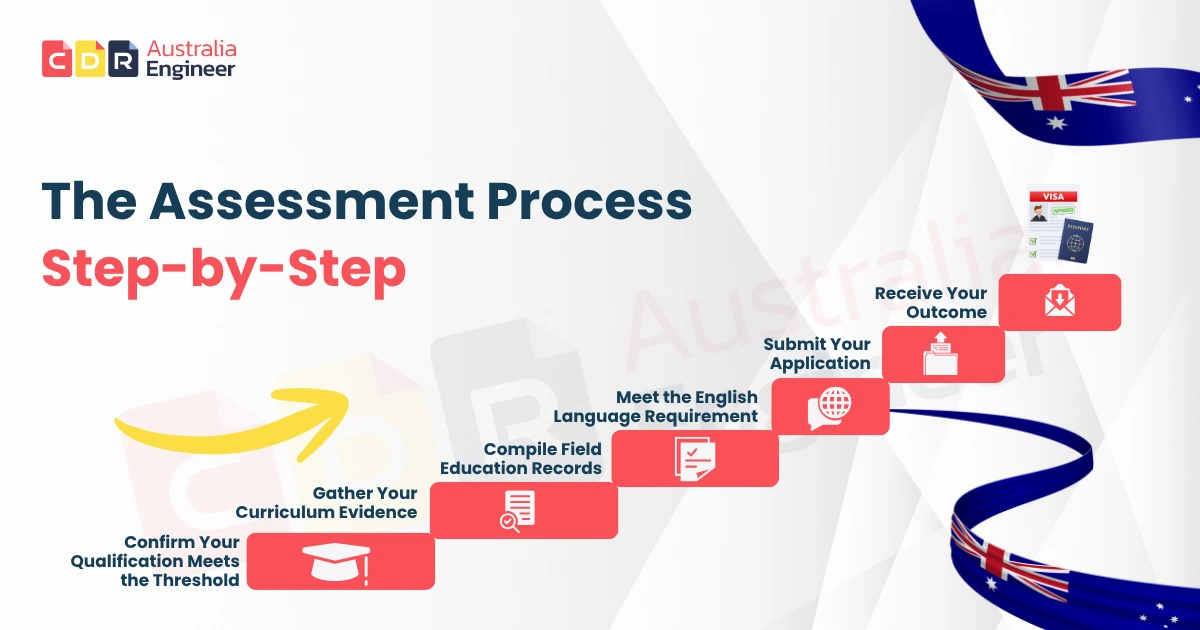
Check whether your degree is from a course AASW already recognizes as substantially equivalent or whether you’ll need to provide additional evidence to demonstrate equivalence.
This is the stage most applicants underestimate. You’ll need a detailed course syllabus that clearly maps your subjects to the required competency and curriculum areas—a vague or incomplete outline is one of the most common reasons applications stall.
Supervised placement hours need to be clearly documented, including where they took place, how many hours were completed, and under what supervision arrangements.
Submit results from an accepted English test, taken within the required validity period.
Once your qualification evidence, curriculum documentation, field education records, and English results are ready, submit your complete application along with certified identity documents.
Processing time varies based on application volume and how complete your documentation is. Applications with clear, well-mapped curriculum evidence tend to move through noticeably faster than those requiring follow-up requests for missing information.
Realistic expectations around processing time make a real difference to how you plan the rest of your migration journey.
Assessment Type | Typical Processing Time |
International qualifications | 14 to 20 weeks |
AASW-accredited Australian qualifications | 3 to 4 weeks |
Renewals of a previous positive outcome | Approximately 2 weeks |
Fees are reviewed annually and take effect from 1 July each year. They vary depending on your qualification type, your location, and any additional services or optional assessments you request, and GST applies for Australian-based applicants. Because these figures change yearly, always confirm current pricing directly through the official AASW portal before budgeting for your application, rather than relying on figures from an earlier year.
CDR australiaengineer specialises in high-quality CDR, RPL and VETASSESS reports for engineers. We offer low-cost, customized and reliable services in diverse engineering disciplines.
Most negative outcomes against the AASW Assessment Requirements aren’t actually caused by a genuine lack of qualification; they’re caused by mistakes in the documentation that could easily have been avoided. The most common problems are:
It’s far better to resolve these issues before submitting. Fixing them upfront costs you a little time now; leaving them unresolved can cost you months and a significant amount of money later.
A positive outcome here is not the same as a visa grant. This process confirms that your qualification meets Australian professional standards; it does not assess your visa eligibility, your points score, your health, or your character requirements. Those are entirely separate processes handled by the Department of Home Affairs. It’s best to treat a positive assessment as one critical, necessary component of a broader migration strategy, not as the finish line itself. Plenty of well-qualified applicants stall out later in their visa journey simply because they assumed a positive assessment meant the hard part was over.
Our expert consultants will assess your profile and recommend the best pathway for your Australian migration goals.

For anyone serious about a social work career in Australia, the answer is unambiguously yes. Social Worker (ANZSCO 272511) sits on the Medium and Long-term Strategic Skills List, which means a positive outcome against the AASW Assessment Requirements opens the door to the Subclass 189 independent visa without needing an employer or state sponsor at all. Demand across aged care, child protection, mental health services, and community welfare remains consistently strong across most Australian states and territories, and social workers also appear on the 482 employer-sponsored visa list, giving applicants more than one realistic pathway forward if the independent route isn’t the right fit.
Applicants who move through this process most smoothly tend to be the ones who prepare their documentation methodically from the very start, rather than scrambling to backfill placement records or squeezing in an English retest at the last possible moment. Treating this as a structured project with its own timeline, rather than a quick formality, tends to produce far better outcomes.
They’re based on three pillars: qualification equivalence to an Australian social work degree, a minimum of 1,000 hours of supervised field education, and English language proficiency.
International qualifications typically take 14–20 weeks to assess, while AASW-accredited Australian qualifications usually take 3–4 weeks.
No. The AASW Migration & Eligibility Assessment primarily evaluates your qualification and field education, not your professional work history.
You’ll receive a negative outcome, but review options are available. Many applicants can address gaps, such as missing field education documentation, and reapply.
No. A positive AASW assessment confirms your qualification meets Australian standards, but your visa outcome is assessed separately by the Department of Home Affairs.
Start with a free consultation. We assess your profile at no cost and guide you every step of the way.

Scan to Connect With Our Experts ⤴︎