
Online

The most important element in your application for qualified social worker entry to Australia is a successful AASW skills assessment. It is a mandatory requirement for all skilled visa subclasses (189, 190, and 491), and visa authorities won’t consider your visa application if it isn’t in their system. It is recognized by employers and state nominating bodies as proof that training and experience are in fact Australian standards and not just a stepping stone to visa grants.
But without knowing what to be evaluated on, it can be confusing. It involves demonstrating evidence for your degree program, placement hours, and practical training to show they are closely aligned to the Australian social work education and accreditation standards rather than just document verification. The great majority of candidates have excellent credentials, but they find it difficult to explain in their written applications how the courses satisfy the evaluators’ requirements. This is not because they are incapable of doing so, but rather because they are unsure of how to express it.
The process takes several steps: you need to prove eligibility, gather evidence of your qualifications and curriculum, meet the English language requirement, submit the application, and wait for a response (which may take anything from a few weeks to several months, depending on the extent to which you have met the requirements).
The AASW skills assessment is a formal assessment by the Australian Association of Social Workers to ensure that your qualification and training are the same as an accredited Australian qualification in social work. To apply for a skilled visa (subclass 190) under ANZSCO 272511—Social Worker, you must be able to achieve a positive outcome, and a positive outcome is what states will use to make a decision on whether to provide a nomination or not.
Obviously, the key in the assessment is the degree, but just as significant, it is what you earned. AASW validates your curriculum, supervised field education hours, and your training in the field against the expectations of an Australian-trained social worker because the qualification does not necessarily mean that all the training will be the same as is required in Australia. This is why sometimes you will find two candidates from two different universities with the same degree, and they will have different responses as per the requirements of the course.
This is also a first test for most applicants in terms of the organization of each supporting paper they provide. Some universities will not have a comprehensive syllabus document, and not all field education documents are created in a format that can easily be transcribed into college courses, so it’s somewhat more of an administrative process than academic. The minute you put details in front of your eyes, and they are ongoing, they can make all the difference from a smooth assessment to months of a drag.
Before you begin, you should generally meet the following:
You don’t need to already be practicing in Australia to apply—many applicants complete this assessment entirely from overseas before ever setting foot in the country.
Check whether your degree is from a course AASW already recognizes as substantially equivalent or whether you’ll need to provide additional evidence to demonstrate equivalence.
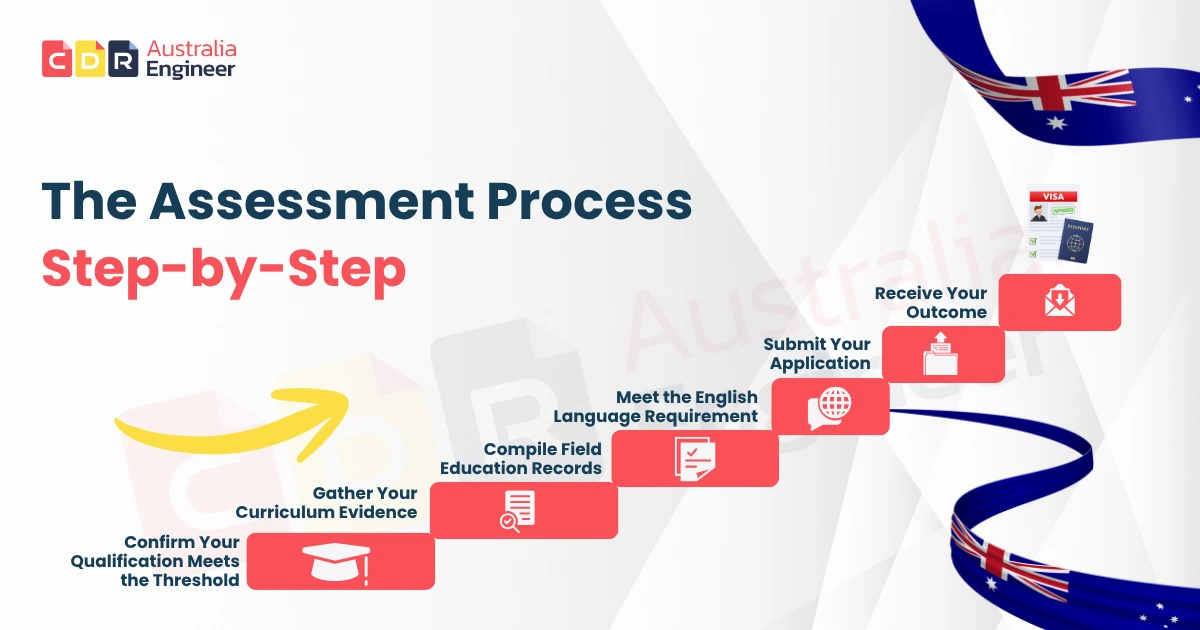
This is the stage most applicants underestimate. You’ll need a detailed course syllabus that clearly maps your subjects to the required competency and curriculum areas—a vague or incomplete outline is one of the most common reasons applicants stall.
Supervised placement hours need to be clearly documented, including where they took place, how many hours were completed, and under what supervision arrangements.
Submit results from an accepted English test, taken within the required validity period.
Once your qualification evidence, curriculum documentation, field education records, and English results are ready, submit your complete application along with certified identity documents.
Processing time varies based on application volume and how complete your documentation is. Applications with clear, well-mapped curriculum evidence tend to move through noticeably faster than those requiring follow-up requests for missing information.
Assessment fees are regularly reviewed and are always subject to change without much notice and should be checked directly on the AASW website prior to application. It is crucial to confirm the fee structure you will be dealing with before you commence your process and not take it for granted based on what you’ve heard elsewhere.
The cost of fees may also vary depending on the assessment type you’re pursuing; an assessment based on a standard qualification typically costs less than an assessment that will involve some extra evidence or an extra review. If you are applying from abroad, make sure you factor in any fees involved with your application, such as certified translations, courier fees for transcripts, or fees for English tests (if they are not already taken on a recognized test).
This is usually paid in advance, and you will not likely get your applications considered until you can verify payment. It is important to complete applications the first time because sometimes they need to be redone and may have to be paid for again.
Understanding where applicants typically go wrong can save weeks of back-and-forth:
Our expert consultants will assess your profile and recommend the best pathway for your Australian migration goals.
Navigating a documentation-heavy assessment like this alongside work or other commitments can be time-consuming. Our team has extensive experience helping applicants across multiple assessed occupations by:
If you’re preparing your application or you’re stuck after a negative outcome, our specialists can review your documents and guide you toward a stronger resubmission.
Processing time depends on application volume and documentation completeness; applications with clear, well-organized curriculum evidence generally move faster.
No. Most applicants complete this assessment from overseas before applying for their visa.
You may still receive a positive outcome by submitting additional evidence—further study, professional development, or documented practice—to demonstrate equivalence.
In many cases yes, either through a formal review process or by reapplying with additional evidence addressing the specific gap identified in your original assessment.
ANZSCO 272511 has remained on Australia’s skilled occupation lists—always confirm current nomination availability before applying.
Start with a free consultation. We assess your profile at no cost and guide you every step of the way.

Scan to Connect With Our Experts ⤴︎