
Online

Understanding subclass 407 visa eligibility is the first and most important step for anyone hoping to enter Australia for structured, workplace-based occupational training. Unlike standard work visas, the subclass 407 visa exists purely to support professional development, and getting the eligibility criteria wrong is one of the most common reasons applications stall or get refused outright. Home Affairs data shows 55% of Subclass 407 applications were refused or withdrawn in the 2025–26 financial year to 30 April 2026, according to the Australian Border Force. That number alone explains why reviewing your visa eligibility properly, before you apply, matters so much.
Below, we break down who qualifies, what your sponsor needs to provide, what recent 2026 rule changes mean for you, and the mistakes that consistently trip up otherwise-qualified applicants.
The 407 training visa allows people to take part in workplace-based occupational training activities to improve skills for their job, area of tertiary study, field of expertise, or a professional development program in Australia. It’s designed strictly for training purposes, not as a general work visa, which is exactly why the requirements are so specific about the nature and structure of the training itself. This distinction matters because applications that resemble general employment rather than genuine skills training are far more likely to be questioned or refused.
The visa covers three main streams: occupational training, workplace-based training, and overseas training, and is employer-sponsored, requiring a formal Deed of Agreement between the sponsor and the training provider. This agreement sets out exactly what training will be delivered and how it will be supervised, which is a key part of what the Department of Home Affairs reviews before approving an application. Choosing the right stream from the outset also determines which supporting evidence and documentation you’ll need to prepare.
Whichever stream applies to you, subclass 407 visa eligibility ultimately comes down to three things: your sponsor’s standing, your personal suitability, and the quality of your training plan. Getting any one of these wrong can weaken the entire application, regardless of how strong the other two are. That’s why it’s worth reviewing each of these three areas carefully before you begin gathering documents or approaching a sponsor.
Eligibility applies to two parties, not just the applicant. Both your sponsoring organization and you, as the individual applicant, need to satisfy separate but related conditions before a visa can be granted.
Your training visa sponsor is very much responsible for this process. To satisfy sponsor-side standards, a sponsoring organization must:
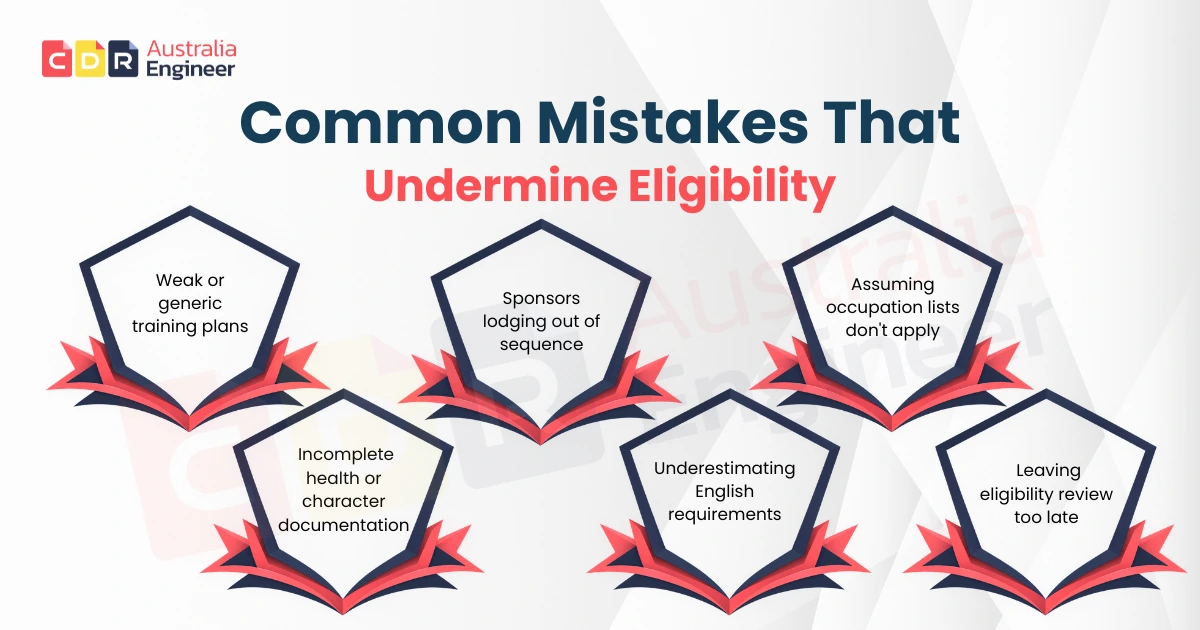
A Critical 2026 Update to Sponsor-Side Eligibility: A critical update affects sponsor-side subclass 407 visa eligibility. From 11 March 2026, the Australian Government implemented a new procedural change to the sponsorship, nomination, and visa process; applicants must now lodge their applications in a specific order.
This means your training visa sponsor needs to have an approved sponsorship and nomination in place before you can even apply for your visa. There’s no longer any flexibility on timing—it’s now a legal requirement.
Eligibility is on the part of the applicant and is determined by a range of personal, health, and skills criteria. The minimum age requirement to apply is 18 years, and applicants must have functional English, which is usually defined as an IELTS Overall score of 4.5 or equivalent as verified by PTE, TOEFL iBT, OET, and Cambridge English. Where a specific training program is identified, then the standard may be raised according to the need for the “skills gap” being filled.
Beyond English proficiency, meeting subclass 407 visa eligibility also requires:
Notably, if you are applying for the visa from within Australia, you must hold a valid temporary substantive visa at the time of application. This is a detail many applicants overlook when assessing their own eligibility, particularly those already living in Australia on another visa type.
English proficiency plays a meaningful role in the assessment, though the bar is set lower than for many other Australian visa categories. Applicants generally need an average IELTS score of at least 4.5 across all four bands, or the equivalent score through PTE, TOEFL iBT, OET, or Cambridge English—a lower threshold than the Competent English requirement used for skilled and employer-sponsored visas. Some applicants may be exempt from this requirement altogether depending on their nationality or if their training will be conducted entirely in English, so it’s worth checking your specific circumstances rather than assuming the standard rule applies.
One factor that catches many applicants off guard when assessing this visa eligibility is whether an occupation list applies to their nomination type. If you are nominated under Occupational Training to Enhance Skills, your occupation must appear on the official 407 visa occupation list of 509 occupations set out under the Migration (LIN 19/050) Instrument 2019. If you’re nominated instead under Registration or Capacity Building Overseas, no occupation list applies.
This distinction matters enormously for anyone trying to self-assess their own standing, since two applicants in very similar circumstances can face entirely different requirements depending purely on which nomination stream their training visa sponsor selects.
Your training plan itself is scrutinized closely as part of the overall occupational training visa assessment. The training must directly relate to your current occupation, field of study, or professional background, and it must follow a formal, structured plan that your sponsor submits as part of the nomination. A vague or generic training plan is one of the fastest ways to derail otherwise solid eligibility, regardless of how qualified you personally are.
The change in subclass 407 visa eligibility that most applicants need to know is about sequential lodgement. In the past, sponsors were able to combine their request for sponsorship approval with the nomination and the subclass 407 visa application. Now, they must do this in stages.
From the applicant’s perspective, this means that sponsorship approval and nomination approval must be granted prior to making the subclass 407 visa application. If a subclass 407 visa application is made prior to the grant of the nomination, the Department of Home Affairs will consider the application unlawful and will refund the application charge. No Bridging Visa will be issued.
Applicants affected by this change need to ensure that they allow adequate time for their training visa sponsor to obtain approvals for sponsorship and nomination prior to making the subclass 407 visa application. This is particularly relevant for applicants seeking to make a training visa application in 2026.
CDR australiaengineer specialises in high-quality CDR, RPL and VETASSESS reports for engineers. We offer low-cost, customized and reliable services in diverse engineering disciplines.
Our expert consultants will assess your profile and recommend the best pathway for your Australian migration goals.

Although obtaining an occupational training visa doesn’t lead to permanent residence, it can be very useful in other ways and at certain stages in a person’s migration plan. Many people use this visa to come to Australia to gain work experience and improve their opportunities to qualify for an employer-sponsored visa. Many people who use this visa as a stepping stone to other visas gain the experience necessary to gain sponsorship at a later stage. Given this, applicants should take the assessment of eligibility for an occupational training visa very seriously, as it may very well determine their prospects beyond the training.
Meeting subclass 407 visa eligibility isn’t inherently complicated, but it is unforgiving of shortcuts. Between the sponsor-side obligations, the applicant’s personal and health requirements, occupation list nuances, and the newly introduced sequential lodgement rule, there are multiple points where an otherwise strong application can fall short.
The safest approach is to treat eligibility as a two-sided assessment from day one: confirm your training visa sponsor is fully approved and prepared to lodge in the correct sequence, and make sure your own documentation training plans, English test results, health checks, and character clearances are complete and consistent. Get both sides right, and the occupational training visa can be a smooth, strategic step in your broader Australian migration goals.
Check both sides: your sponsor must be an approved Temporary Activities Sponsor with a genuine training plan, and you must meet age, English, health, and character requirements.
Yes. It’s a training visa, not an employment visa—you just need a sponsor willing to nominate you for a genuine training program.
Only under the Occupational Training to Enhance Skills stream, where your occupation must appear on the official 407 occupation list. Other streams don’t require this.
Since March 2026, sponsorship and nomination must be approved before the visa is lodged. Lodging too early gets the application deemed invalid, with no Bridging Visa issued.
Not directly, but it can support a transition to other migration pathways later on
Start with a free consultation. We assess your profile at no cost and guide you every step of the way.

Scan to Connect With Our Experts ⤴︎