
Online

Sorting out RPEQ vs NER is one adverse effect of the mobility of the modern engineer. They seem to have a similar function but, in actual fact, differentiate completely different areas. RPEQ is a government-issued license for engineering services in/for Queensland, regardless of where you’re based. NER is a voluntary national registration, administered by Engineers Australia, and neither is a migration skills assessment.
This distinction is important beyond admin. An engineer performing work in Queensland, whilst under NER only, is in breach of law, as is their employer, and it is likely that the work in question will not receive approval. The rule of thumb is that if the work is for Queensland, RPEQ is mandatory no matter where you are located; for all other work, NER is the better and the fastest option for other states as well. The location of the work determines the requirement, rather than the location of the engineer.
RPEQ is a Queensland engineering license administered by BPEQ and regulated under the Professional Engineers Act and was established in 1930. RPEQ is applied to all practitioners, including those based outside of Queensland. Therefore, a designer based in Melbourne who is doing a project in Brisbane needs an RPEQ or needs to be directly supervised by a person with an RPEQ.
Registration is achieved by possessing an accredited degree in engineering, consideration against relevant work experience, and assessment with a minimum of one of BPEQ’s 19 assessed areas. Contractors and clients check the public register, which exposes practitioners to a high degree of legal and contract irregularities. As such, engagement without registration is highly discouraged.
NER is the National Competency Register established in 2015 and managed by Engineers Australia and provides the public with a range of engineers that have been assessed. Currently, it is on a voluntary basis, but it is becoming one of the key pathways for mandatory state schemes, RPEV in Victoria, and the ACT’s mandatory engineering scheme, which will come into effect in March 2025.
Eligibility is achieved through a portfolio-based assessment that is not focused on the practice location, unlike most assessments, and a high degree of CPD. As such, it has become very popular with practitioners who practice in multiple states.
Feature | RPEQ | NER |
Legal status | Mandatory by legislation | Voluntary (increasingly a pathway into other states’ schemes) |
Scope | Queensland, including work done for Queensland from elsewhere | National |
Governing body | BPEQ (statutory regulator) | Engineers Australia (professional body) |
First-time cost | ~$700–$1,500 all-in | Assessment typically $300–$800+, plus membership |
Renewal | Annual, tied to CPD | Ongoing CPD to remain listed |
Costs don’t run on a shared schedule, which trips people up. RPEQ fees are set annually by BPEQ and vary by assessment route, except for a first-time application in the four-figure range once assessment and registration costs are combined, with a smaller annual renewal fee on top. Because BPEQ revises its fee schedule periodically, confirm current amounts on the BPEQ website before budgeting. NER runs through Engineers Australia’s own fee structure, with the assessment itself usually $300–$800 or more, on top of whatever your existing membership already costs. Neither figure includes certification or translation costs for overseas qualifications, which add up faster than most first-time applicants expect.
Renewal isn’t a standing formality either. BPEQ opens its RPEQ renewal window each year from 1 April to 31 May, and registration is contingent on holding 150 hours of CPD across a rolling three-year cycle.
Yes, partly. NER-registered engineers who are eligible will receive an RPEQ Assessment Letter from Engineers Australia that meets BPEQ’s competency assessment requirement in the matching area, and no second full assessment will be required. However, the letter has to be submitted as part of a formal BPEQ application, and registration cannot be processed until that application has been accepted by BPEQ. RPEQ registration is never achieved by NER.
One of the most misunderstood aspects of the RPEQ vs NER topic is that the assessment letter should be used to get around the paperwork but not the legal requirement. The BPEQ application must still be submitted and fees paid, and you await the Board’s decision before you can lawfully sign off the work in Queensland. It is in fact the engineers who take the letter for granted who are most likely to be practicing without registration by accident.
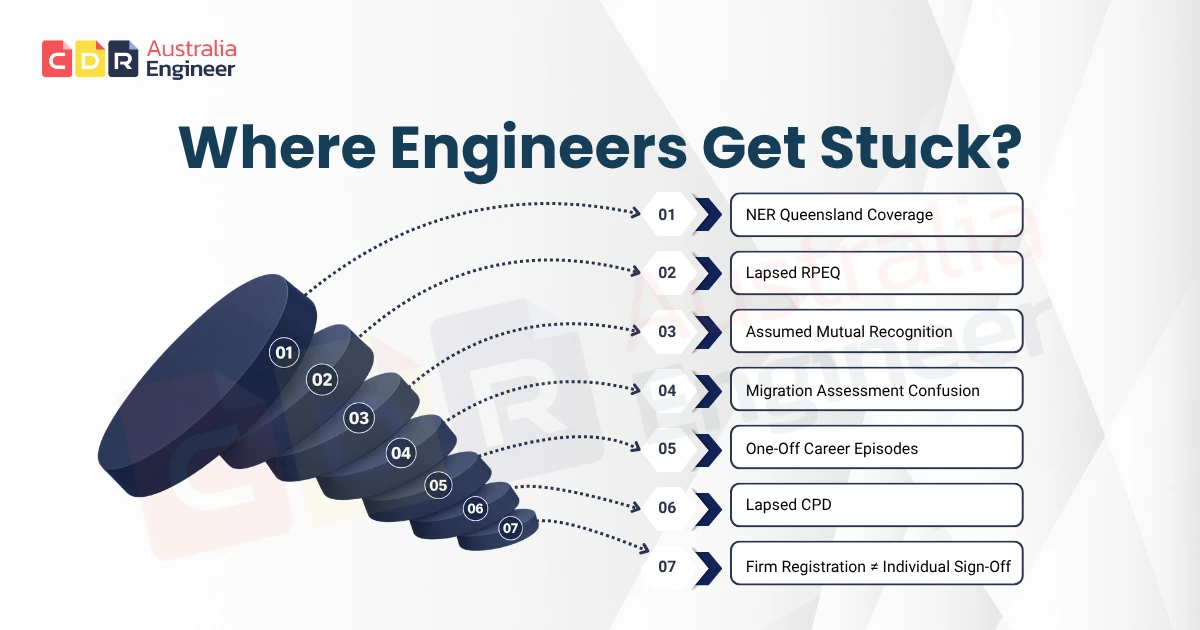
A handful of mistakes show up again and again in the RPEQ vs NER conversation. Most of them aren’t about a lack of competence; they’re about timing, assumptions, or simply not knowing which rule applies until it’s already too late to fix cleanly. A little forward planning avoids almost all of them:
Most of the mistakes above come down to one thing: documentation that isn’t built early enough or thoroughly enough to hold up under assessment. Career episodes, CPD records, and competency evidence are far easier to get right the first time than to reconstruct under deadline pressure.
This is where working with a specialist like CDR Australia Engineer makes a practical difference. Rather than treating your RPEQ or NER application as a one-off form to fill in, their team helps engineers build accurate, assessment-ready documentation—career episodes, CPD summaries, and competency statements aligned to what BPEQ and Engineers Australia actually look for. For engineers juggling active projects alongside a registration deadline, that guidance often means the difference between a smooth first-time approval and a drawn-out back-and-forth over evidence gaps.
Neither comes with a built-in pay rate. What actually drives salary is what the credential unlocks: RPEQ lets you legally sign off on Queensland work, and sign-off authority tends to sit with more senior, higher-billing roles. NER signals that same seniority nationally. The bump people notice is the responsibility, not the letters. It’s the same pattern you see with almost every professional credential in engineering: the qualification correlates with higher pay because it correlates with more independent, higher-liability work, not because an employer is paying extra for an acronym. Treat RPEQ and NER as prerequisites that open the door to better-paid, higher-responsibility roles, rather than as a lever you can pull for an immediate raise.
CDR australiaengineer specialises in high-quality CDR, RPL and VETASSESS reports for engineers. We offer low-cost, customized and reliable services in diverse engineering disciplines.
In the same discussion, two more acronyms surface. Unlike NER, CPEng is a professional credential, not a government license, and is also administered by Engineers Australia and is a credential for senior-level, independent professional judgement, not for granting legal authority anywhere. A CPEng assessment is not valid to replace RPEQ or NER by itself but may be incorporated to fulfill the latter two requirements.
Unfortunately, Victoria has no equivalent to its own RPEQ. RPEV is the closest term it has. Before applying for registration, engineers are required to be assessed by an approved entity, which in this instance is Engineers Australia, IPWEA Victoria, or APEA, in the five compulsory disciplines, as outlined above, in order to be eligible to be registered by the Business Licensing Authority. Although it is an active application, it can be used to cut the time required for engineers already registered in another jurisdiction.
Our expert consultants will assess your profile and recommend the best pathway for your Australian migration goals.

Choose RPEQ if any part of your work is destined for Queensland, even from interstate or overseas. There’s no substitute for it, and starting the application early avoids the scramble of an urgent deadline later.
Choose NER as your baseline if you work in NSW or another state without a general mandatory scheme or move between jurisdictions regularly. It’s the credential most employers and clients already recognize, and it doubles as a head start on future state schemes.
Add RPEV if your work touches Victoria across one of the five mandatory disciplines. Check your existing NER or RPEQ evidence first—it may cover most of what’s required.
Plan toward Chartered (CPEng) once you’ve got a few years of registered practice behind you, particularly if senior sign-off roles or international mobility are part of your longer-term career goals.
RPEQ is a mandatory state license to practice engineering in or for Queensland. NER is a voluntary national competency register, increasingly used as a pathway into other states’ mandatory schemes. The simplest way to remember it: RPEQ is about legal permission in one place, and NER is about a portable record of competence everywhere.
No. NER is a competency signal, not a legal registration. If your work is in or for Queensland, RPEQ is still required, though your NER evidence can genuinely speed up the RPEQ application via the Assessment Letter pathway described above.
Generally yes—BPEQ has confirmed the Act can apply to services provided for Queensland even when the engineer is elsewhere. Physical location is not the deciding factor; where the engineering service is delivered or used is.
No. CPEng is a separate Engineers Australia credential recognizing senior-level competency. It can support an RPEQ or NER application but doesn’t substitute for either, and it isn’t itself a legal right to practise anywhere in Australia.
Not yet, but the trend is toward it. Victoria (RPEV) and the ACT now have mandatory schemes; NSW has narrower, building-specific requirements rather than a general one, and other states have flagged similar reforms as under active consideration.
Start with a free consultation. We assess your profile at no cost and guide you every step of the way.

Scan to Connect With Our Experts ⤴︎