

Online
Today
Skip to main content

CDR Australia Engineer

CDR Australia Engineer Header

Onshore and Offshore Visa in Australia: How to Choose

The difference between an onshore and offshore visa in Australia is simple. It is where you are when you apply. You are physically in Australia when you lodge an onshore application. You lodge an offshore application while you are outside the country. It sounds easy, but the answer impacts your work rights, your bridging visa, your travel options, and in some cases, whether your application is even valid at all. A costly and avoidable mistake to make in the visa process is choosing the wrong side in an onshore and offshore visa.

The timing of the choice of the onshore and offshore visa in Australia is often awkward for overseas engineers—a graduate about to finish a degree, a 482 worker coming to the end of a job, or an engineer overseas contemplating whether to wait for an invitation at home or move first. This article covers the rules, shows which common visas fall on which side, covers the October 2026 student visa changes, and sets out the risks to check before you lodge.

Benefits of Understanding Onshore and Offshore Visa in Australia for Engineers

  • Know which lodgement side your visa allows
  • Avoid an invalid application and lost fees
  • Plan around your current visa conditions
  • Understand how bridging visas affect work and travel
  • Choose the route that suits your timing and risk
  • Prepare your skills assessment and CDR with confidence
  • Stay ahead of the 2026 student visa changes
onshore and offshore visa in australia

What Is an Offshore Visa Application?

An offshore visa application is one you lodge while you are outside Australia. Many first-time applicants use this route because they are still living in their home country. In the onshore and offshore visa in Australia comparison, this is the most common starting point for engineers who plan their move from overseas. You usually submit your documents online from your home country, then wait for a decision before you travel.

Common features of offshore applications:

  • You apply from overseas, and for some visas you must also be outside Australia when the visa is decided.
  • There is usually no bridging visa, because you are not in Australia while waiting.
    You cannot move to Australia and begin work or study until the visa is granted and you have entered on it.
  • Your plans for housing, work, and family travel usually wait until the decision, so timing needs careful thought.
  • Your documents need to be complete at lodgement, including your skills assessment, English test result, and identity and employment evidence.

The main advantage is certainty: you are not relying on a temporary visa that may be about to expire. You are not affected by the conditions of a current Australian visa, and you can plan your move calmly from home. Many skilled applicants also use this time to prepare their Engineers Australia assessment, improve their English score, and look for sponsoring employers before they travel.

Have Any Question?

CDR australiaengineer specializes in high-quality CDR, RPL and VETASSESS reports for engineers. We offer low-cost, customized and reliable services in diverse engineering disciplines.

Onshore vs Offshore Visa in Australia: Quick Comparison

Feature

Onshore

Offshore

Where you are when you apply

In Australia

Outside Australia

Typical starting point

You hold another visa.

You are overseas.

Staying in Australia while waiting

Usually yes, on your current visa or a bridging visa

Not applicable

Risk if your current visa is ending

Higher, because timing matters

Lower

Must you be offshore at the grant?

No, unless the rules say otherwise.

Sometimes yes

Best suited to

People already living, studying, or working in Australia

People applying from home

Which Visas Are Usually Onshore or Offshore?

This is where many people go wrong. Some visas must be lodged on one side, while others allow either. The table below is a general guide only. Rules differ by stream and by your circumstances, so check the Home Affairs page for your exact visa before you lodge.

Visa

Where you can usually apply

189 Skilled Independent

In or outside Australia, after you receive an invitation

190 Skilled Nominated

In or outside Australia, after state or territory nomination

491 Skilled Work Regional

In or outside Australia, after nomination or family sponsorship

494 Skilled Employer Sponsored Regional

Generally in or outside Australia, once the employer nomination is in place

482 Skills in Demand

Generally in or outside Australia, depending on your circumstances

186 Employer Nomination Scheme

Generally in or outside Australia, depending on the stream

485 Temporary Graduate

Commonly lodged in Australia after study, but check current rules

500 Students

Offshore for many applicants since 2 October 2026 (see below)

820/801 Partner

Onshore

309/100 Partner

Offshore

600 Visitors

Depends on the stream, and tourist stream applicants are generally offshore.

Notice that most skilled migration visas do not force you onshore or offshore. That means the real question is often not “which side is allowed” but “which side is smarter for my timing and risk.”

Big Change: Student Visa Rules From 2026

If you’re thinking about switching from a temporary visa to a student visa while you are in Australia, the rules were tightened in October 2026. This change will directly impact many temporary visa holders on onshore and offshore visa in Australia. Migration practices guidance published today states that holders of 17 listed temporary visas can no longer lodge an application for a student visa (subclass 500) or student guardian visa (subclass 590) whilst in Australia. The visas listed include the 482 Skills in Demand visa, the 485 Temporary Graduate visa, working holiday visas, and visitor visas.

For people who must now apply offshore, the rule also says you must be outside Australia when the visa is granted. Existing student visa holders can apply for another student visa onshore only if an exemption applies.

What this means in practice:

  • A 482 worker whose job ends can no longer assume they can switch to a student visa inside Australia.
  • A 485 holder planning more study may need to leave Australia, apply, and wait offshore.
  • Plan the sequence before you spend money on a course, because a valid application can depend on where you are.

These rules are detailed and have exemptions, so read the current Home Affairs guidance or speak to a registered migration agent before relying on this summary.

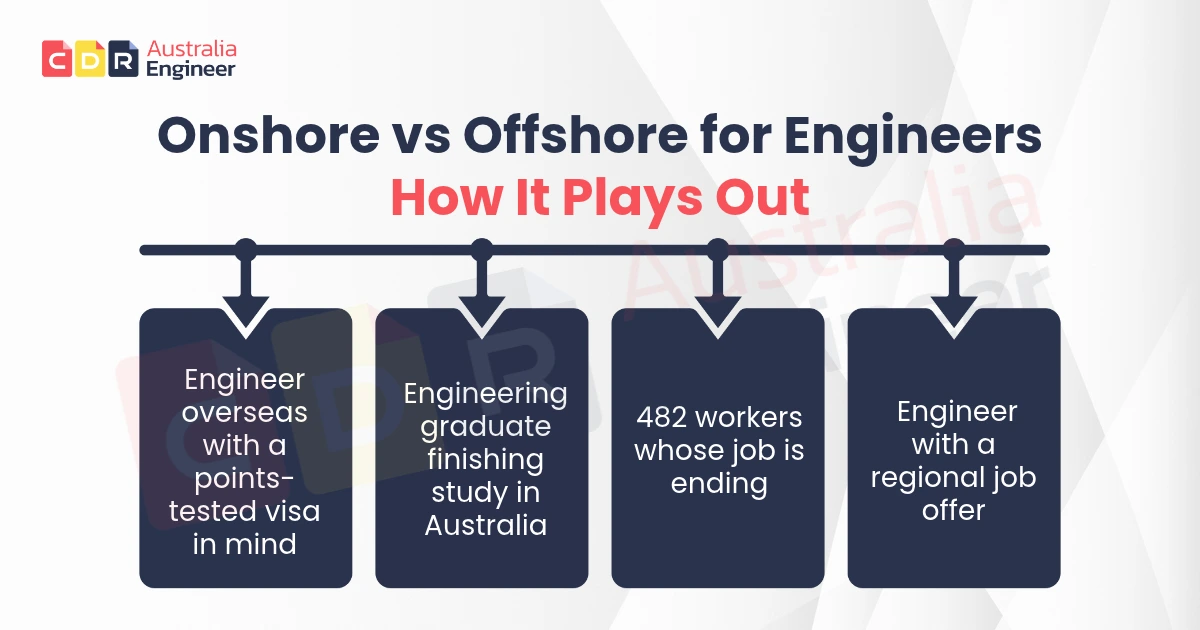
Onshore vs Offshore for Engineers: How It Plays Out

onshore and offshore visa in australia

These four examples show how the onshore and offshore visa in Australia work for different engineers.

1. Engineer overseas with a points-tested visa in mind

 If you are applying for a 189, 190, or 491, you can often lodge while still overseas. You do not have to move first.
Focus on your Engineers Australia skills assessment, English score, and points claim.

2. Engineering graduate finishing study in Australia

 You may be eligible for a temporary graduate visa onshore.
Use that time to gain Australian experience, build your Engineers Australia assessment evidence, and plan your next visa.

3. 482 workers whose job is ending

 time is critical. Do not assume a student visa is a backup, given the October 2026 rule change.
Check whether your employer can nominate you for another visa, whether you can lodge a new application before your current visa expires, and what bridging visa you might receive.

4. Engineer with a regional job offer

 The 494 route may allow you to apply from within or outside Australia.
494 visa requirements: this explains what you and your employer each need to prepare.

In all four cases the skills assessment is separate from the onshore or offshore decision. Whether you are in Australia or overseas, a skilled visa application usually depends on a valid assessment, and your Career Episodes and CDR need to be ready before you lodge.

Bridging Visas: The Safety Net of Onshore Applications

When you lodge an eligible onshore application while holding a substantive visa, you may receive a bridging visa. In an onshore and offshore visa in Australia, right decision-making is the main safety net of the onshore route. It keeps you lawful in Australia after your main visa ends until the application is decided.

Points to understand:

  • Bridging visas differ. Some allow work, some limit it, and some restrict travel.
  • If you leave Australia on a bridging visa that does not allow travel, you may not be able to return without a new visa.
  • A bridging visa is not a guarantee of the visa you applied for.

If you are planning to travel while an onshore application is pending, check your bridging visa conditions before you book flights.

Are you ready to begin your Australian Migration Journey?

Our expert consultants will assess your profile and recommend the best pathway for your Australian migration goals.

CDR Australia Engineers | Expert CDR Report Writing Services

Advantages and Drawbacks of Each Route

Onshore advantages

  • You can keep living and working in Australia.
  • You may keep earning Australian experience while waiting.
  • You avoid a long separation from family, work, or study.

Onshore drawbacks

  • You must hold a visa that allows you to apply.
  • Your current visa conditions may limit your options.
  • If you have no valid visa, you may be unlawful, and your options narrow quickly.
  • Past refusals or cancellations can restrict onshore applications.

Offshore advantages

  • You can plan from home without the pressure of an expiring visa.
  • You avoid problems caused by current visa conditions.
  • It may be safer if your status in Australia is uncertain.

Offshore drawbacks

  • You cannot work or study in Australia while waiting.
  • You may be separated from family or a job.
  • Some visas require you to stay offshore until granted.

Common Mistakes to Avoid

  • Lodging on the wrong side, which can make your application invalid.
  • Ignoring visa conditions such as “No Further Stay.”
  • Applying after your current visa has expired.
  • Assuming a bridging visa allows travel.
  • Leaving the skills assessment and CDR until the last minute.
  • Relying on old rules, fees, or lodgement lists.

It depends on where you are when you lodge the application. Onshore means you are in Australia. Offshore means you are outside Australia.

Generally, you must choose the correct visa and lodgement location before you apply. Check the rules for your visa before you submit.

Yes, many skilled visas, such as the 189, 190, and 491, can be lodged from outside Australia once you meet the requirements and receive an invitation or nomination.

There is no single answer. Processing times depend on the visa, the stream, how complete your application is, and Home Affairs priorities. Check the Home Affairs processing time tool for your visa.

It depends on the bridging visa you receive. Some allow full work rights, some limit work, and some do not allow work at all. Check the conditions on your bridging visa grant notice.

Ready to start your CDR?

Start with a free consultation. We assess your profile at no cost and guide you every step of the way.

Connect With Our Assessment Experts

Scan the QR code to connect with our expert CDR consultants and get professional guidance for your Engineers Australia assessment process. 
→ Fast response, trusted support, and complete assistance for successful approval.
Need Support? ↑

 Scan to Connect With Our Experts ⤴︎