
Online

The Subclass 491 visa is Australia’s points-tested provisional visa for skilled workers willing to live and work in designated regional areas. It adds 15 bonus points to your SkillSelect score, the highest nomination bonus of any skilled migration pathway, and leads directly to permanent residency through the Subclass 191 visa after three years of regional living and work. For engineers and ICT professionals who cannot reach the 85 to 95 points required for a Subclass 189 invitation, the 491 is the most accessible and often the fastest route to Australian PR in 2026.
From 1 July 2026, the Subclass 491 visa fee increased to AUD $6,140 for the primary applicant under the revised Department of Home Affairs fee schedule. Processing times as of April 2026 run from 3 to 7 months for 25% of applications and up to 28 months for 90% of cases, wide ranges that reflect how significantly state nomination timing and application completeness affect outcomes. This guide covers every aspect of the 491 pathway: eligibility, the 15-point bonus, state nomination, the PR pathway via Subclass 191, fees, and what skills assessment you need before lodging.

The Subclass 491 visa, formally known as the Skilled Work Regional (Provisional) visa, replaced the Subclass 489 visa in November 2019. It is a five-year provisional visa for skilled workers nominated by a state, territory, or eligible family member to live and work in designated regional Australia. Unlike the Subclass 189 (permanent, anywhere in Australia) and Subclass 190 (permanent, state commitment), the 491 is provisional, but its 15-point nomination bonus makes it accessible to a significantly wider pool of applicants.
Detail | Information |
Visa Name | Skilled Work Regional (Provisional) Visa, Subclass 491 |
Visa Type | Provisional – 5 years from date of grant |
Minimum Points | 65 points (invitation threshold typically 65–80+ with 15 bonus points) |
Age Requirement | Under 45 at time of invitation |
Nomination Bonus | Plus 15 points – highest of any skilled migration pathway |
Visa Application Fee (from 1 July 2026) | AUD $6,140 (primary applicant) |
Processing Time (25% of cases) | 3 to 7 months from lodgement (April 2026 data) |
Processing Time (50% of cases) | 6 to 20 months from lodgement |
PR Pathway | Subclass 191 after 3 years regional living and minimum taxable income |
Regional Income Requirement for 191 | Approximately AUD $53,900 taxable income per year |
Source: Department of Home Affairs April 2026 processing data and revised July 2026 fee schedule. The Subclass 491 visa is one of the most popular skilled migration pathways in Australia, and in 2026, it is the primary route for engineers and ICT professionals with 65 to 80 points who cannot compete in the Subclass 189 independent stream.
To be eligible for the Subclass 491 visa, you must satisfy all of the following requirements at the time you receive your invitation. Requirements are assessed at invitation date. not at EOI submission date.
Not all of Australia qualifies as regional under the 491 visa. Major CBDs of Sydney and Melbourne do not qualify, however most other areas of NSW and Victoria are designated as regional. Check the Department of Home Affairs regional areas map before committing to a specific location.
CDR australiaengineer specialises in high-quality CDR, RPL and VETASSESS reports for engineers. We offer low-cost, customized and reliable services in diverse engineering disciplines.
The 491 visa uses the same SkillSelect points test as the Subclass 189 and 190, with one critical difference: state or territory nomination adds 15 points to your score, compared to 5 points for Subclass 190 nomination. This 10-point difference makes the 491 accessible to applicants who would wait years for a Subclass 189 invitation.
Category | Detail | Max Points |
Age | 25–32 years receives maximum points | 30 |
English Language | Superior English (IELTS 8.0+ each band) | 20 |
Skilled Employment – Overseas | 3–8+ years of skilled employment overseas | 15 |
Skilled Employment – Australian | 1–8+ years of skilled employment in Australia | 20 |
Educational Qualifications | Doctorate, Masters or Bachelor degree | 20 |
Australian Study Requirement | 2+ years full-time study in Australia | 5 |
Specialist Education Qualification | Masters by Research or Doctorate from Australian institution | 10 |
Partner Skills | Partner holds skills assessment and Competent English | 10 |
State or Territory Nomination | Subclass 491 nomination | 15 |
Professional Year / NAATI | Completed Professional Year or community language accreditation | 5 each |
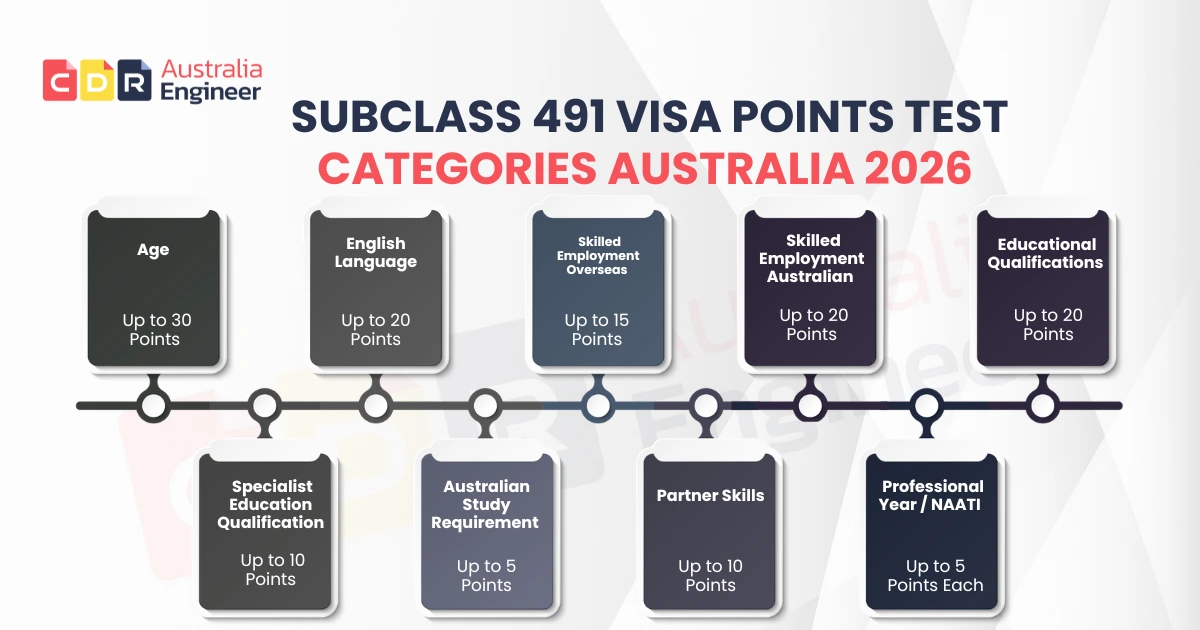
A typical mid-career engineer with 70 base points receives 85 points after a state nomination, placing them firmly within invitation range for most states. Submit your EOI the moment you become eligible, your EOI submission date is the tiebreaker when two candidates share the same points score.
State and territory nomination is the gateway to the Subclass 491 pathway. Each state and territory runs its own nomination program independently, with different occupation lists, eligibility criteria, and invitation schedules. Getting state nomination right, choosing the right state for your occupation and background, is the most consequential decision in the entire 491 application process.
State/Territory | Key Engineering and ICT Focus | Nomination Activity 2026 |
South Australia | Engineering, construction, healthcare, ICT | Consistent monthly rounds – actively targeting skilled engineers |
Victoria | Civil, structural, ICT, education | Victorian Skilled Migration portal – occupation and state ties assessed |
Mining, civil, electrical, petroleum | Resources sector demand – regional QLD actively nominating | |
Western Australia | Mining, petroleum, mechanical, ICT | Sustained LNG and AUKUS-driven demand – strong engineering focus |
New South Wales | Civil, structural, ICT, nursing | Infrastructure pipeline – ongoing rounds with priority occupations |
Tasmania | Civil, environmental, renewable energy | TOSOL – eligible after 3 months employment, very low competition |
Northern Territory | Civil, mechanical, healthcare | Reopened rounds July 2026 – strong demand across key disciplines |
ACT | Civil, ICT, defence engineering | Federal government projects – AUKUS and infrastructure driving demand |
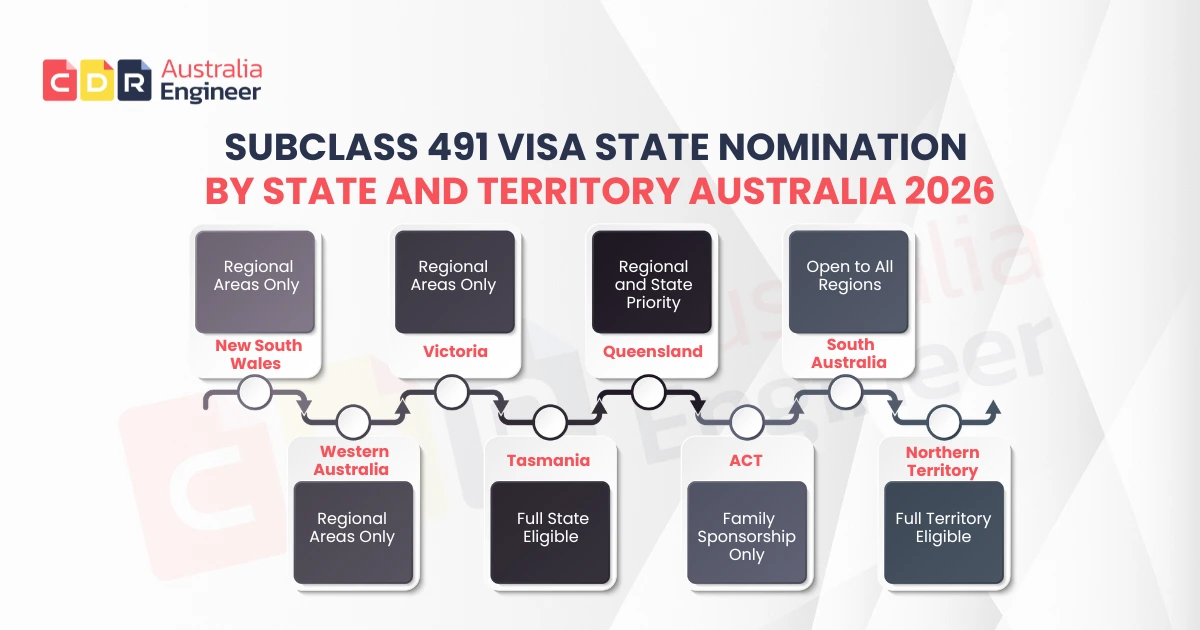
Tasmania offers the lowest competition for nomination of any state in 2026 and is particularly attractive for engineers and ICT professionals who can secure employment in Hobart or regional Tasmania. South Australia has remained the most consistent nominator for engineering occupations, publishing monthly invitation outcomes and running continued rounds through 2026.
From 1 July 2026, the Department of Home Affairs revised the fee schedule for all skilled migration visas. Update for Subclass 491 visa; fee for the primary applicant went up to AUD $6,140. Those applying for a visa should account for this in their costings.
Applicant Category | Fee from 1 July 2026 (AUD) |
Primary applicant | AUD $6,140 |
Secondary applicant aged 18 or over | AUD $3,070 |
Secondary applicant under 18 | AUD $1,535 |
Second instalment (dependent English requirement not met) | AUD $4,890 |
Processing Times as of April 2026: 25% of applications finalised in 3 to 7 months; 50% within 6 to 20 months; 90% within 28 months. These figures cover the visa stage only, after you lodge your formal application following state nomination. They do not include the time spent waiting for state nomination or sitting in the SkillSelect EOI pool. Applications that are decision-ready at lodgement, complete skills assessment, health checks finalised, all evidence uploaded, consistently process faster.
The Subclass 491 visa is provisional, but it carries a clear and achievable permanent residency pathway through the Subclass 191 (Permanent Residence Regional) visa. After three years of living, working, and earning a minimum taxable income in a designated regional area, 491 holders can apply for permanent residency.
The three requirements for Subclass 191 eligibility are:
A simple direct PR pathway for 491 visa holders who complete their regional commitment. 33,000 Subclass 191 visas were estimated to be granted in 2025-26 – it’s evident there’s strong backing for regional migration from government. Engineers and ICT professionals employed in regional Australia routinely earn well above the AUD $53,900 income threshold, making the PR transition a realistic outcome for the vast majority of 491 holders who complete their regional commitment.
Our expert consultants will assess your profile and recommend the best pathway for your Australian migration goals.
The Subclass 491 visa pathway begins with a skills assessment, and for engineers and ICT professionals, that means a CDR or ACS RPL report that accurately maps your experience to Australian competency standards. A well-prepared assessment document is what determines whether your points score reflects your actual calibre, whether your EOI ranks competitively, and whether your state nomination application succeeds.
CDRAustraliaEngineer provides complete documentation support for Engineers Australia CDR reports, ACS RPL assessments, and VETASSESS skills reports, the mandatory first step for any Subclass 491 visa application. Get your assessment right the first time and approach your state nomination from the strongest possible position.
From 1 July 2026, the primary applicant fee is AUD $6,140 under the revised Department of Home Affairs fee schedule. Secondary applicants aged 18 and over pay AUD $3,070. Those under 18 pay AUD $1,535. A second instalment of AUD $4,890 applies if dependent applicants do not meet the English language requirement.
Processing times (Department of Home Affairs April 2026) 25% applications processed within 3 to 7 months; 50% within 6 to 20 months; 90% within 28 months. Processing of applications starts when the application is lodged, not from the date of expression of interest (EOI) or state nomination.
State or territory nomination for the Subclass 491 adds 15 bonus points to your SkillSelect score, the highest nomination bonus of any skilled migration pathway. This compares to 5 bonus points for Subclass 190 state nomination, making the 491 the most accessible pathway for applicants with 65 to 80 base points.
If you live and work in the designated regional area for 3 years with the minimum taxable income (around AUD $53,900 per year), you may be eligible to apply for Subclass 191 Permanent Residence (Skilled Regional). Evidence of income must be provided by ATO Notices of Assessment for 3 income years within the visa validity period.
Yes, for most overseas engineers. Engineers Australia requires a CDR for applicants without a Washington Accord accredited qualification. The CDR must be submitted and a positive outcome received before you can lodge an EOI or apply for state nomination. Engineers from Washington Accord countries qualify for Pathway A, no CDR required.
Free consultation & document collection.
ANZSCO code & category assessment.
Expert CDR writing by engineers.
Quality check & plagiarism test.
Delivery + free revisions support.
Start with a free consultation. We assess your profile at no cost and guide you every step of the way.

Scan to Connect With Our Experts ⤴︎