
Online

ANZSCO 233215 Transport Engineer is the Australian and New Zealand Standard Classification of Occupations code for transport engineers, professionals who plan, design, and optimise transportation systems to improve infrastructure efficiency and the safety and cost-effectiveness of moving people and freight. The occupation sits at ANZSCO Skill Level 1, requiring a bachelor’s degree or higher in civil, traffic, or transportation engineering.
In 2026, Transport Engineer is an MLTSSL visa occupation and is therefore eligible for the entire range of General Skilled Migration visas to Australia. The assessing authority is Engineers Australia (EA) and those with a qualification that is not an accredited by Washington Accord are assessed through a Competency Demonstration Report (CDR). The ongoing investment in the Australian infrastructure projects including roads, rail, ports and public transport continues to exceed $AUD120 billion across the active pipeline and this trend ensured continued demand in Australia for ANZSCO 233215 Transport Engineers to be in high demand across all states in Australia in 2026.
The ANZSCO 233215 Transport Engineer profession involves individuals who review, propose, and determine options and operational needs; conceptualize and design basic systems; oversee construction work; and manage the functioning and maintenance of various transport infrastructure systems in roads, highways, railways, airports, seaports, public transport services, and corridors of travel.
Core duties under ANZSCO 233215 include:
In some Australian states, Transport engineers will need to have registration or licensing when stamping documents in the construction of major infrastructure work. In Queensland, the relevant transport engineers engaged in work on State roads need be registered RPEQ, through the Board of Professional Engineers Queensland (BPEQ).
Confirming your correct ANZSCO code before lodging any skills assessment application is essential. The table below covers all key occupation details for ANZSCO 233215 as of 2026.
Detail | Information |
ANZSCO Code | 233215 |
OSCA Code | OSCA equivalent – confirm on Engineers Australia portal for current assessment applications |
Occupation Title | Transport Engineer |
Skill Level | Level 1 – Bachelor degree or higher qualification required |
Assessing Authority | Engineers Australia (EA) |
MLTSSL Listed | Yes – qualifies for Subclass 189, 190, 491, 482, 186, and 494 |
Subclass 189 Eligible | Yes – Skilled Independent permanent visa available |
Average Salary (2026) | AUD $95,000 – $140,000 per year (SEEK June 2026) |
Assessment Validity | 3 years from date of outcome letter |
CDR Required | Yes for non-Washington Accord qualifications (Pathway B) |
EA Processing Time | 8 to 12 weeks for complete applications |
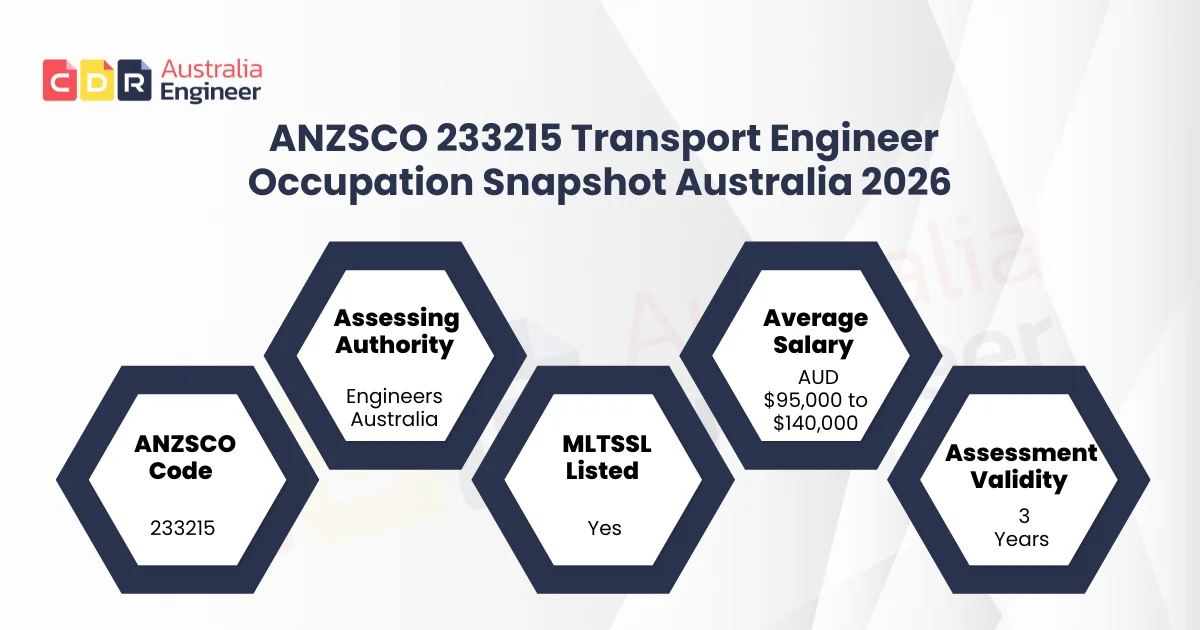
Source: Engineers Australia migration skills assessment guidelines 2026, Department of Home Affairs occupation lists April 2026, SEEK salary data June 2026. From 1 July 2026, Engineers Australia increased migration skills assessment fees by 3–4% in line with CPI and wage price index movements. Always verify the current fee on the Engineers Australia website before submitting.
If you are an overseas trained transport engineer without a Washington Accord recognised qualification, a Competency Demonstration Report (CDR) is required to pass the Engineers Australia migration skills assessment for ANZSCO 233215. Your CDR will showcase your engineering capability and is supported by actual work examples.
A complete CDR for transport engineering consists of five components:
Career episodes must be written in the first person and describe your specific individual contribution, not the overall project team’s work. Generic project descriptions or content that does not clearly isolate your personal engineering responsibilities are the most common reasons CDRs receive a not-suitable outcome for ANZSCO 233215.
CDR australiaengineer specialises in high-quality CDR, RPL and VETASSESS reports for engineers. We offer low-cost, customized and reliable services in diverse engineering disciplines.
Engineers Australia offers six assessment pathways for ANZSCO 233215 Transport Engineer. The correct pathway depends on where and how you obtained your engineering qualification.
Pathway | Who It Applies To |
Pathway A | Washington, Sydney, or Dublin Accord accredited qualification – no CDR required. Fastest pathway for eligible applicants |
Pathway B | Non-accredited overseas qualification – full CDR with three career episodes, summary statement, and CPD list required. Most common pathway for overseas transport engineers |
Pathway C | No formal engineering qualification – extensive work experience evidence required in lieu of academic credentials |
Pathway D | IPENZ (Engineering New Zealand) members – assessed via mutual recognition arrangement |
Pathway E | Experienced engineers with significant post-graduate professional experience – abridged assessment process |
Pathway F | Former EA members applying for re-assessment – simplified evidence requirements |
Most overseas transport engineers apply under Pathway B, the non-accredited overseas qualification route requiring a full CDR. Applicants from Washington Accord signatory countries, including the UK, USA, Canada, India, South Korea, and others, may qualify for Pathway A and bypass the CDR requirement entirely. Confirm your country’s accreditation status on the Engineers Australia website before proceeding.
Positive Engineers Australia Skills Assessment for Transport engineer ANZSCO 233215 allows to access full range of the available Australia skilled migration visas. Due to MLTSSL listing,transport engineer is eligible for points-tested and sponsored visa categories.
Visa Subclass | Type | Key Requirement |
Subclass 189 | Permanent – Skilled Independent | Points-tested, no employer or nomination required |
Permanent – Skilled Nominated | State nomination + 5 bonus points | |
Subclass 491 | Provisional – Skilled Regional | Regional nomination + 15 bonus points – PR via 191 |
Subclass 482 | Temporary – Skills in Demand | Employer-sponsored, Core Skills stream |
Subclass 186 | Permanent – Employer Nomination | Direct entry or TRT after 2 years on 482 |
Subclass 494 | Provisional – Employer Regional | Regional employer sponsorship – PR via 191 |
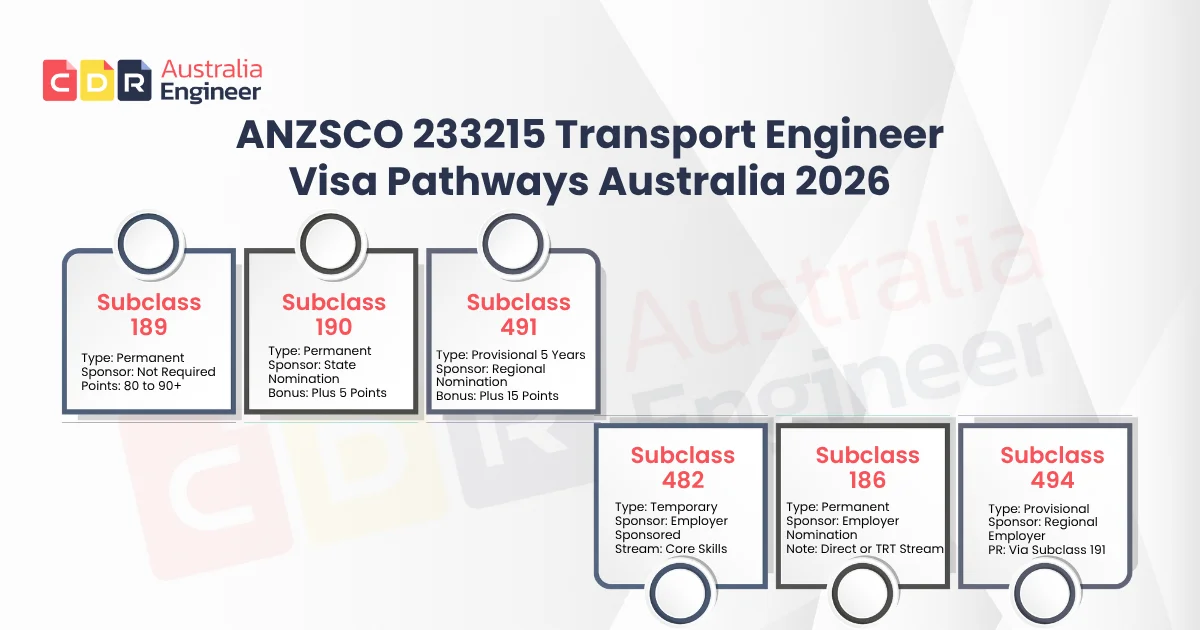
Transport Engineer: This job continues to be an Occupation on the States lists year after year. The states with the most infrastructure projects underway like QLD, NSW and VIC regularly nominate Transport engineers for Subclass 190 and 491 Visas. The round cut off for transport engineers on an 189 Visa in 2026 will likely range from the mid 80’s to the low 90’s points in SkillSelect rounds in 2026.
Transport engineering is supported by sustained infrastructure investment in 2026, making it one of the more stable and well-compensated civil engineering disciplines in Australia. The combination of urbanisation, population growth, and government commitment to major transport projects keeps demand for ANZSCO 233215 Transport Engineer professionals consistently high.
Experience Level | Avg. Annual Salary (AUD) | Typical Employer |
Graduate (0–3 years) | $70,000 – $90,000 | Consulting firms, state road authorities |
Mid-Level (3–8 years) | $95,000 – $120,000 | AECOM, WSP, Arcadis, GHD, Jacobs |
Senior (8–15 years) | $120,000 – $155,000 | Major infrastructure programmes, state departments |
Principal / Lead (15+ years) | $155,000 – $190,000+ | Programme directors, national infrastructure leads |
Source: SEEK salary data June 2026 and Hays Salary Guide FY25/26 Key employers for transport engineers in Australia include AECOM, WSP, GHD, Jacobs, Arcadis, Aurecon and Transport for NSW with salaries at the high end boosted by significant 2026 projects including Sydney Metro, Melbourne Airport Rail, Cross River Rail and Bruce Highway Upgrade.
Our expert consultants will assess your profile and recommend the best pathway for your Australian migration goals.
The CDR is the most critical document in your ANZSCO 233215 Transport Engineer migration application. A well-structured CDR that accurately maps your road design, traffic modelling, or public transport planning experience to Engineers Australia’s competency framework is what separates a positive outcome from a not-suitable result.
CDR Australia Engineers offers full support for the documentation needed in a transport engineer’s CDR application; be it carcer episodc writing, summing statement writing, complling CPD, or your entire applicaton. Wc arc a dedicatcd team that specialises ONLY in engineering migration;wc arc well aware of what thc Engineers Australia assessments will demand forANZSCO 233215in 2026.
The ANZSCO code for Transport Engineer in Australia is 233215. This occupation is listed on the MLTSSL and assessed by Engineers Australia for all skilled migration visa applications. It qualifies for the full range of General Skilled Migration visas including the Subclass 189 permanent independent pathway.
Yes, for most overseas transport engineers. Engineers Australia requires a CDR for applicants without a Washington Accord accredited qualification (Pathway B). The CDR includes three career episodes, a summary statement, and a CPD list. Engineers from Washington Accord countries qualify for Pathway A, no CDR required.
Transport engineers in Australia earn between AUD $95,000 and $140,000 per year at mid to senior level according to SEEK June 2026 data. Graduates start at AUD $70,000–$90,000. Senior and principal engineers on major infrastructure programmes earn AUD $155,000–$190,000+.
Transport Engineer ANZSCO 233215 is MLTSSL listed, qualifying for Subclass 189 (Skilled Independent), 190 (Skilled Nominated), 491 (Skilled Regional), 482 (Skills in Demand), 186 (Employer Nomination), and 494 (Employer Regional). A positive Engineers Australia skills assessment is required before lodging any of these visa applications.
Engineers Australia processes complete CDR applications for ANZSCO 233215 in 8 to 12 weeks from the date all documents are received. Incomplete applications, missing transcripts, employment references, or English test results, are placed on hold until resolved. EA fees increased 3–4% from 1 July 2026.
Free consultation & document collection.
ANZSCO code & category assessment.
Expert CDR writing by engineers.
Quality check & plagiarism test.
Delivery + free revisions support.
Start with a free consultation. We assess your profile at no cost and guide you every step of the way.

Scan to Connect With Our Experts ⤴︎