
Online

Choosing a degree in Australia in 2026 is no longer just an academic decision, for most international students and skilled migrants, it is a career and migration strategy rolled into one. The Australian Government has confirmed 185,000 permanent migration places for 2025–26, with the skilled stream accounting for the majority. However, not all degrees connect equally to those places. Some qualifications lead directly to occupations on the Medium and Long-term Strategic Skills List (MLTSSL) and the Core Skills Occupation List (CSOL). Others lead to oversaturated fields where neither job offers nor visa invitations follow graduation.
The most employable degrees in Australia in 2026 share three characteristics: they align with documented skills shortages, they appear on Australia’s skilled occupation lists, and they lead to roles that employers are actively sponsoring or that qualify for points-tested permanent visas. This guide covers the top degrees, the salary data behind them, the assessment bodies and visa pathways they connect to, and what makes each one a genuine career investment rather than a credential that looks strong on paper but stalls in practice.

The most employable degrees in Australia are those directly tied to skill shortage occupations. Jobs and Skills Australia publishes annual labour market data that confirms which sectors consistently cannot fill roles from the domestic graduate pipeline alone.
Four criteria determine whether a degree is genuinely employable in the Australian context:
Australia’s technology workforce is projected to reach 1.2 million jobs by 2030, driven by AI adoption, cloud infrastructure, and cybersecurity demand. Engineering infrastructure investment exceeds AUD $120 billion across active projects. Both sectors are pulling from international graduate and skilled migrant pipelines because domestic supply falls consistently short.
The following degrees are ranked by a combination of graduate employment rate, occupation list presence, average starting salary, and visa pathway strength, not simply by reputation or historical graduate numbers.
Degree | Avg. Starting Salary | Assessment Body | PR Pathway |
Engineering | AUD $75,000 – $109,000 | Engineers Australia (CDR) | MLTSS – Subclass 189/190/491 |
Information Technology | AUD $80,000 – $100,000 | ACS (RPL or General Skills) | MLTSSL/CSOL – Subclass 189/190/482 |
Data Science and AI | AUD $90,000 – $120,000 | ACS | MLTSSL – Subclass 189/190/491 |
Nursing and Healthcare | AUD $70,000 – $95,000 | AHPRA / ANMAC | MLTSSL – Subclass 189/190 |
Construction Management | AUD $75,000 – $100,000 | AIQS / Engineers Australia | MLTSSL – Subclass 189/190/491 |
Accounting and Finance | AUD $65,000 – $85,000 | CPA / CAANZ | MLTSSL – Subclass 189/190 |
Education | AUD $70,000 – $85,000 | AITSL | State nomination – Subclass 190/491 |
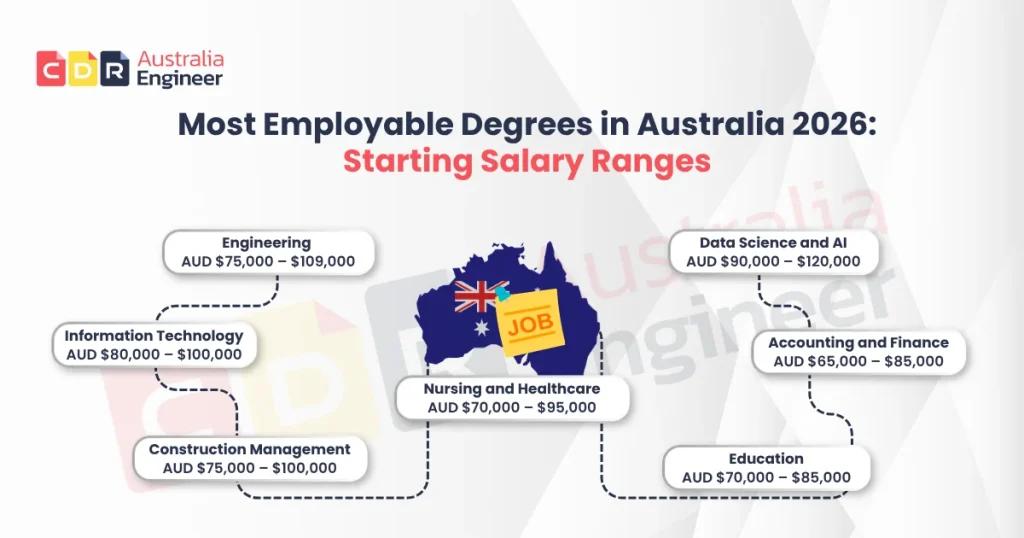
Source: Jobs and Skills Australia 2026, SEEK salary data June 2026, Department of Home Affairs skilled occupation lists April 2026.
Engineering remains one of the most employable degrees in Australia in 2026 across nearly every discipline, civil, mechanical, electrical, software, mining, and petroleum. A 7.2% growth rate for engineering jobs is expected over the next five years, with a median wage approaching AUD $105,000 annually according to Jobs and Skills Australia.
Australia’s infrastructure pipeline exceeds AUD $120 billion in active projects, housing construction targeting 1.2 million new homes by 2029, AUKUS defence commitments, renewable energy buildout, and major transport upgrades across every state. Engineering occupations dominate the MLTSSL, with civil, structural, electrical, mechanical, and mining engineers all appearing on the list and qualifying for the full range of skilled migration visas.
For overseas engineering graduates, the path to Australian employment and permanent residency runs through a skills assessment with Engineers Australia. A Competency Demonstration Report (CDR) is the primary document for applicants without an accredited Australian qualification, and getting it right the first time is what determines whether your engineering degree translates into an Australian career.
CDR australiaengineer specialises in high-quality CDR, RPL and VETASSESS reports for engineers. We offer low-cost, customized and reliable services in diverse engineering disciplines.
IT degrees produce graduates eligible for some of the fastest-growing and highest-paid occupations in Australia. ICT roles are projected to grow at 12% over the next five years, with average annual earnings around AUD $95,000–$137,000 across mid-level positions according to SEEK and Hays FY26/27 data.
Three Structural Forces in 2026 reshaping the digital economy: AI adoption in enterprise scale, pervasive cybersecurity talent shortage and the ongoing trend of cloud migration within all major verticals. Each of these creates demand for specific ICT roles that Australian institutions are not producing in sufficient numbers.
Data Engineers are one of the top five in-demand roles across the entire Australian economy in 2026 according to Morgan McKinley’s Australia Salary Guide. Average salaries for Data Engineers run AUD $127,000–$160,000, with senior practitioners billing AUD $120–$175 per hour in the contract market. Australia’s data-driven economy is projected to add AUD $100 billion annually by 2030 through analytics and AI innovation.
Australia is running a huge structural deficit in its cyber talent pool. In 2026, Cybersecurity Architects were the best paying IT contractor in Australia at a rate of AUD $180-$260 per hour (senior permanent jobs attractAUD $150,000-$180,000) and Bachelor of Cybersecurity courses are turning out grads into employment within 3 months of graduation from institutions like La Trobe University, Griffith University and the University of Newcastle.
All skilled ICT occupation assessments for skilled migration are undertaken by the Australian Computer Society (ACS) using either a General Skills assessment pathway or RPL pathway. A positive ACS assessment outcome must be obtained before submitting your application for a Subclass 189, 190 or 482 visa.
Beyond engineering and IT, several other degrees produce graduates with genuine employment security in 2026. Each of the following fields consistently appears on Australia’s skilled occupation lists and offers clear PR pathways for qualified graduates.
Bachelor and Master programs in Data Science and Analytics produce graduates eligible for ICT roles on the MLTSSL. Average salaries for data professionals run AUD $90,000–$125,000 per year according to SEEK. Popular universities for this degree include Deakin, Monash, RMIT, and the University of Queensland.
Healthcare is Australia’s largest employing sector, projected to grow by over 15% in the next five years. Registered nurses, physiotherapists, and mental health specialists all appear on the MLTSSL. Average salaries range AUD $70,000–$95,000 with strong state nomination priority across most jurisdictions.
Construction Management graduates can access quantity surveyor and project management roles assessed by AIQS and Engineers Australia. Based on Australia’s housing construction targets and infrastructure pipeline, construction is likely to feature a of one of the highest graduate-to-vacancy ratios of any professional degree in 2026.
Holding one of the most employable degrees in Australia is not just about getting a job, it is about building a migration strategy. For skilled migrants and international students, the degree you hold determines which assessment body handles your skills assessment, which visa subclasses you can access, and how competitive your points score will be in SkillSelect.
Degree Field | Assessment Body | Visa Pathway |
Engineering | Engineers Australia | CDR required – Subclass 189, 190, 491, 482, 186 |
Information Technology | ACS | RPL or General Skills – Subclass 189, 190, 491, 482 |
Nursing | AHPRA / ANMAC | Direct registration – Subclass 189, 190, 482 |
Data Science | General Skills – Subclass 189, 190, 491 | |
Construction Management | AIQS | Skills assessment – Subclass 189, 190, 491 |
Accounting | CPA / CAANZ | Direct membership – Subclass 189, 190 |
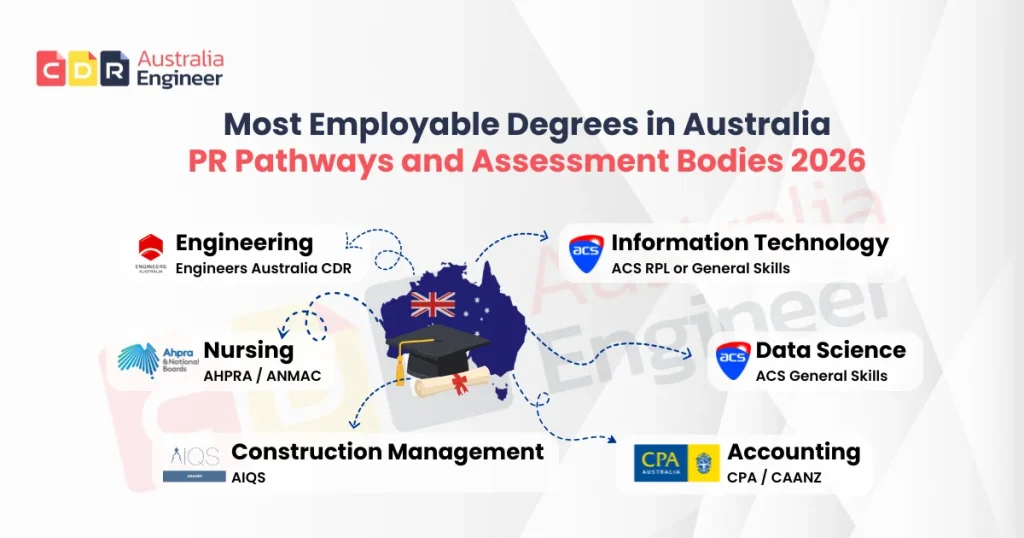
For engineers specifically, the CDR is the first and most critical step. Engineers Australia processes assessment applications in 8–12 weeks for complete submissions. From 1 July 2026, Engineers Australia increased its assessment fees by 3–4% in line with CPI, confirming the continuing cost of getting the document wrong and reapplying.
Holding one of Australia’s most employable degrees gives you the foundation, but the skills assessment is what unlocks the visa pathway, the employment eligibility, and ultimately the permanent residency. For engineers and ICT professionals, the quality of your CDR or ACS RPL report determines whether your qualification is recognised at the level it deserves.
CDRAustraliaEngineer provides complete documentation support for Engineers Australia CDR reports, ACS RPL assessments, and VETASSESS skills reports, helping graduates and experienced professionals turn their overseas qualifications into positive Australian skills assessment outcomes.
Our expert consultants will assess your profile and recommend the best pathway for your Australian migration goals.
In 2026, engineering and IT will once again be the most employable degrees in Australia. Both are aligned with the MLTSSL and provide graduate starting salaries above AUD $75,000. In the following top rankings are Data Science, Nursing, Construction Management, all with an important presence on the occupation list and high demand from the industry.
Mining engineering provides top grad salaries ranging from AUD $91,000 to $109,000 (AUD $30,000 more than the average graduate) along with being an MLTSSL. Civil, electrical and software engineering are next and are all on the MLTSSL, offering stable nomination by many states/territories.
Yes, most likely for any skilled stream option. The Subclass 189 visa, 190 visa or 491 visa requires a skills assessment regardless of whether your degree was gained overseas or in Australia prior to lodging the visa application.Engineers need a CDR through Engineers Australia; ICT graduates need an assessment through ACS.
Data Engineering and Cybersecurity lead IT salary outcomes. Data Engineers range AUD $127K-$160K on average. While on the flip side, Cybersecurity Architects chargeAUD $180 – $260ph on contract. 2026, these both appear in consistently marked up as “in demand roles”, both by Jobs and Skills Australia andMorgan McKinley.
Yes. Engineering is one of the strongest degree-to-PR pathways in Australia. Most engineering ANZSCO codes are MLTSSL listed, qualifying for Subclass 189 (independent permanent visa), Subclass 190 (state nominated), and Subclass 491 (regional provisional). A positive Engineers Australia skills assessment through the CDR pathway is the mandatory first step.
Start with a free consultation. We assess your profile at no cost and guide you every step of the way.

Scan to Connect With Our Experts ⤴︎