
Online

Petroleum engineering courses in Australia sit at the intersection of two things that matter enormously in 2026: one of the world’s strongest resources economies and a global energy transition that is reshaping what petroleum engineers actually do. Australia’s LNG export sector remains the third-largest in the world. The North West Shelf, Browse Basin, and Gippsland offshore fields continue generating consistent demand for petroleum engineering expertise, while new hydrogen, carbon capture, and unconventional resources projects are creating entirely new technical roles within the same discipline.
For international students and overseas engineers, petroleum engineering courses in Australia serve two purposes simultaneously: they deliver world-class technical education and they create a direct pathway to skilled migration. UNSW Sydney is ranked #1 in Australia and #13 globally for Petroleum Engineering in the QS World University Rankings by Subject 2026. Those who comply with the requirements ofANZSCO 233612 can get the opportunity to receive a permanent residence permit with Engineers Australia’s assessment of their skills and experience.

The technical aspects of oil and gas and energy resources are explored thoroughly in petroleum engineering degree courses Australia. Well drilling, reservoir modelling and charactersition through to production enhancement and field abandonment is all within scope of the degree, in 2026 unconventional resources, CCS and digital reservoir control (AI and IOT technology) have also become integral to programs at top Australian unis.
Core subjects covered across most Australian petroleum engineering programs include:
Australia’s petroleum engineering programs are closely tied to industry. The Australian School of Petroleum and Energy Resources at the University of Adelaide is the only dedicated petroleum engineering school in Australia and Southeast Asia, offering direct connections to industry-trained academics and active research partnerships with major operators.
Choosing the right institution affects not just your education but your migration outcome. Washington Accord accreditation is the key factor, graduates of accredited programs qualify for Engineers Australia Pathway A assessment, bypassing the CDR requirement.
University | Program | Annual Fee (2026) | IELTS Minimum |
UNSW Sydney | Master of Professional Engineering (Petroleum) | AUD $49,026 | 6.0 (no band below 6.0) |
Curtin University | BE (Hons) Petroleum Engineering | AUD $37,507 | 6.0 |
University of Adelaide | Master of Petroleum Engineering | AUD $51,000 | 6.5 (no band below 6.0) |
Edith Cowan University | Bachelor of Technology (Engineering) in Petroleum | AUD $42,650 | 6.0 |
Curtin University | Graduate Diploma, Petroleum Engineering | AUD $38,800 | 6.0 |
Curtin University | PhD Petroleum Engineering | AUD $38,000 | 6.5 |
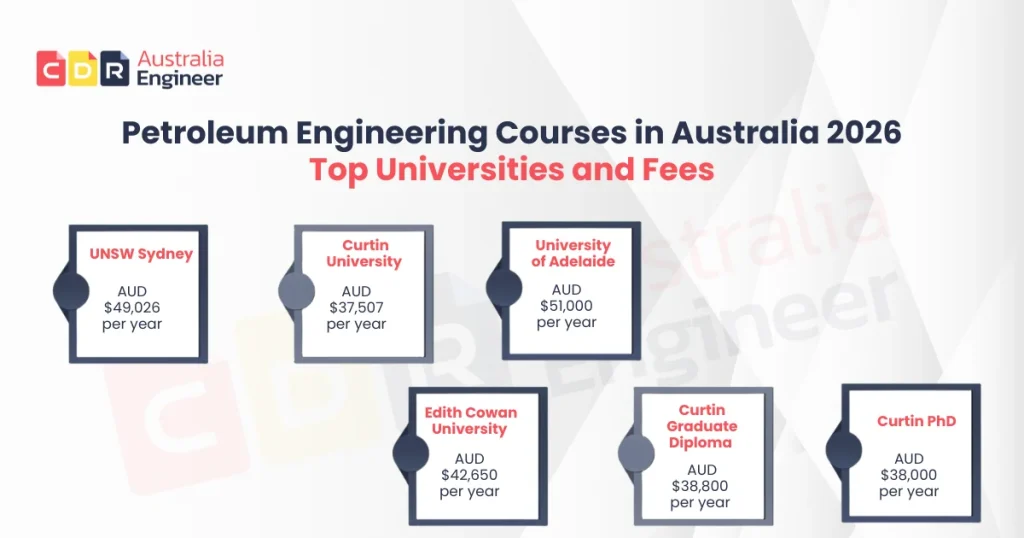
Source: IDP Australia, university official fee schedules (2026). Curtin University ranks 4th in Australia and 32nd globally for Petroleum Engineering in the QS World University Rankings by Subject 2026. The University of Adelaide’s Master of Petroleum Engineering offers access to the Tempest reservoir simulator and field experience at an Australian sedimentary basin, practical exposure that directly strengthens a CDR or visa application.
Petroleum engineering consistently delivers some of the strongest graduate employment outcomes and starting salaries of any engineering discipline in Australia. For international students and overseas engineers, understanding the career trajectory, not just the degree, is what makes the investment decision clear.
Experience Level | Avg. Annual Salary (AUD) | Typical Employer | Location Premium |
Graduate (0–2 years) | $80,000 – $100,000 | Consulting firms, junior reservoir roles | WA rates at upper end |
Mid-Level (3–7 years) | $120,000 – $160,000 | Woodside, Santos, Beach Energy | WA and QLD above average |
Senior (8–15 years) | $160,000 – $200,000 | Major operators, FIFO roles | FIFO adds AUD $20,000–$50,000 |
Principal / Lead | $200,000 – $250,000+ | LNG programme leads, offshore operators | WA North West Shelf dominant |
For overseas-qualified petroleum engineers, a positive Engineers Australia skills assessment is what converts these salary figures and career outcomes from possibilities into realities. Without a recognised qualification or a successful CDR under Pathway B, Australian employers in regulated petroleum engineering roles cannot formally recognise your experience, regardless of how strong your technical background is.
CDR australiaengineer specialises in high-quality CDR, RPL and VETASSESS reports for engineers. We offer low-cost, customized and reliable services in diverse engineering disciplines.
Australian petroleum engineering programs are available at bachelor, graduate diploma, master, and PhD levels. Choosing the right level depends on your existing qualifications and migration strategy.
The undergraduate pathway runs 4 years full-time and covers the full technical scope from foundational engineering science through to specialised petroleum subjects. Curtin University and Edith Cowan University offer the strongest bachelor-level petroleum programs in Australia in 2026. Graduates from Washington Accord accredited programs can proceed directly to Engineers Australia Pathway A assessment, the fastest route to an ANZSCO 233612 skills assessment outcome.
Master-level petroleum engineering courses run 1 to 2 years depending on your undergraduate background. Entry typically requires an engineering bachelor degree at honours level or equivalent, with a minimum GPA of 4.0 to 5.0 depending on the institution. UNSW’s master program covers Reservoir Engineering, Geomechanics, and environmental science, while Adelaide’s program includes a mandatory research thesis and access to the Tempest reservoir simulator.
Curtin’s Graduate Diploma program offers a faster pathway for engineers who need to formalise their petroleum engineering qualifications. Next intake is 22 July 2026. This is a practical option for overseas engineers already working in oil and gas who need an Australian-accredited qualification to support an Engineers Australia skills assessment under Pathway A rather than submitting a full CDR.
Completing petroleum engineering courses in Australia or overseas connects directly to ANZSCO 233612, the occupation code for Petroleum Engineer in Australia’s skilled migration system. This code appears on both the MLTSSL and the Core Skills Occupation List (CSOL), qualifying graduates for the full range of skilled migration visas.
Factor | Detail |
ANZSCO Code | 233612 – Petroleum Engineer |
Assessing Authority | Engineers Australia (EA) |
MLTSSL Listed | Yes, full range of skilled migration visas available |
Average Salary (2026) | AUD $140,000 – $250,000+ (SEEK June 2026, incl. FIFO) |
Assessment Validity | 3 years from date of outcome letter |
CDR Required | Yes for non-Washington Accord qualifications (Pathway B) |
EA Processing Time | 8 to 12 weeks for complete applications |
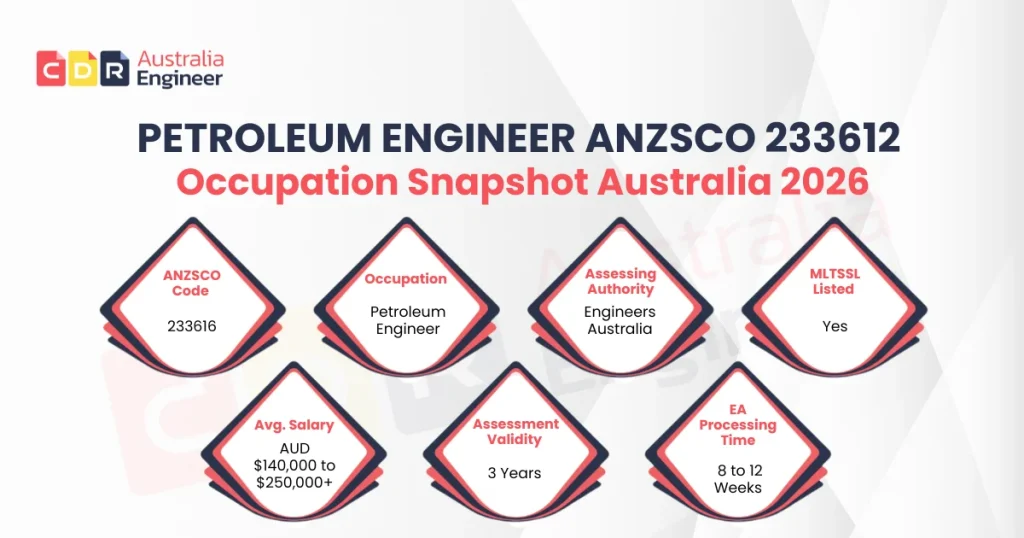
The distinction between Pathway A and Pathway B is critical for international students. Graduates of Washington Accord-accredited programs, including Curtin, UNSW, and Adelaide, qualify for Pathway A, which requires no CDR. Graduates of non-accredited overseas institutions must submit a full CDR under Pathway B: three career episodes, a summary statement, and a CPD list.
For overseas petroleum engineers who did not graduate from a Washington Accord accredited institution, a Competency Demonstration Report (CDR) is the mandatory document for Engineers Australia assessment. The CDR demonstrates your engineering competency through real project experience rather than academic credentials alone.
A complete CDR for petroleum engineering consists of:
Engineers Australia increased its migration skills assessment fees by 3–4% from 1 July 2026. CDR applications are processed in 8 to 12 weeks for complete submissions. Incomplete applications, missing transcripts, employment references, or English test results, are placed on hold until deficiencies are resolved.
A positive Engineers Australia skills assessment for ANZSCO 233612 opens the full range of Australian skilled migration visas. Petroleum engineers may also apply for the following programs in 2026: Points-tested, Employer-sponsored, Permanent residency programs.
Visa Subclass | Type | Key Requirement |
Subclass 189 | Permanent – Skilled Independent | Points-tested, no employer or nomination needed |
Permanent – Skilled Nominated | State nomination + 5 bonus points | |
Subclass 491 | Provisional – Skilled Regional | Regional nomination + 15 bonus points |
Subclass 485 | Temporary Graduate | For Australian graduates, 2 to 4 years post-study work rights |
Subclass 482 | Temporary Skills in Demand | Employer-sponsored, no points test |
Subclass 186 | Permanent Employer Nomination | Direct entry or TRT after 2 years on 482 |
Most active Petroleum engineer nominations in the Australian states during 2026 have been recorded for Queensland and Western Australia. WA nominates petroleum engineers under Subclass 190 due to sustained demand from LNG operations and offshore projects. Graduate starting salaries in WA run AUD $80,000–$100,000, among the highest of any engineering discipline at entry level.
Our expert consultants will assess your profile and recommend the best pathway for your Australian migration goals.
Completing petroleum engineering courses in Australia or overseas is the foundation, but the Engineers Australia skills assessment is what unlocks the visa pathway. For overseas graduates without a Washington Accord accredited qualification, a well-prepared CDR is the difference between a positive outcome and months of delays.
CDR Australia Engineer provides complete CDR documentation support for petroleum engineers, covering career episode writing, summary statement mapping, CPD compilation, and full application review. We know what the Engineers Australia assessors expect under ANZSCO 233612 in 2026.
UNSW Sydney holds the first position in Australia and the 13th globally in Petroleum Engineering according to the QS World University Rankings by Subject 2026 and costs AUD $49,026 annually. Curtin University is in fourth position in Australia and 32nd in the world and is offering courses starting from AUD $37,507 per year.
Only if their qualification is not Washington Accord accredited. Graduates of Curtin, UNSW, and University of Adelaide qualify for Engineers Australia Pathway A, no CDR required. Overseas graduates from non-accredited institutions must submit a full CDR under Pathway B.
ANZSCO 233612 – Petroleum Engineer ANZSCO code in MLTSSL. Engineers Australia assess all skilled migration visa applications for petroleum engineers. This includes all Subclass 189, 190, 491, 482, and 186.
AUD $140,000–$195,000 per year on average, with senior FIFO roles in Western Australia exceeding AUD $250,000 when allowances are included. Graduate starting salaries in WA run AUD $80,000–$100,000.
1 to 2 years depending on your undergraduate background and institution. UNSW and Adelaide run 2-year programs for non-petroleum engineering backgrounds. Curtin’s Graduate Diploma is approximately 1 year for engineers needing a faster Australian-recognised qualification.
Start with a free consultation. We assess your profile at no cost and guide you every step of the way.

Scan to Connect With Our Experts ⤴︎