
Online

PR in Australia for engineers in 2026 is more competitive than it has ever been, but also more strategically manageable, if you understand what has changed and where the real opportunities sit. The Australian Government confirmed 185,000 permanent migration places for 2026–27, with approximately 71%, around 132,200 seats, allocated to the skilled stream. The distribution across visa categories has shifted significantly from the previous year, and engineers who are planning their pathway based on 2025 data are working with the wrong map.
The most consequential shift: Subclass 186 Employer Nomination Scheme places jumped from 44,000 to 58,040, making it the largest single pathway in the entire skilled stream. At the same time, Subclass 491 regional places were cut from 33,000 to just 14,110, a drop of more than 57%. For engineers deciding between a points-tested and employer-sponsored route to PR in Australia, these numbers reframe the entire decision. This guide covers every current pathway, the 2026 points test reality, the CSIT threshold, the December 2026 points test reform timeline, and what CDR and skills assessment steps you need to take first.

Permanent residency in Australia: PR, Australian Permanent residency allows workers to live and work in Australia permanently, claim Medicare services, sponsor their families, apply for citizenship. Permanent residency doesn’t bind you to an employer, occupation or a state; it only comes with some general requirements of length of stay.
For engineers, permanent residency is accessed through one of two frameworks: the General Skilled Migration (GSM) points-tested program, or the employer-sponsored program. Both require a positive skills assessment as a precondition, and for most overseas engineers, that means a Competency Demonstration Report (CDR) assessed by Engineers Australia, or an RPL report assessed by the Australian Computer Society (ACS) for ICT engineering roles.
Engineering occupations that qualify for permanent residency pathways in 2026 include:
Being MLTSSL listed qualifies an occupation for the full range of skilled migration visas including Subclass 189, 190, 491, 482, and 186. Not all engineering occupations sit on the MLTSSL, some are on the STSOL or CSOL only, which restricts visa options. Always confirm your ANZSCO code and list status before planning your pathway.
The 2026–27 program year introduced the most significant redistribution of skilled migration places in several years. Understanding where places have moved is the most important strategic insight for engineers planning their pathway to PR in Australia in 2026.
Visa Category | 2025–26 Places | 2026–27 Places | Change |
Subclass 186 – Employer Nomination | 44,000 | 58,040 | ▲ +32% |
Subclass 190 – Skilled Nominated | 30,000 | 32,310 | ▲ +8% |
Subclass 189 – Skilled Independent | 18,000 | 19,990 | ▲ +11% |
33,000 | 14,110 | ▼ -57% | |
Total Skill Stream | ~132,200 | ~132,200 | Unchanged |
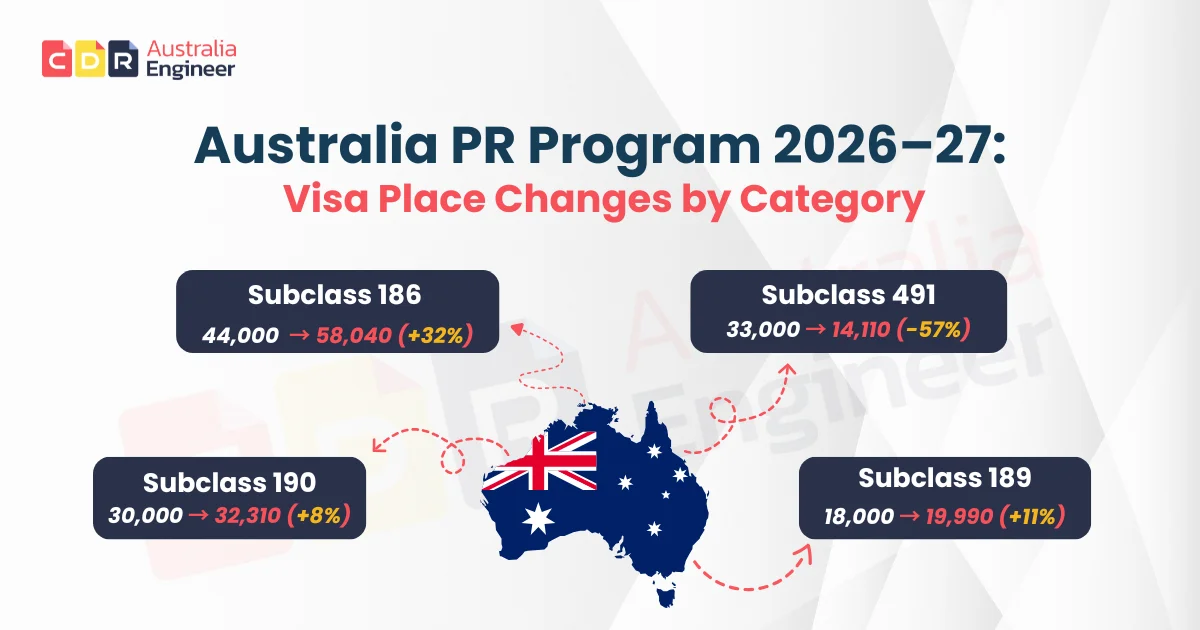
Source: Department of Home Affairs 2026–27 Migration Program planning levels, May 2026. The pattern is clear: the government has redirected places from regional points-tested pathways toward employer sponsorship and state nomination. Engineers who were planning to use the Subclass 491 as their primary PR pathway need to reassess, 14,110 places for the entire country is a significant constraint compared to 33,000 the year before.
The main permanent and provisional visa pathways for engineers in 2026 are outlined below. Each has different eligibility requirements, processing timelines, and strategic suitability depending on your points score, occupation, and whether you have employer support.
The Subclass 189 is a points-tested permanent visa with no employer or nomination requirement. The competitive points threshold for most engineering occupations in 2026 sits at 85 to 95 points, significantly above the legal minimum of 65. Based on verified 2026 SkillSelect data, the 189 is now effectively reserved for applicants with strong English, maximum or near-maximum age points, and significant Australian or overseas skilled employment. Processing time for 50% of cases is approximately 5 months from lodgement.
The Subclass 190 adds 5 bonus points via state or territory nomination and grants immediate permanent residency. 190 places increased to 32,310 for 2026–27, the second-largest pathway in the skilled stream. Most states actively nominate engineers across civil, electrical, mechanical, and software disciplines. The Subclass 190 is processing faster than the 189 in 2026, with median grant times of 5 to 7 months.
The Subclass 491 adds 15 bonus points via regional nomination and leads to permanent residency through the Subclass 191 after three years. Places were cut by 57% to just 14,110 for 2026–27, making state nomination significantly more competitive than in previous years. Tasmania, South Australia, and ACT remain the most accessible states for engineering nominations under this pathway.
The Subclass 186 is now the largest single pathway in Australia’s entire skilled migration program at 58,040 places for 2026–27. It grants immediate permanent residency through either the Direct Entry stream (skills assessment required) or the Temporary Residence Transition stream after two years on a Subclass 482. For engineers with employer support, this is now the most reliable and fastest route to permanent residency in 2026.
CDR australiaengineer specialises in high-quality CDR, RPL and VETASSESS reports for engineers. We offer low-cost, customized and reliable services in diverse engineering disciplines.
The legal minimum points score to submit an EOI is 65 points. In 2026, that figure is almost irrelevant for planning purposes. The competitive minimum, the score you actually need to receive an invitation, is substantially higher for most engineering occupations.
Visa Pathway | Legal Minimum | 2026 Competitive Score |
65 points | 85 to 95+ points for most engineering occupations | |
Subclass 190 – Skilled Nominated | 65 points (70 with nomination) | 70 to 85 points including 5-point nomination bonus |
Subclass 491 – Skilled Regional | 65 points (80 with nomination) | 65 to 80 points including 15-point nomination bonus |
Source: SkillSelect invitation data June 2026, verified competitor analysis. The points test is expected to change from 1 July 2027 following the May 2026 Federal Budget announcement, consultation opened June 2026 and draft legislation is expected December 2026. Until then, the existing points test remains fully in force.
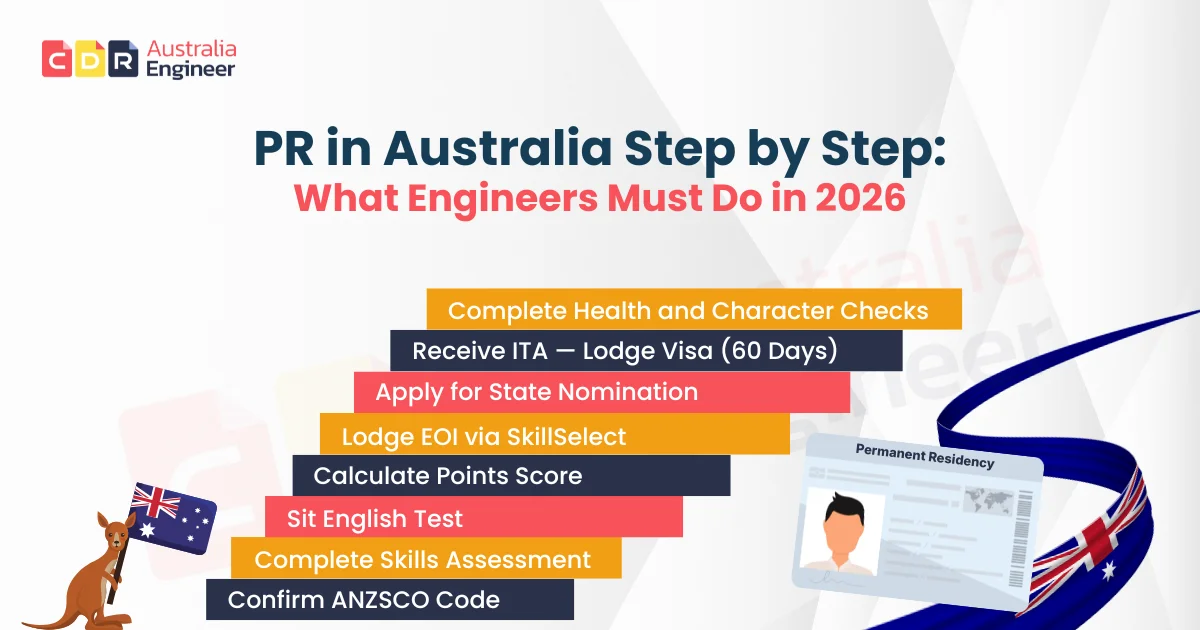
Getting PR in Australia as an engineer follows a structured sequence. The order matters, errors at any stage create delays that compound through every subsequent step.
From 1 July 2026, the Core Skills Income Threshold (CSIT) for employer-sponsored visas is AUD $79,499. This is relevant for engineers pursuing the Subclass 482 to 186 pathway, your guaranteed salary must meet or exceed this figure at nomination.
A positive skills assessment is the mandatory first step before any PR in Australia application can proceed. Engineers Australia is the assessing authority for most professional engineering occupations. The ACS assesses ICT engineering roles. The assessment you need depends on your occupation and the pathway you choose.
The skills assessment must be valid at the time you receive your Invitation to Apply, not just when you submit your EOI. EA assessments are valid for 3 years. If your assessment expires while waiting in the SkillSelect pool, you must renew it and update your EOI, which resets your submission date and can significantly delay invitation timing.
For most engineers, the gap between their current score and the competitive threshold is bridgeable, but it requires knowing which categories offer the highest return for your specific profile.
One Timing Note that Many Applicants Overlook: your EOI submission date is the tiebreaker when two candidates share the same points score. Submitting the moment you become eligible, rather than waiting to refine your profile, can make the difference between invitation and a 12-month wait.
Our expert consultants will assess your profile and recommend the best pathway for your Australian migration goals.
The path to PR in Australia for engineers in 2026 begins with a skills assessment that accurately reflects your qualifications and experience. With the Subclass 186 now the largest PR pathway and employer sponsorship accelerating processing times, a positive EA CDR or ACS RPL report is the document that unlocks every option, points-tested and employer-sponsored alike.
CDR Australia Engineer provides complete documentation support for Engineers Australia CDR reports, ACS RPL assessments, and VETASSESS skills reports, the mandatory first step for any Australian permanent residency application as an engineer. Get your assessment right the first time and enter the migration system with the strongest possible foundation.
The Department of Home Affairs confirmed 185,000 permanent migration places for 2026–27, with approximately 71%, around 132,200 seats, allocated to the skilled stream. The largest single category is now the Subclass 186 Employer Nomination Scheme at 58,040 places, followed by Subclass 190 at 32,310 and Subclass 189 at 19,990.
The legal minimum EOI score is 65 points, but the competitive score for most engineering occupations sits at 85 to 95+ points for Subclass 189. The Subclass 190 with state nomination requires 70 to 85 points including the 5-point bonus. Subclass 491 regional invitations may still occur at 65 to 80 points including the 15-point regional bonus.
Yes, for most overseas engineers. Engineers Australia requires a CDR for applicants without a Washington Accord accredited qualification. The CDR must be submitted and a positive outcome received before lodging an EOI or applying for any skilled migration visa. Engineers from Washington Accord countries qualify for Pathway A, no CDR required.
CSIT is AUD $79,499 (1 July 2026), is the minimum salary for Subclass 482 visa employer sponsored nomination applications and for the Subclass 186 Temporary Residence Transition stream of employer sponsored nominations. This minimum guaranteed salary is inclusive of any superannuation contributions, bonuses and allowances.
Yes, the May 2026 Federal Budget confirmed a ground-up rewrite of the points test. Consultation opened June 2026, draft legislation is expected December 2026, and implementation is flagged from 1 July 2027. The current points test remains fully in force until then. Engineers with active EOIs will be protected by transitional arrangements.
Start with a free consultation. We assess your profile at no cost and guide you every step of the way.

Scan to Connect With Our Experts ⤴︎