
Online

Every engineer preparing a Competency Demonstration Report for Engineers Australia eventually faces the same challenge—how to open each Career Episode in a way that gives assessors the context they need without wasting the limited word count that should be demonstrating competency. The answer is the Project Summary Proforma. This structured introductory section appears at the start of each career episode and serves as the factual foundation on which the rest of your narrative is built.
Getting it right does not guarantee a positive assessment, but getting it wrong almost always weakens one. This will help you explains exactly what a Project Summary Proforma is, what it must contain, how to write it correctly, and the mistakes that cause Engineers Australia assessors to flag career episodes before they have even read the main narrative. A clear and accurate proforma helps establish the project context and demonstrates consistency across your CDR documentation. It also gives assessors an immediate understanding of your engineering role, project background, and the experience described in the career episode.
The career episode summary proforma is the formatted header area that is located at the beginning of the narrative body of each career episode of a competency demonstration report. Before an engineer’s personal engineering story begins, engineers in Australia should have a nicely structured set of facts about the project or engineering activity being described.
Every field in the proforma serves a specific purpose. The title tells the assessor what kind of engineering activity they are about to read. The duration confirms the timeline and allows cross-referencing with your employment documents. The organization name establishes where the work took place. The position held clarifies your seniority, and the location grounds the project in context. Together these five fields give the assessor everything they need to evaluate your narrative before reading a single line of it.
The proforma is not about the career episode itself; it’s about the structure around it. Imagine the briefing of a piece of work that enables an assessor to get a sense of scale, scope, setting, and your role in a project as soon as they read it, before they read about how you used your engineering skills in the project.
Engineers Australia’s MSA Booklet specifies that each career episode must include the following pro forma details:
Proforma Field | What It Must Contain |
Career Episode Title | Name of the project or engineering activity |
Duration | Start and end dates of the episode (month and year) |
Organization | Full name of the company, institution, or body |
Position Held | Your job title during this episode |
Location | City and country where the work was performed |
These five fields are mandatory. Missing or vague entries in any of them signal to the assessor that the application may lack authenticity or attention to detail—two qualities Engineers Australia assesses throughout the entire CDR. An incomplete proforma does not just weaken one career episode—it raises questions about the reliability of your entire submission and can prompt additional scrutiny across all three episodes.
Many engineers treat the proforma as a simple formality, but it plays an important role in your CDR. Engineers Australia uses the information to cross-check your career episodes with employment references and other supporting documents. Inconsistent dates, job titles, or organization names can raise questions about the accuracy of your application.
A clear and consistent proforma helps establish the project context, supports the credibility of your engineering experience, and makes it easier for assessors to verify the information in your CDR.
Our expert consultants will assess your profile and recommend the best pathway for your Australian migration goals.

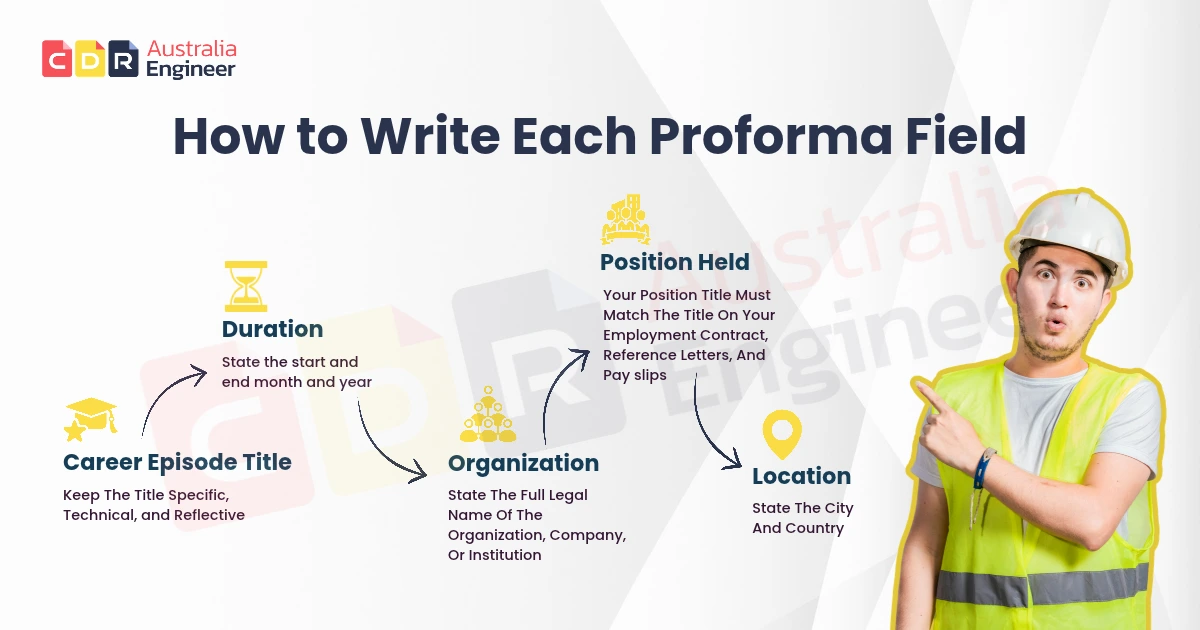
Your episode title should clearly identify the engineering activity without being vague or overly generic. A title like “Civil Engineering Project” tells an assessor nothing. A title like “Structural Design and Load Analysis for a Multi-Storey Commercial Building in Karachi” immediately communicates the discipline, the nature of the work, and the context.
Keep the title specific, technical, and reflective of the actual engineering activity you describe in the narrative that follows. Avoid project code names or internal references that have no meaning outside your organization.
State the start and end month and year of the episode. For example: March 2021 to November 2022. Do not use approximate terms like “approximately two years” or leave end dates blank for ongoing projects—state the period relevant to the episode itself, not the project’s overall lifespan.
If the episode was part of your academic studies, use the semester or academic year period during which the engineering activity took place. Duration must be consistent with the employment or study period reflected in your supporting documents.
State the full legal name of the organization, company, or institution. Abbreviations or informal trading names should be avoided unless they are the organization’s formally registered name. If you worked for a contractor deployed to a client site, name the company that employed you—not the client organization—unless your engagement was directly with the client.
Your position title must match the title on your employment contract, reference letters, and payslips for the corresponding period. Upgrading your title—even slightly—between your pro forma and your supporting documents is a common credibility issue that assessors are trained to identify. If your formal title was “Graduate Engineer” but you performed duties equivalent to a senior role, address this in the narrative body of the career episode, not by altering the proforma.
State the city and country where the engineering work was physically performed. If the project involved work across multiple locations, state the primary location and note the others briefly. Remote or hybrid working arrangements should reflect where the majority of the engineering activity occurred.
Three career episodes are required for each CDR submission, and each episode must also have its own full project summary proforma. The three episodes will address various aspects of your engineering competency, such as design, analysis, project management, problem solving, communication, and so on. Engineers Australia expects a variety of these in the different episodes. Each proforma must show three different and valid projects, roles, or periods of engineering activity.
It is not allowed to utilize the same project for more than one career episode. Repeating projects from the same organization in all three episodes is acceptable but harms your application, as it’s not as indicative of the breadth of competencies you can demonstrate or the depth of your engineering experiences.
The Summary Statement is the document that establishes a connection between each competency element of Engineers Australia’s Stage 1 standard and specific paragraphs that are numbered in your Career Episodes. Assessors employ it as a cross-reference document, reading your Summary Statement and then checking if the paragraphs you have written support the competency you said you demonstrated.
This cross-referencing is held together by the Project Summary Proforma. The assessor will refer to the Career Episode 2 proforma to understand the context of the project prior to reading paragraph 4, when reading “Competency Element 1.1—PE1.1—demonstrated in Career Episode 2, paragraph 4. If the pro forma is not clear or consistent, it disrupts this momentum, and the assessor must make inferences, which is not required in a well-prepared CDR.
The Summary Statement is reviewed first by Engineers Australia assessors and then by the review of each Career Episode Proforma to ensure authenticity and context in 2026. A strong narrative combined with a weak pro forma has the effect of asking the assessor to do what they should have done for them—and in a high-volume assessment environment, that is not doing them a favor.
Use this checklist to verify every proforma is complete and consistent before lodging your CDR:
Each career episode starts with the Project Summary Proforma, which an Engineers Australia assessor will look at first. It establishes the authority, background, and consistency of what follows. A consistent engineering application that clearly, specifically, and completely fills out the three career episodes is a strong sign of authenticity, professional preparation, and scrutiny to the first line.
Our CDR specialists can assist you in combining your career episodes in a way that is suitable for Engineers Australia and in creating consistent project summary proformas with your employment documents, as well as accurately mapping your competencies in the Summary Statement, and much more.
Yes. Engineers Australia requires a complete proforma at the start of every career episode. Omitting or partially completing it is a documentation error that can delay your assessment.
Yes. Engineers Australia accepts academic engineering activities, including final-year projects, design projects, and supervised lab work. Name the institution as the organization and your student or intern role as the position held.
Inconsistencies between your proforma and employment documents are a leading cause of unsuitable assessment outcomes. Your position title, organization name, and duration must match your reference letters and payslips exactly—discrepancies can be treated as misrepresentation.
The proforma is a structured header—not a narrative. It occupies only the opening few lines. The full career episode, including the pro forma, should be between 1,000 and 2,500 words.
Yes, but using the same organization for all three is not recommended. Engineers Australia expects each episode to demonstrate different competency areas—three episodes from one employer limit the breadth of experience you can show.
Start with a free consultation. We assess your profile at no cost and guide you every step of the way.

Scan to Connect With Our Experts ⤴︎

