
Online

💥🥂 NEW YEAR GRAND DISCOUNT — Save up to 35% on Our Services. Offer Ends at 1st week of Jan
Businesses that have a history of strong workplace culture and compliance while consistently undertaking a large volume of sponsorships will be invited by the Department of Home Affairs to become an Accredited Sponsor in Australia. It sits above Standard Business Sponsorship and delivers a practical advantage that most skilled workers never consider when searching for a sponsored role: faster visa processing, reduced documentation, and streamlined nomination approvals.
For engineers, ICT professionals, and skilled tradespeople, knowing which employers hold accredited sponsorship in Australia can make a real difference. Their Subclass 482 nominations move to the front of the queue, often cleared within five business days rather than several months. However, the rules, thresholds, and compliance expectations have changed considerably in 2026.
Not all Australian employers who sponsor overseas workers are equal. Standard Business Sponsorship (SBS) is the baseline tier, any lawfully operating Australian business can apply. Accredited sponsorship sits above that. It is a premium status granted to employers who have already held an approved SBS and have proven they operate at a higher standard of compliance and workforce integrity.
Australia currently has approximately 3,580 accredited business sponsors actively using the Subclass 482 framework. This is a deliberately small group, accreditation is not automatic, and it requires a demonstrated track record. When an engineer or ICT professional is nominated by one of these employers, their application is flagged for priority handling from the moment it is lodged.
For skilled workers pursuing employer-sponsored migration, the type of sponsor their employer holds directly affects their visa timeline and experience. Here is what accredited sponsorship in Australia delivers in practice:
Most Subclass 482 nominations lodged by accredited sponsors are finalised within five business days. Standard Business Sponsor nominations can take weeks to months. For engineers and ICT professionals in time-sensitive roles, defence, construction, infrastructure, this speed differential has direct commercial value. Some low-risk nominations are auto-approved within minutes of lodgement.
Accredited sponsors carry a proven compliance history. Home Affairs recognises this by requiring less documentation at the nomination stage. The employer does not need to re-establish its credentials with each individual nomination, reducing the administrative burden on both sides and removing a common source of processing delays.
Standard Business Sponsors must advertise roles on national third-party platforms as part of Labour Market Testing (LMT). Accredited sponsors can use their own company website as an eligible advertising platform. For large engineering firms and technology companies that attract high volumes of specialist applicants, this removes an administrative layer without weakening the intent of LMT.
Visa applicants nominated by an accredited sponsor are not required to obtain overseas police certificates, provided the employer provides a written reference confirming the applicant is of good character and has no criminal convictions. Overseas police certificates can take up to six weeks to obtain in some jurisdictions. Removing this step alone can significantly accelerate an applicant’s mobilisation to Australia.
Being an accredited sponsor tells skilled workers they can expect their potential future employer to meet all relevant compliance standards. From 2026, where Home Affairs will introduce an online public register of approved sponsors, that accredited status is something that will stand out as a big tick of approval. Engineers and ICT professionals actively seek out accredited employers because they know the process will be faster and better managed.
CDR australiaengineer specialises in high-quality CDR, RPL and VETASSESS reports for engineers. We offer low-cost, customized and reliable services in diverse engineering disciplines.
The practical differences between the two tiers go beyond processing speed. The table below outlines what changes for the worker when an accredited sponsor nominates them.
Factor | Standard Business Sponsor | Accredited Sponsor |
Processing Speed | Weeks to months | ~5 business days |
Nomination Assessment | Manual genuine position check | Auto-approved for low-risk roles |
Labour Market Testing | Third-party ads required | Company website ads accepted |
Documentary Load | Full documentation required | Reduced documentation |
Police Certificate | Certificate required | Written sponsor reference accepted |
Home Affairs Recognition | Standard | Priority trusted status |
From a worker’s perspective, being nominated by an accredited sponsor reduces the risk of your application stalling on administrative grounds and puts a firm timeline on your processing, something a standard nomination cannot guarantee.
To qualify for accredited sponsorship in Australia status, an employer must already hold an approved SBS and meet the requirements of at least one of the four recognised accreditation categories defined by Home Affairs.
Category | Key Requirements |
Category 1: Government Agencies | Commonwealth, state, or territory government entities. Australian workers must make up at least 75% of the workforce in Australia. |
Category 2: Australian Trusted Traders | If your organisation holds Australian Border Force Trusted Trader accreditation, streamlined accreditation is available as an automatic eligibility requirement. |
Category 3: Low Volume, High Australian Workforce | Sponsors with low visa usage but at least 85% Australian workers. Approval rate for lodged nominations must exceed 97% over the past two years. |
Category 4: High Volume, Medium Australian Workforce | Sponsors with higher sponsorship volume and at least 75% Australian workers. Must demonstrate consistent compliance history with no adverse immigration record. |
Across all categories, the following baseline standards apply: all Subclass 482 visa holders must be engaged under a written contract meeting the National Employment Standards (NES); all employees must be paid according to an Enterprise Agreement or an internal salary table reflecting current market rates; and the business must have no adverse information recorded against it with Home Affairs.
An employer might choose an accredited sponsorship at the time of their new standard business sponsorship application, at renewal, or at a stand-alone stage within an active sponsorship approval. The following briefly outlines the process.
One Important Note: Accredited Sponsorship in Australia can be revoked if the employer no longer meets accreditation criteria, for example, due to corporate restructure, a drop in the Australian workforce percentage, or if a character reference provided to Home Affairs is later found to be inaccurate. Maintaining compliance is not optional; it is the condition on which accredited status rests.
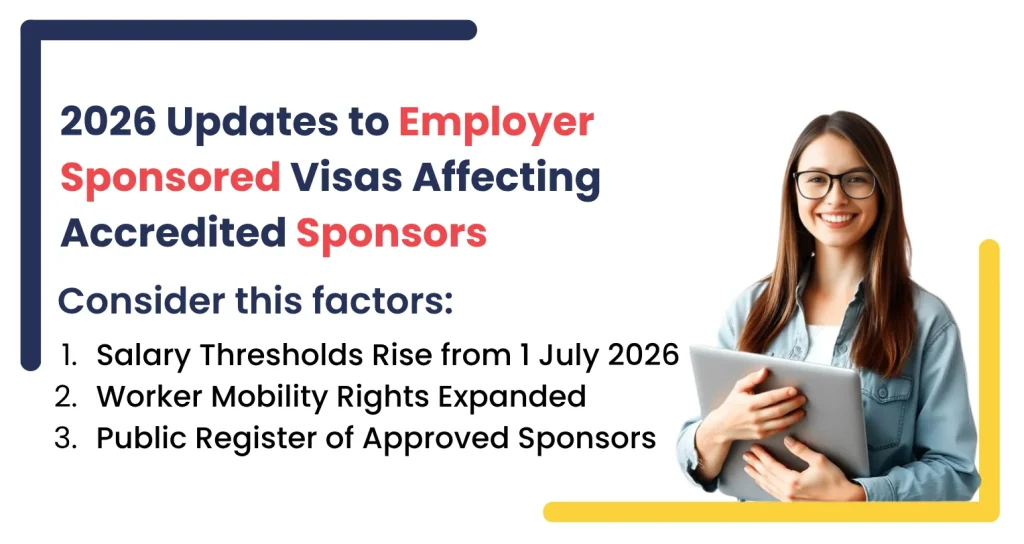
The employer-sponsored visa framework has changed substantially in 2026. Engineers and ICT professionals need to understand these updates before approaching any potential sponsor.
The Core Skills Income Threshold (CSIT) rises to AUD $79,499 from 1 July 2026, up from $76,515. The Specialist Skills Income Threshold increases to AUD $146,717. Superannuation, allowances, and performance bonuses cannot be used to meet these minimums. Employers must also pay the Annual Market Salary Rate (AMSR) if it exceeds the CSIT for the relevant role.
Sponsored workers now receive 180 days to find a new sponsor if employment ends, up from 60 days previously, subject to a 365-day lifetime cap per visa. Time worked with an approved sponsor in the same occupation can now count toward the two-year period required for Subclass 186 PR, even if the worker changed employers mid-visa.
The Migration Amendment (Combatting Migrant Exploitation) Bill 2025 passed both Houses on 1 April 2026 and is awaiting Royal Assent. Once enacted, it creates a publicly accessible register of approved work sponsors. Skilled workers will be able to identify accredited sponsors directly, adding another layer of value to the status.
An accredited sponsor nominates skilled workers for the same visa subclasses as a Standard Business Sponsor. The difference is speed, reduced friction, and fewer documentation hurdles. The main pathways available in 2026 are:
Visa | Type | Duration | PR Pathway |
Subclass 482 Core Skills | Temporary | Up to 4 years | Via 186 after 2 years |
Subclass 482 Specialist Skills | Temporary | Up to 4 years | Via 186 after 2 years |
Permanent | Permanent | Immediate PR | |
Subclass 494 Regional | Provisional | 5 years | Via 191 after 3 years |
The Specialist Skills stream is best suited for ICT architects and engineers in more senior roles with earnings of $146,717 or more. A role at this salary no longer needs to appear on the Core Skills Occupation List (CSOL), a major hurdle when sponsoring rare technical talents.
Targeting employers who hold accredited sponsor status is the fastest path to a resolved visa outcome in 2026. Here is how to identify and approach them effectively:
Meanwhile, prepare your skills assessment documentation before approaching any employer. The most common reason a willing accredited sponsor cannot proceed is that the worker does not yet hold a positive skills assessment outcome.
Our expert consultants will assess your profile and recommend the best pathway for your Australian migration goals.
Accredited sponsorship in Australia offers engineers and ICT professionals the fastest and most reliable route to an employer-sponsored visa in 2026. However, the pathway starts long before a nomination is lodged. Your skills assessment outcome determines whether any nomination, from an accredited or standard sponsor, proceeds at all.
CDRAustraliaEngineer provides complete documentation support for Engineers Australia CDR reports, ACS RPL assessments, and VETASSESS skills reports. Get your assessment right the first time, and your accredited sponsor can do the rest.
An accredited sponsor is a premium-tier employer with priority processing under five days, reduced documentation, flexible labour market testing, and police certificate exemptions. A Standard Business Sponsor is the baseline tier with no such benefits.
No. A positive skills assessment is still mandatory regardless of sponsor status. Accreditation speeds up visa processing, it does not replace the assessment.
Government agencies; Australian Trusted Traders; low-volume sponsors with at least 85% Australian workers; and high-volume sponsors with at least 75% Australian workers and a nomination approval rate above 97%.
Core Skills Income Threshold: AUD $79,499. Specialist Skills Income Threshold: AUD $146,717. Superannuation and allowances cannot be counted toward either figure.
Five years from the date of approval, aligned with the underlying Standard Business Sponsorship period.
Start with a free consultation. We assess your profile at no cost and guide you every step of the way.

Scan to Connect With Our Experts ⤴︎