
Online

One of the most straightforward visa pathways to move to Australia permanently is through the GSM pathway. General skilled migration is an option that doesn’t require an employer sponsor. They determine if you’re eligible based on your occupation, your qualifications, your English skills, your age, and your work experience.
Doing a points test, the Department of Home Affairs ranks each candidate. This is what many engineers, IT specialists, accountants, and tradespeople believe is their best opportunity to secure a stable future in Australia. There are a number of moving parts, though, which must come together in the proper sequence. One or more errors in determining an occupation code, or a partial assessment, can cost you months. There has also been an increased level of competition, and preparation has become more important than ever.
At cdraustraliaengineer.com, we help skilled migrants who don’t want to face those setbacks from the get-go. We create competency demonstration reports and provide support for Engineers Australia, ACS, VETASSESS, and TRA assessments.
This experience teaches us where applicants earn points and where they unnoticeably lose points. This article is about how GSM operates in reality as it relates to visa selection, visa invitation, and visa acceptance. You will discover the differences between the three types of visas and which authority will be assessing your visa. You will also learn how to construct an effective score that is competitive. Keep reading to make clear and confident decisions about what to do next.

Employer-sponsored visas restrict visa holders to a single employer and job. This is done completely in the GSM pathway. You are not evaluated upon a job offer but on your own profile. This independence provides you actual control over your migration result. The program consists of three visas: subclass 189, subclass 190, and subclass 491. They are all points-tested and all have occupations on the skilled occupation list. You also have to get a positive skills assessment, meet the English requirement, and be under 45 at the time of invitation.
A 65-point score is the lowest required to submit an expression of interest. In fact, the score of invited candidates is much higher, particularly for popular jobs. Do not use 65 as the goal number, but as the entry number. Competitive scores vary by program year and occupation, so please look for the most recent competitive scores.
Choosing the right subclass early shapes your timeline and your obligations after grant.
Visa | Type | Nomination | Bonus Points | Key Condition |
Subclass 189 | Permanent | None | None | Live anywhere in Australia |
Subclass 190 | Permanent | State or territory | 5 | Live in the nominating state for two years |
Subclass 491 | Provisional | State, territory, or eligible relative | 15 | Live and work regionally for three years |
The right subclass within the GSM pathway depends on your points score and your flexibility. The 189 offers the most freedom but demands the highest score. The 190 and 491 add bonus points through nomination in exchange for living in a particular state or region. Compare your own score and lifestyle plans against these conditions before you lodge anything. The sections below explain each visa in more detail.
Many applicants start with the 189 and later realize their score falls short. In that case, state nomination through the 190 is a practical next step. The 491 suit applicants with moderate scores who are open to regional life. After three years, it can lead to permanent residency through the subclass 191. Each state also sets its own rules, so check them before choosing a route. A short consultation with cdraustraliaengineer.com can help you compare your options with your actual profile.
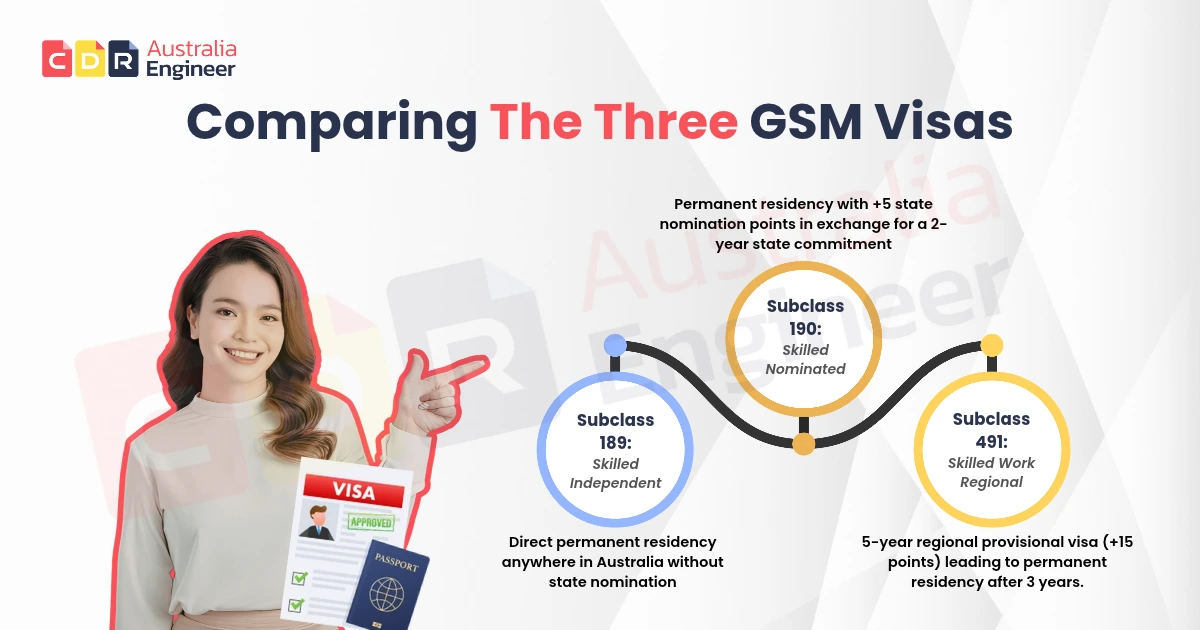
The subclass 189 grants permanent residency with no state nomination. You can live and work anywhere in Australia from the day of the grant. It is also the most competitive option within the GSM pathway. Applicants rely on strong English, solid experience, and a high base score. The occupation must appear on the MLTSSL to qualify.
The subclass 190 is also permanent but needs nomination from a state or territory. Nomination adds five points to your score. In return, you commit to living and working in that state for two years. Each state publishes its own occupation list and criteria, and these change often. Check state websites regularly before you lodge an expression of interest.
The subclass 491 is a provisional visa valid for five years. A nomination from a state, territory, or eligible relative adds fifteen points. You must live and work in a designated regional area. After three years and meeting income requirements, you can apply for permanent residency through the subclass 191. For applicants with moderate scores, this route often opens doors that remain closed elsewhere.
Our expert consultants will assess your profile and recommend the best pathway for your Australian migration goals.
GSM application development can not proceed without a positive skills assessment. The authority that assesses you depends on your occupation. Engineering occupations are assessed by Engineers Australia and ICT occupations by the Australian Computer Society. VETASSESS encompasses a large range of occupations and trades recognition. Australia is a body that evaluates trade qualifications. There are also bodies for accounting, quantity surveying, and health professions.
A competency demonstration report is required for engineers. It consists of career episodes, a summary statement, and a continuing professional development record. It takes time and understanding of the expectations of Engineers Australia to write well. That is where CDRAustraliaEngineer.com comes into effect most, as a robust CDR safeguards your timeline and your credibility. The processing time will vary from authority to authority and across the different types of cases. Always check the current times on the official website before arranging for your lodgement.
The points test rewards age, English, education, and experience. Applicants aged 25 to 32 earn the highest age score of 30 points. Superior English earns 20 points, while proficient English earns 10. Skilled employment, an Australian study, and a completed professional year all add points. Single applicants, and those with a skilled partner, earn additional points as well.
Three levers usually make the biggest difference. English improvement is often the cheapest and fastest way to gain points. A nomination from a state or region adds five or fifteen points. Australian work experience is also rewarded generously. Retake your English test if you sit just below a threshold. Ten extra points can change your standing completely.
Once your assessment and points are ready, you lodge an Expression of Interest through SkillSelect. The EOI is not a visa application. It simply places you in a ranked pool of candidates. The department issues invitations in rounds, starting with the highest scores. Invited applicants then have 60 days to lodge the visa application. Your EOI stays active for two years, and you can update it at any time. Keep it current whenever your English score, experience, or nomination status improves.
Common mistakes are surprisingly consistent:
The first step in every successful GSM application is the proper strategy. We start by examining your skills, experience, and desired field of work at cdraustraliaengineer.com. You are then mapped with your best assessing authority and visa subclass. Our writers create CDRs, ACS reports, supporting papers, etc., which reflect your true ability. Also, we can make a realistic estimation of your points so that you can make preparations to improve them early.
There are many clients who come in not knowing what to aim for between 189 or 190, or 491. A brief consultation typically resolves the best way. Once you are ready to move forward, please reach out to the team at cdraustraliaengineer.com and provide them with a custom assessment plan.
The minimum score to lodge an expression of interest is 65 points. Invitations usually require more, particularly for the subclass 189. State and regional nomination can lift your score by five or fifteen points.
No, you do not need an employer sponsor. Eligibility depends on your occupation, skills assessment, English level, age, and points score.
It depends on your score and your flexibility. The subclass 189 offers the most freedom, while the 190 and 491 improve your chances through nomination.
Timeframes differ between assessing authorities and depend on case complexity. Check the official website of your authority for current processing times before you plan.
Yes, onshore applicants can apply on a valid visa. Australian study and work experience may also add points to your total.
Start with a free consultation. We assess your profile at no cost and guide you every step of the way.

Scan to Connect With Our Experts ⤴︎

