
Online

The Overseas Qualification Assessment (OQA) is the Architects Accreditation Council of Australia (AACA) pathway for architects who hold an architecture qualification from outside Australia. It is used by applicants who want to work toward architect registration in Australia or need an AACA assessment for skilled migration.
AACA uses the OQA to assess whether an overseas architecture qualification is comparable to a current Australian-accredited qualification. It also checks your professional competencies against the 2021 National Standard of Competency for Architects (NSCA). This means the OQA looks at both what you studied and what you can demonstrate from your real project experience.
The competency assessment has three parts: a portfolio of 3 to 4 architectural projects, written summary statements, and a competency assessment interview. Many applicants have strong experience but lose strength in how they select, explain, and evidence their work.
This explains what the OQA is, who needs it, how the assessment works, and how to prepare a strong application. It also covers the portfolio, common mistakes, and what happens after your assessment, so you can plan each step with confidence.

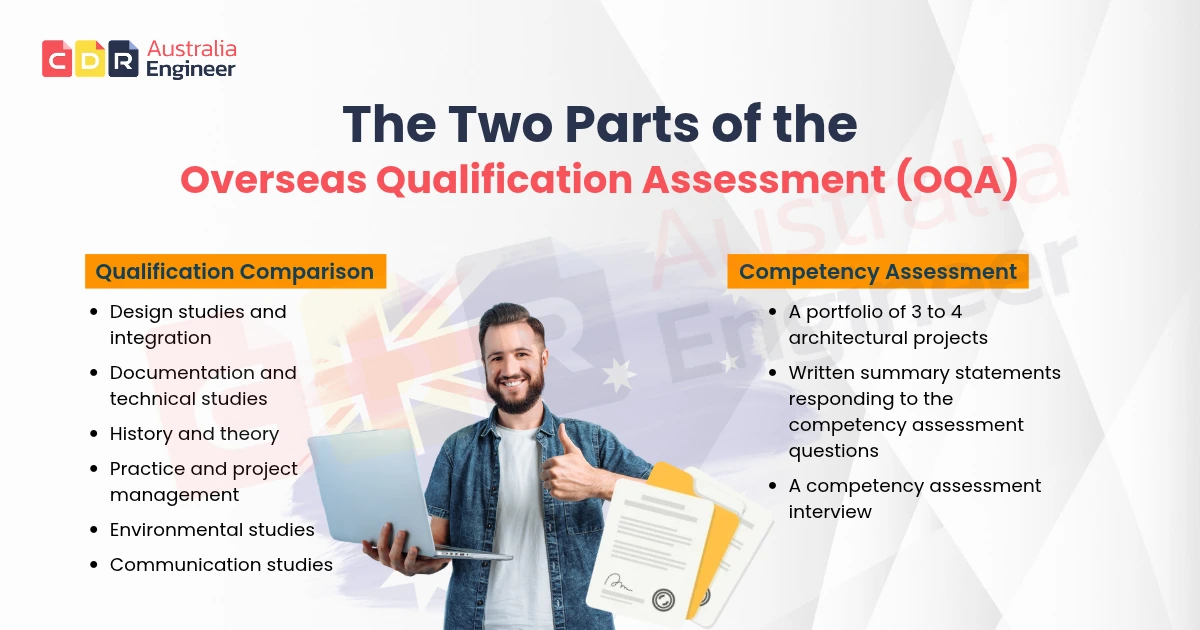
The Overseas Qualification Assessment (OQA) is AACA’s assessment program for overseas architectural qualifications. AACA uses it to determine whether an overseas academic qualification is comparable to a current Australian-accredited architecture qualification. This comparison is made against six prescribed subject core areas: design studies and integration, documentation and technical studies, history and theory, practice and project management, environmental studies, and communication studies.
The Overseas Qualification Assessment also looks at your competencies. Applicants must demonstrate the relevant requirements of the 2021 National Standard of Competency for Architects (NSCA), using evidence from their education and professional experience. A degree alone is not enough. Assessors want to see that you can apply architectural knowledge in real projects.
The OQA competency assessment consists of a portfolio of 3 to 4 architectural projects, written summary statements responding to the competency assessment questions, and a competency assessment interview. Each part supports the others, so your evidence, statements, and interview answers should be consistent.
The Overseas Qualification Assessment (OQA) is relevant for architects who are seeking a pathway toward registration in Australia and for those who need an AACA assessment for skilled migration purposes. A suitable outcome can also contribute toward progression to the Architectural Practice Examination (APE), where applicable.
The Overseas Qualification Assessment (OQA) may be relevant if you:
If one or more of these apply to you, the OQA is likely the pathway you need to understand first. It checks both your overseas qualification and your competencies against the 2021 NSCA, so it suits architects who want their education and real project experience recognized in Australia. Whether you studied recently or have many years of professional practice, the assessment looks at how your knowledge and project work compare with Australian expectations.
Eligibility and requirements can change, so always check the latest AACA guidance before you apply. Confirming the current requirements early helps you choose the right projects and avoid delays later in the process. It also gives you time to gather drawings, project documents and academic records, so your evidence is organized before you start writing your summary statements.
Our expert consultants will assess your profile and recommend the best pathway for your Australian migration goals.

The portfolio is the core evidence in your competency assessment. AACA requires 3 to 4 architectural projects and does not accept more than four.
Your projects should demonstrate your architectural knowledge, your decisions, and your individual contribution, supported by drawings, sketches, or other documentation. AACA recommends including a student or academic project, such as a final design project, because it can be a useful basis for discussion in the interview. Professional projects can also be included.
Your written summary statements are a key part of the Overseas Qualification Assessment (OQA). They should address the relevant NSCA competency areas and respond to the competency assessment questions for the 2021 National Standard of Competency for Architects.
Each claim should connect to specific evidence in your projects, so assessors can see where it is supported. If you say you resolved a design, technical, or environmental challenge, point to the drawings, sketches, or documentation that show it. A clear link between each statement and its evidence makes your application easier to assess.
Generic descriptions of architectural practice are much weaker than specific examples from your own work. Instead of describing what architects usually do, explain what you did on the project, the decisions you made, the knowledge you applied, and the challenges you addressed. Be clear about your personal contribution, especially on team projects, and avoid presenting team achievements as your own.
Your statements should also match the rest of your OQA application. Project details, dates, and responsibilities need to be consistent across your portfolio and statements, because the same information will come up again in the competency assessment interview.
The competency assessment interview is part of the Overseas Qualification Assessment (OQA). It follows your portfolio and written summary statements, and it gives assessors the chance to confirm that your evidence reflects your own knowledge and experience.
You should be ready to explain your projects, your responsibilities, your design and technical decisions, and the knowledge you applied. Expect to talk about what the project involved, what your role was, why you made certain choices, and how your work relates to the relevant 2021 NSCA competencies. If you worked as part of a team, be ready to clearly identify what portion of the project was your own work.
Only list projects that you know inside and out and can speak to confidently. If you can’t explain the decisions that went into a project, it can turn into a liability in the interview—even if it sounds good on paper. And that’s why AACA suggests you include a student or academic project such as a final design project; it’s one you can typically talk about at length.
Prepare by reviewing each project in your portfolio and rereading your written statements. Prepare to reference drawings and documentation that support each statement and for your responses to be consistent with the project information you supplied. Consistency between your portfolio, your statements, and your interview answers makes your application more credible.
Once you submit your Overseas Qualification Assessment (OQA) documents, AACA reviews them before the competency assessment interview. After reviewing your documents, AACA may give feedback or ask for additional information. If you receive a request, respond clearly and keep your answers consistent with the projects, statements, and evidence you already submitted.
A suitable outcome gives you an outcome letter, which can contribute toward progression to the Architectural Practice Examination (APE), where applicable. The APE is a separate step, and eligibility requirements apply, so check AACA’s current guidance to confirm what you need after your OQA.
A skilled migration assessment can also be provided on request. If you are applying for the OQA for migration purposes, make this request when you apply so that your outcome can support your visa plans.
Because the process can involve feedback, an interview, and further steps, it helps to plan your OQA application early. A well-organized portfolio, clear written statements, and confident interview preparation give you the best chance of a smooth outcome.
If you are preparing for the OQA, CDRAustraliaEngineer can help you organize your projects, strengthen your evidence, and prepare with confidence. Support can include:
It is AACA’s assessment program for architects with overseas qualifications. It checks whether your qualification is comparable to a current Australian-accredited architecture qualification and assesses your competencies against the 2021 NSCA.
Architects with a qualification obtained outside Australia who want to pursue registration, skilled migration assessment, or recognition of their competencies.
A portfolio of 3 to 4 architectural projects, written summary statements, and a competency assessment interview.
Three to four. AACA does not accept more than four.
Yes. AACA recommends including a student or academic project, such as a final design project, as it can support discussion in the interview.
Start with a free consultation. We assess your profile at no cost and guide you every step of the way.

Scan to Connect With Our Experts ⤴︎

