
Online
Today

CDR Australia Engineer

Automotive Electrician | ANZSCO Code: 321111

An Automotive Electrician is a skilled trade professional responsible for installing, maintaining, and repairing electrical wiring and electronic components in motor vehicles. These tradespeople work on heavy machinery, passenger cars, commercial trucks, and increasingly electric and hybrid vehicle platforms under ANZSCO 321111. This occupation is assessed by VETASSESS (on behalf of Trades Recognition Australia (TRA)) for Australian skilled migration purposes. The assessment evaluates trade qualifications, on-the-job training, and practical competency against the Australian standard for ANZSCO 321111.

This occupation is listed on Australia’s skilled occupation lists, making it a viable pathway to permanent residency through skilled migration and employer-sponsored visas. Qualified candidates are in a strong position to secure both employment and migration outcomes due to Australia’s EV sector’s rapid growth and ongoing skilled trade gaps.
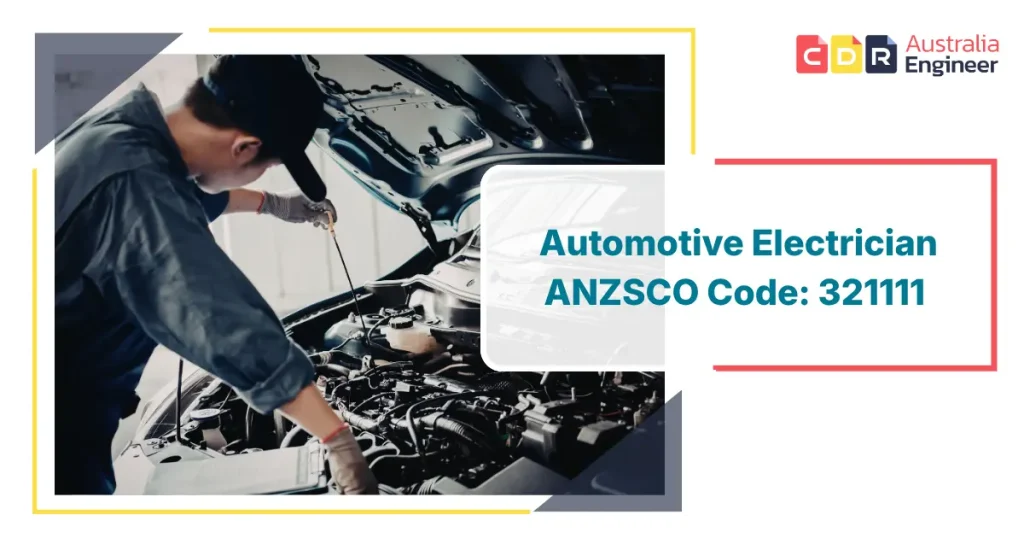
Automotive Electrician | ANZSCO Code: 321111 skills and job opportunities

Skills Required for ANZSCO 321111

To achieve a positive VETASSESS skills assessment for ANZSCO 321111, applicants must demonstrate strong technical, diagnostic, and safety competencies specific to vehicle electrical systems.

Core Technical Skills

  • Installing and maintaining electrical circuits and wiring in vehicles
  • Using diagnostic scanners and testing equipment
  • Swapping out sensors, electrical components, and assemblies
  • Connecting vehicle accessories to power systems
  • Reading automotive wiring diagrams and manuals

Modern Industry Skills

  • Diagnosing hybrid and electric vehicle (EV) systems
  • ADAS calibration and fault diagnosis
  • ECU programming and reprogramming
  • Testing CAN bus communication and diagnostics
  • Installing aftermarket automotive electrical accessories

Soft Skills

  • Strong troubleshooting and fault-finding skills
  • Focus on WHS and workshop safety standards
  • Accurate testing and repair documentation
  • Technical communication with customers and workshop teams

Demand and Market Trends in Australia

Across Australia, demand for trade-qualified vehicle electricians continues to rise, driven by advanced vehicle technologies, greater electronic integration, and a shortage of skilled automotive professionals.

Why Demand Is High

  • Rapid growth of electric vehicle (EV) and hybrid markets
  • Increasing electronic complexity in modern vehicles
  • Insufficiently skilled automotive electrical technicians across the country
  • Strong demand in mining and resource industries (WA & QLD)
  • Ongoing opportunities in defence and fleet maintenance sectors

Job Market Overview

  • Excellent job opportunities in Australia’s largest cities
  • High local demand, particularly in mining regions of Queensland and Western Australia
  • Expanding EV dealership and servicing networks

Employer sponsorship opportunities for qualified professionals

Career Path in Australia

Entry Level (Apprentice Technician)

  • Assists with routine testing and component replacement
  • learns about testing, wiring, and workshop safety procedures.
  • Develops diagnostic skills under supervision

Qualified Trade Technician

  • Identifies and fixes automotive electrical problems
  • Works on conventional, hybrid, and EV systems
  • Manages job cards and repair estimates

Senior Trade Technician

  • Handles advanced ECU and CAN bus diagnostics
  • Resolves complex electrical system faults
  • Coordinates with suppliers and mentors apprentices

Workshop Supervisor / Fleet Electrical Specialist

  • Oversees maintenance schedules and workshop operations.
  • Manages quality assurance and technical compliance
  • Ensures WHS and manufacturer servicing standards

Skill Level

Skill Level 3 (Trade Occupation)

This trade occupation is classified as Skill Level 3 under the ANZSCO framework. This typically requires:

  • AQF Certificate III in Automotive Electrical Technology (AUR30320)
  • Minimum two years of workplace training
  • AQF Certificate IV may also be accepted
  • Three years of relevant experience may substitute formal qualifications
  • State or territory licensing may be required
  • Practical competency in AUR30320 core and elective units required

Skill Assessment Authority

For migration purposes, ANZSCO 321111 is assessed by VETASSESS, which conducts trade skills assessments on behalf of Trades Recognition Australia (TRA).

  • Stage 1: Review of qualifications, employment history, and training records
  • Stage 2: Practical assessment or technical observation report
  • OSAP pathway for offshore applicants
  • MSA pathway for onshore applicants
  • JRP pathway for international trade graduates

Specializations

  • Light Vehicle Technician
  • Heavy Vehicle Technician
  • Electric Vehicle (EV) Technician
  • Diesel and Plant Equipment Electrician
  • Marine Vehicle Electrician
  • Automotive Alarm and Security Installer
  • ADAS Calibration Technician
  • Fleet Electrical Specialist
  • Auto Air Conditioning Electrical Technician
  • Automotive Aftermarket Accessories Installer

Occupation Lists Overview

On the Occupation Lists

  • Subclass 189 – Skilled Independent Visa
  • Subclass 190 – State/Territory Sponsored Visa
  • Subclass 491 – Skilled Work Regional (Provisional) Visa
  • Subclass 186 – Employer Nomination Scheme (ENS)
  • Subclass 494 – Skilled Employer Sponsored Regional (Provisional) Visa
  • Subclass 482 – Temporary Skill Shortage (TSS) Visa
  • Subclass 407 – Training Visa
  • Subclass 485 – Temporary Graduate Visa

Occupation Category under Unit Group 3211

  • 321111 Automotive Electrician

Have Any Question?

ChatGPT said:

CDRaustraliaengineer specialises in high-quality CDR pathway reports for engineers. We offer low-cost, customised, and reliable services tailored to meet Engineers Australia’s standards.

Meet our Expert

Pratima Joshi

"Skill Assessment Expert"

Have Any Question?

ChatGPT said:

CDRaustraliaengineer specialises in high-quality CDR pathway reports for engineers. We offer low-cost, customised, and reliable services tailored to meet Engineers Australia’s standards.

Job Outlook for ANZSCO 321111

Weekly Earnings (Median)

AUD $1,450 – $1,750 per week

Full-time Employment Share

~85%

Average Full-time Hours

40–44 hours per week

Female Share

~3%

Median Age

35–38 years

Workforce Size

~11,000 – 13,000 workers

Employment Growth (Annual)

Growing — driven by EV expansion and trade shortage

Industry Demand

Automotive retail, mining, defence, fleet management

5-Year Outlook

Strong growth, particularly in EV and heavy vehicle sectors

Alternative Title

Automotive Electrical Fitter


Visa Options for Electrician (General)

Qualified electricians can access Australian permanent residency and temporary work visas through several pathways, depending on migration skills assessment outcome, work experience, and points score.

Skilled Migration Visas

  • Subclass 189 – Skilled Independent Visa
  • Subclass 190 – Skilled Nominated Visa
  • Subclass 491 – Skilled Work Regional Visa

Employer-Sponsored Visas

  • Subclass 186 – Employer Nomination Scheme Visa
  • Subclass 482 – Temporary Skill Shortage Visa
  • Subclass 494 – Skilled Employer Sponsored Regional Visa

Other Pathways

  • Subclass 485 – Temporary Graduate Visa
  • Subclass 407 – Training Visa

English Language Requirement

Test

Overall

Minimum

IELTS

6.0 – 7.0

Minimum 6.0 in each band (Listening, Reading, Writing, Speaking)

OET

B

Minimum B in all sections

TOEFL iBT

60 – 94+

Minimum section scores vary depending on visa subclass

PTE Academic

50 – 65

Minimum 50 in each component


Qualification Requirements

Applicants typically need the following to obtain a successful VETASSESS/TRA skills assessment:

  • AQF Certificate III in Automotive Electrical Technology (AUR30320)
  • Minimum two years of workplace training
  • AQF Certificate IV in relevant automotive electrical field
  • Three years of experience can replace the formal qualifications.
  • Employment history matching ANZSCO 321111 duties
  • Experience in diagnostics, installation, and electrical repairs
  • Licensing from a state or territory may be necessary.

Tasks Performed

  • Using diagnostic tools to identify vehicle electrical faults
  • Installation and replacement of wiring, sensors, and electronic components
  • Connecting vehicle accessories to power systems
  • Repairing alternators, starters, lighting, and control modules
  • Identifying issues with the CAN bus, airbags, ABS, and engine management
  • Installing and programming aftermarket automotive accessories
  • Maintaining workshop records and safety compliance documentation

Automotive Electrician vs Electrician (General) (ANZSCO 321111 vs 341111)

Automotive Electrician (ANZSCO 321111)

  • Specialises in the electrical and electronic systems of motor vehicles and heavy equipment
  • Works in workshops, dealerships, fleet operators, mining sites, and EV service centres
  • Requires AQF Certificate III in Automotive Electrical Technology (AUR30320)
  • Assessed by VETASSESS on behalf of TRA; alternative title: Automotive Electrical Fitter

Electrician General (ANZSCO 341111)

  • Installs and maintains electrical systems across residential, commercial, and industrial buildings
  • Works across construction, infrastructure, and maintenance environments
  • Requires Certificate III in Electrotechnology Electrician and state-based licensing
  • Covers a broader scope of electrical work beyond vehicles

Key Differences

While both are Skill Level 3 trade occupations assessed through TRA pathways, ANZSCO 321111 specializes in vehicle electrical systems, whereas an Electrician General works across the full range of building and infrastructure electrical installation and maintenance. Selecting the correct ANZSCO code is crucial, as submitting under the wrong occupation will result in a delayed or rejected skills assessment outcome.

Final Thoughts

ANZSCO 321111 is a highly relevant trade occupation for skilled migration to Australia, with strong employment demand across the automotive, mining, defense, and fleet management sectors. The accelerating growth of electric vehicles in Australia makes this an increasingly future-proof trade with long-term career and migration prospects.

However, achieving a successful outcome requires qualifications and documented work history that clearly meet TRA and VETASSESS requirements. Errors in documentation or incorrect pathway selection are among the most common causes of delays and rejected assessments.

Remember Us

If you need assistance with your skills assessment for this trade occupation, our team at CDRAustraliaEngineer is here to help. We provide end-to-end guidance tailored to your profile, helping you navigate the entire assessment process and avoid common errors that lead to delays or rejection.

We assist with:

  • Skills assessment preparation for VETASSESS trade occupations
  • Detailed document review and verification to ensure TRA compliance
  • Accurate ANZSCO code selection based on your specific duties and experience
  • Guidance on Australian skilled migration and PR visa pathways
  • Support for reapplications and previously unsuccessful VETASSESS assessments

Looking for expert CDR Writer for Engineers Australia?

Creating a CDR Report may be difficult due to Engineers Australia’s standards and rules ( EA ). Our experienced engineers have assisted many people in obtaining approval for their report from the EA via the use of powerful projects.

People Also Ask

An automotive electrician installs, maintains, and fixes electrical wiring and electronic parts in cars. They also perform ECU programming, component replacement, fault diagnosis, and high-voltage system servicing for hybrid and electric vehicles.

Yes. Demand is strong due to Australia’s growing electric vehicle market, the increasing electronic complexity of modern vehicles, and ongoing skilled trade shortages in the automotive sector. Demand is particularly high in the mining regions of Western Australia and Queensland.

The skills assessment for this occupation is conducted by VETASSESS on behalf of Trades Recognition Australia (TRA). The assessment involves a two-stage process documentary evidence review followed by a technical assessment and must be completed before lodging most skilled migration visa applications.

Applicants need an AQF Certificate III in Automotive Electrical Technology (AUR30320) with at least two years of on-the-job training or an AQF Certificate IV. In certain pathways, formal qualifications may be replaced with three years of relevant experience.

Professionals in this trade earn a median weekly wage of approximately AUD $1,450 to $1,750 per week in full-time roles. Senior technicians, EV specialists, and those working in the mining sector can earn considerably more depending on location and employer.

Yes. This occupation is eligible for permanent residency through Subclass 189, 190, and 491 visas, plus employer-sponsored pathways including Subclass 186 and 482. A positive VETASSESS/TRA skills assessment is required first.