
Online

Computer engineer salary in Australia is one of the first things overseas applicants check before committing to a skilled migration pathway. Current 2026 market data puts the average between AUD $82,300 and AUD $100,000 a year, with senior specialists in networking, systems architecture, and cloud infrastructure clearing well beyond AUD $150,000. Demand keeps climbing as banks, mining companies, telcos, and government agencies expand their network and systems teams to support cloud migration and cybersecurity upgrades.

Detail | Information |
Occupation | Computer Network and Systems Engineer |
ANZSCO Code | 263111 |
Skill Level | 1 (Bachelor Degree or higher, ICT major) |
Assessing Authority | Australian Computer Society (ACS) |
RPL Pathway Available | Yes, for non-ICT-major applicants |
Average Salary 2026 | AUD $82,300 – $100,000 |
Entry-Level Salary | AUD $53,400 – $65,000 |
Senior-Level Salary | AUD $109,500 – $170,000+ |
Skilled list status changes with each government update, so always confirm your occupation’s current MLTSSL or CSOL standing directly with ACS before lodging an Expression of Interest. One more thing worth flagging: “Computer Engineer” is not itself a formal ANZSCO title. It’s used across industry and job boards to describe several closely related occupations, and ANZSCO 263111 is the closest and most common match for professionals working across networks and systems, but engineers with a hardware, electronics, or telecommunications-heavy background should confirm the right code with ACS or Engineers Australia before assuming this is their pathway.
Jobted’s 2026 data puts the average computer engineer salary in Australia at AUD $82,300 gross per year, roughly AUD $6,860 a month, about 18% above the national average wage. Indeed’s figures place the average closer to AUD $86,727, while SEEK’s job-ad data shows a typical advertised range of AUD $90,000 to $100,000. The title is representative of popularity and adoption for this domain and range of activities, including but not limited to; Network Engineering, System Integration, Embedded Hardware and Infrastructure.
The jump from entry to senior figures is massive – entry-level under 3 years gets approximately $53,400-$54,200 per annum. By the ten-to-twenty-year mark, senior computer engineers commonly earn AUD $109,500, with top-end roles in finance, defence, and mining exceeding AUD $170,000 once bonuses and allowances are included.
Experience | Typical Salary (AUD) | Notes |
Entry-level (0–3 years) | $53,400 – $65,000 | Graduate and junior network roles |
Mid-career (4–9 years) | $74,300 – $110,000 | Project ownership, specialisation begins |
Senior (10–20 years) | $109,500 – $170,000+ | Architecture, leadership, chartered status |
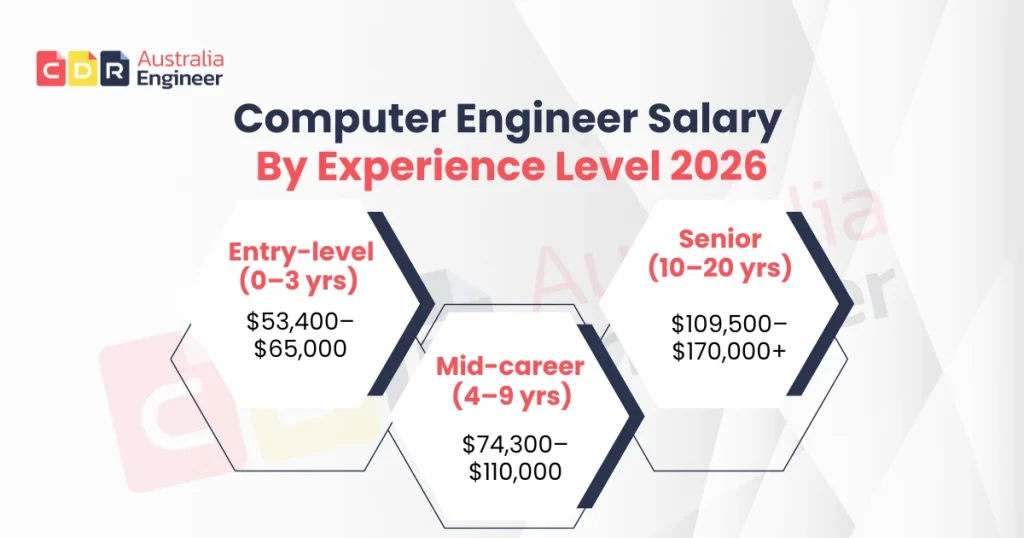
Moving from entry-level to senior pay brackets is rarely a straight line of annual raises. Engineers who switch employers every two to three years, add a specialisation such as cybersecurity or cloud networking, and pick up vendor certifications tend to reach the upper brackets faster than those who stay with one employer long-term.
CDR australiaengineer specialises in high-quality CDR, RPL and VETASSESS reports for engineers. We offer low-cost, customized and reliable services in diverse engineering disciplines.
Factor | Computer Engineer | Software Engineer |
ANZSCO Code | 263111 | 261313 |
Average Salary 2026 | $82,300 – $100,000 | $105,000 – $130,000 |
Senior Salary | $109,500 – $170,000+ | $150,000 – $200,000+ |
Core Focus | Networks, systems, hardware-software integration | Application and software development |
Assessing Body | ACS | ACS |
A software engineer salary in Australia typically sits higher, mainly because pure software roles concentrate in high-paying finance and big-tech employers in Sydney and Melbourne. Computer engineers work across networking, systems administration, and infrastructure, sectors that pay well but skew slightly lower on average. Both occupations fall under ACS, so overseas applicants often assess against whichever code most closely matches their actual work history.
Demand for computer and network engineers remains steady into the back half of 2026, driven by enterprise cloud migration, expanded cybersecurity budgets, and continued investment in critical infrastructure across mining, defence, and finance. Jobs and Skills Australia continues to flag ICT-adjacent occupations, including network and systems engineering, among the roles where local supply has not kept pace with demand, which is why the occupation remains a realistic target for skilled migration even as broader software-only hiring slows in places.
Regional tech hubs outside Sydney and Melbourne, particularly Brisbane, Adelaide, and Perth, are absorbing a growing share of network and infrastructure roles. For applicants weighing a regional visa such as the Subclass 491, this matters: regional nomination adds extra SkillSelect points, and regional employers are increasingly competitive on pay for this occupation.
Specialisation | Typical Salary Uplift | Why It Pays More |
Cloud Networking (AWS/Azure) | +$15,000 – $30,000 | Every enterprise migration project needs it |
Cybersecurity & Network Security | +$20,000 – $35,000 | Regulatory pressure and breach risk |
DevOps / Infrastructure Automation | +$15,000 – $25,000 | Bridges systems engineering and software delivery |
Embedded Systems & IoT | +$10,000 – $20,000 | Niche hardware skill set, fewer qualified applicants |
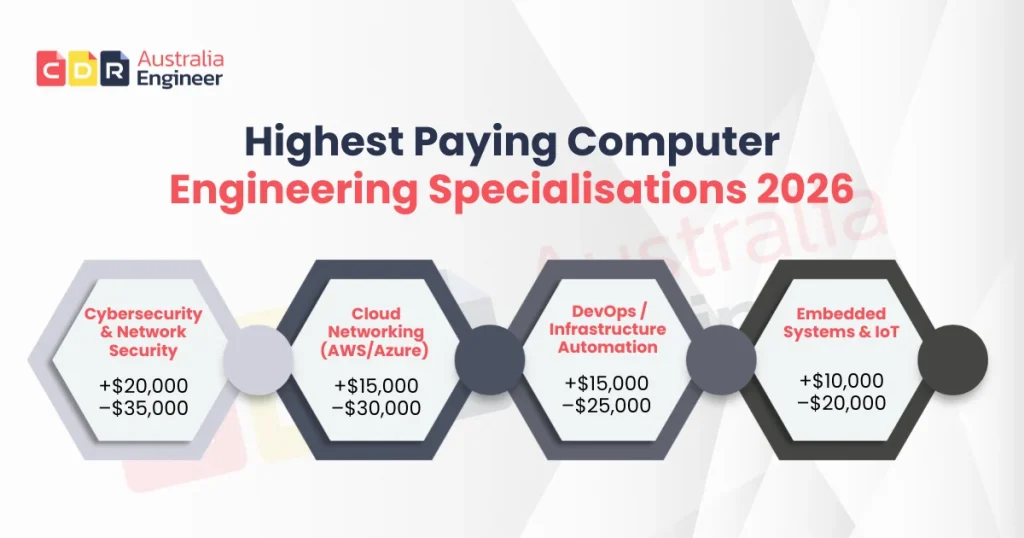
These uplifts sit on top of the base salary bands already covered above and compound with seniority. A senior engineer with a cybersecurity specialisation and a relevant certification is often the one clearing $170,000-plus, while a generalist network engineer at the same experience level typically sits mid-bracket.
Banks and insurers, particularly the big four and their technology subsidiaries, pay above the ICT-wide average for network and systems roles because outages carry direct financial and regulatory consequences. Western Australia and Queensland mining firms, on the back of a shortage of specialist engineers with experience in industrial control systems and remote site connectivity pay a healthy bonus to engineers happy to take FIFO rosters, along with South Australian government departments and AUKUS-linked defense contractors paying good base pay and a clearance allowance (which makes the job tricky until permanent residency is attained), and telecommunications and cloud-native tech companies.
For internationally qualified professionals, access to a competitive computer engineer salary starts with a positive ACS skills assessment against ANZSCO 263111, not with a job offer. If your degree carries a closely related ICT major, ACS assesses your qualification directly. If it doesn’t, or you hold no formal ICT qualification, the RPL pathway lets you demonstrate equivalent knowledge through two detailed project reports and Key Areas of Knowledge responses.
Once your assessment is positive, you can lodge an Expression of Interest through SkillSelect and pursue the Subclass 189 independent visa, a state-nominated 190 or 491, or an employer-sponsored 482 leading to a 186. Each pathway opens a different route to the salary ranges outlined above, and your points score determines which one is realistic.
Our expert consultants will assess your profile and recommend the best pathway for your Australian migration goals.
Reaching the upper end of the range is rarely accidental. It comes down to deliberate choices around documentation, specialisation, and timing, particularly for overseas applicants building a migration strategy and a career strategy at once.
Computer Engineer salaries in Australia for 2026 range anywhere from $53k to over $170k with business spending on networks, cloud services and IT security infrastructure maintaining strong demand for tech professionals. Getting there as an overseas professional depends on one document above all others: a correctly matched ANZSCO code and a positive ACS assessment. CDR Australia Engineer prepares ACS RPL project reports, Key Areas of Knowledge responses, and full skills assessment documentation for computer and network engineers pursuing skilled migration. Speak to our team before you lodge your application.
Current data places the average computer engineer salary between AUD $82,300 and $100,000 a year, with senior specialists earning $109,500 to over $170,000 depending on industry and location.
Most computer engineers migrate under ANZSCO 263111, Computer Network and Systems Engineer, which is assessed by the Australian Computer Society (ACS).
Yes. The ACS RPL pathway allows applicants without a closely related ICT qualification to demonstrate equivalent skill through two project reports and Key Areas of Knowledge responses.
Software engineers average somewhat higher pay, roughly $105,000 to $130,000, because software-specific roles concentrate in high-paying finance and technology employers, while computer engineers work across networking, systems, and infrastructure.
This course has a General Skills fee of $1,498 excluding GST. Or, choose the RPL stream for an individual cost of $625 excluding GST if you have a minimum of 6 years experience and no formal IT qualification.
Start with a free consultation. We assess your profile at no cost and guide you every step of the way.

Scan to Connect With Our Experts ⤴︎