
Online

Whether you’re migrating or working in Australia, one of your first steps is to get your APharmC skills assessment correct—it’s an overseas-trained pharmacist! Whether your overseas qualifications and competencies meet the Australian requirements to practice as a pharmacist in Australia will be determined by the Australian Pharmacy Council assessment. It is not a trivial step—it is a necessary step for most of the skilled categories of visas, and it is necessary for provisional registration with the Pharmacy Board of Australia. The APharmC skills assessment is not based on years of service or location of service training; it is based on the stream of qualification (whether or not the stream is recognized by APharmC) and the knowledge and competency requirements for each stream. This may lead to varying routes to assessment for two pharmacists having the same academic qualifications and qualification history in both countries of qualification and registration.
We help overseas-trained pharmacists to write an acceptable application for the APC skills assessment, which meets the requirements of the Australian Pharmacy Council. Each phase is explained in such a way that you can take a logical approach to the process and provide documentation that reflects a consistent and credible application.
The Australian Pharmacy Council (APharmC), also known as the APC skills assessment body, is the body to assess the skills and competencies of overseas-trained pharmacists working in Australia or wishing to migrate to Australia. A Skills Assessment Outcome (SAO) is an outcome of this assessment required for a Skilled Migration visa and AHPRA Registration.
Overall, the assessment reflects overall endorsement:
It is not designed to validate a particular overseas credential, such as a pharmacy degree, but to validate a qualification and competency to be comparable to the Australian standard.
Please note that the stream you are being assessed on is not a “one size fits all” process, as the APharmC skills assessment is not. It looks at your experience of competence and your status of registration—not just the path or work you have undertaken to get registered as a pharmacist elsewhere. If two candidates who have similar-looking CVs are chosen for different streams, it may be because of where they have earned the qualification, if it is recognized, and whether the candidate has been registered elsewhere. This classification influences all the following activities in the process, such as the exam you will be taking and how you will document the activities.
What’s often confused with the skills assessment and the registration to practice is that there’s no distinction. The APharmC skills assessment is designed to establish one thing: that your qualification and competency from overseas is actually equal to it in Australia. It does not as such confer any rights of practice. The skills assessment is a separate legal process to become a pharmacist in Australia; the Pharmacy Board of Australia conducts this process. In practical terms, an APC skills assessment is a record of qualification and competency—it is not a license or certificate, your eligibility for registration is determined separately by AHPRA based on its own separate criteria, and, in most cases, a positive skills assessment result is a necessary first step to provisional registration and does not replace it.
A surprising number of people make this mistake when they apply. Once they receive confirmation that they have passed a skills assessment, many will consider themselves job-ready to go and start practicing, but they are not. The pathway can be broken down into two phases: skills assessment and registration with AHPRA, which each have their own requirements, time to complete, and documentation. Registration is not a part of the assessment and will not be completed at the same time. If the applicant is not familiar with this distinction at the outset, they may make the wrong computation and end up waiting longer to start working in Australia when they are able to
For those who have a particular pathway and method of qualification, follow the following pathways in the application:
Competency Stream: A pharmacist who has completed his pharmacy degree in another country is not included in the above streams. The usual requirement for applicants under this stream would be that they pass the CAOP (Competency Assessment of Overseas Pharmacist) exam to demonstrate their competence in their work in an Australian environment, in practical terms.
Knowledge Stream: For pharmacists who have been qualified outside of Australia, Canada, Ireland, New Zealand, the UK, or the USA. This stream’s examination is the Overseas Pharmacist Readiness Assessment (OPRA), which is a new examination that replaced the old examination called Knowledge Assessment of Pharmaceutical Sciences (KAPS).
International Student Stream: Requiring that applicants have successfully completed an accredited program as an international student from an approved Australian or New Zealand qualifying pharmacy program.
New Zealand Stream: Based on the country’s registration and qualification recognition for practicing pharmacists in New Zealand.
The most critical part of the process is choosing the right stream in the beginning, as it would be easy to get a delay in the application process by trying the wrong stream.
The Knowledge Stream has been changed, but references to the KAPS exam will still be observed in most of the pharmacist’s research on the subject of assessment, as this was the body of knowledge assessed for pharmacists and has been used for many years. However, from 2025, OPRA officially discontinued KAPS, and the final KAPS exam was conducted in November 2024, and from 2025 onwards, the OPRA exam will be the only recognized exam for overseas pharmacists applying for provisional registration.
The OPRA exam assesses the knowledge and skills of a candidate to ensure they are ready to practice safely in Australia and has an emphasis on the biomedical, pharmaceutical, and clinical sciences underpinning the practice of pharmacy in Australia and New Zealand. It does not examine issues that are specific to the Australian (or NZ) context of pharmacy practice (e.g., legislation, practice standards), as these are covered during the internship period.
Applicants who are preparing for the OPRA exam must have the following information:
As a result of replacing the KAPS with OPRA, it is suggested that you always refer to the current information and requirements on the official APC candidate portal—and not to information that is outdated and refers to the KAPS exam.
A good application will probably require:
Academic Documentation
Registration Evidence
English Language Proficiency
Identification and Translation
This assessment will normally be required for overseas-trained pharmacists wanting to work or migrate to Australia. This includes:
If you are looking to make a career of working in pharmacy, there are many careers and occupations that are available. One of those careers may be a hospital pharmacist (ANZSCO 251511) or a retail pharmacist (ANZSCO 251513).
This is something that is important to verify if you’re not sure which visa subclass you’d be applying for, as it may impact your documentation and processing stream.
Our expert consultants will assess your profile and recommend the best pathway for your Australian migration goals.
Delays at the assessment stage may also be caused because of avoidable problems, despite having good academic qualifications. Common problems include:
Many of these problems arise because the process is being thought of as just a formality, not detailed and based on evidence. From the beginning, it is important to make it correct to establish the stream and avoid unnecessary delays in document preparation and exam preparation.
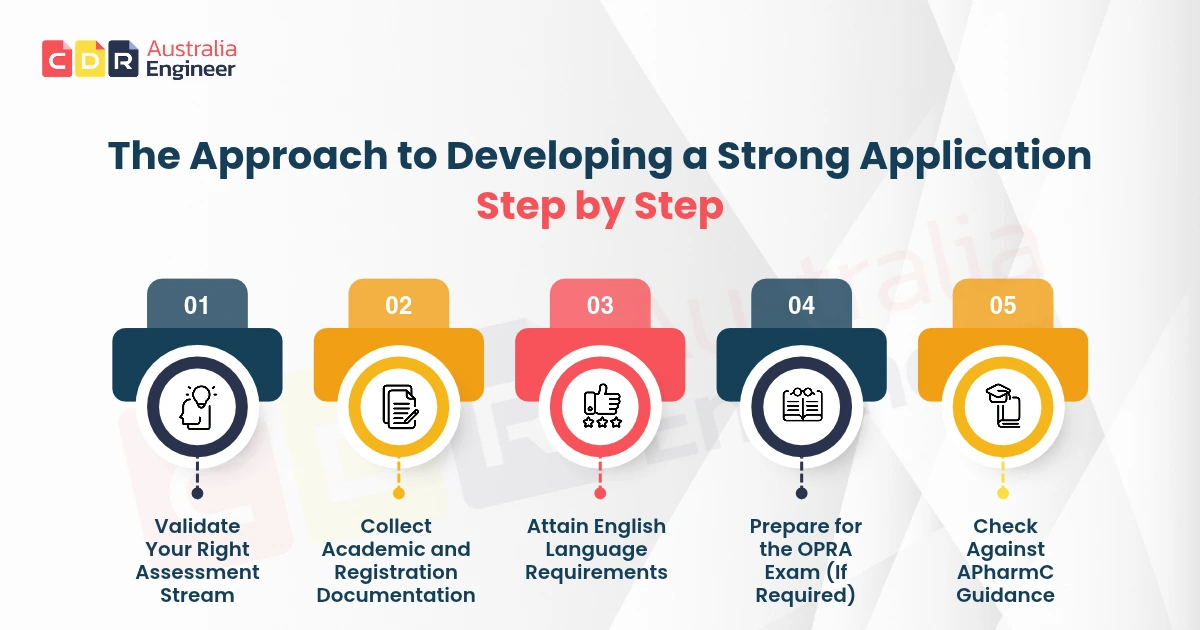
Determine your qualification background, country of training and registration, etc., and decide whether you are in the competency, knowledge, international student, or New Zealand stream.
As the Second Step, Academic and Registration Documentation Is Needed. Submit certified copies of degree, transcript, and current or previous registration (must be certified as required by APharmC).
Take an English language proficiency test such as IELTS; ensure you get to the minimum requirement in each part before applying.
The new exam is the Knowledge Stream; if you are in this exam, be sure to prepare for the current exam early rather than the old KAPS (no longer offered) in the biomedical, pharmaceutical, or clinical science areas.
The Australian Pharmacy Council has a comprehensive, up-to-date set of requirement documents for each stream and exam. Please make sure to use this as your main reference before you submit an application.
Knowledge of the assessment framework alone is not enough; a competent choice of stream as well as thorough and accurate documentation is required. When it comes to the process of applying for an OPRA, it’s crucial to invest time and effort at the beginning so that an applicant doesn’t find themselves in a situation where they have to wait longer in the future if the pathway is not confirmed or if they aren’t ready and prepared for the current OPRA exam. The goal is to get an application that can be submitted during the time it takes to gather the documents until submission.
Students and other candidates are new to the process of completing a formal skills assessment and may be new to the preparation for an exam as well as completing documentation. A successful stream and preparation the first time means less risk of the stream getting delayed and a clear and confident roadmap for applicants to register and migrate.
A significant component of transferring to Australia as a pharmacist is the Australian Pharmacy Council evaluation to determine if the skills and knowledge of another country’s pharmacist are the same as Australian standards, and if they are not, which skills are missing and what competencies are demonstrated.
Yes. The words “APharmC” and “APC” are interchangeable with respect to the skills assessmen
No. The OPRA exam will take the place of the KAPS exam, and the final KAPS exam will be in November 2024. Instead, those who applied for the Knowledge Stream take the OPRA exam.
KAPS has been replaced by the Overseas Pharmacists Readiness Assessment (OPRA) by the Australian Pharmacy Council (APC) for internationally qualified pharmacists who want to practise in Australia.
These are variable processing times and rely on stream and documentation. Please note that processing times may vary; see the official Australian Pharmacy Council website for the latest information
Start with a free consultation. We assess your profile at no cost and guide you every step of the way.

Scan to Connect With Our Experts ⤴︎