
Online

An engineer with twelve years of postgraduate experience assumes the Chartered Engineer Assessment is a formality, a box-ticking exercise once you’ve put in the years. Then the application stalls at the industry review stage, not because the experience isn’t there, but because the evidence submitted doesn’t map clearly to the competencies Engineers Australia is actually assessing.
Years of experience and a passed assessment are not the same thing, and this gap is where most applications lose time. This assessment is Engineers Australia’s formal evaluation process for awarding CPEng status. It doesn’t simply confirm how long you’ve been practicing—it tests whether you can demonstrate, through documented evidence and a professional interview, that you meet the competency standard for independent engineering practice.
Getting the preparation wrong doesn’t just risk a rejected application; it can mean months of delay while evidence is rebuilt and resubmitted. That delay isn’t only a scheduling headache—it can push back promotions, tenders, or visa-linked deadlines riding on a smooth approval. Understanding what the assessment is actually checking for, before you begin, is what separates applicants who move through in one pass from those who end up rebuilding their case later.
The Chartered Engineer Assessment is the method Engineers Australia uses to assess whether an engineer has the competency required for Chartered Professional Engineer (CPEng) status. It’s not the same as regular membership, and it’s not based solely on experience or job title.
The assessment determines whether an applicant has the ability to work independently and apply general and specialist engineering knowledge to solve complex, high-risk problems with sound judgement, engineering leadership, and professional accountability. Applicants are currently assessed by Engineers Australia against the National Competency Standard for Engineering (NCSE) 2012, which will be replaced by NCSE 2026, endorsed and coming into effect from 2027. Candidates who have already started an application should check the relevant due dates based on which standard they’re preparing for.
Two pathways exist. The standard pathway is available for engineers with 5–15 years of postgraduate engineering experience, and it involves a self-assessment, documented evidence, and a professional interview. Engineers with 15+ years of experience may apply through an expedited interview process instead, but this still involves proving competency—not just years in practice.
CPEng is a professional credential issued by Engineers Australia, not a state-issued legal license. Engineers Australia is an approved assessment entity for RPEQ in Queensland, but holding CPEng does not on its own meet the state’s current requirements for registration.
Eligibility is built on Engineers Australia membership, professional experience, and area of practice, not on any single factor alone.
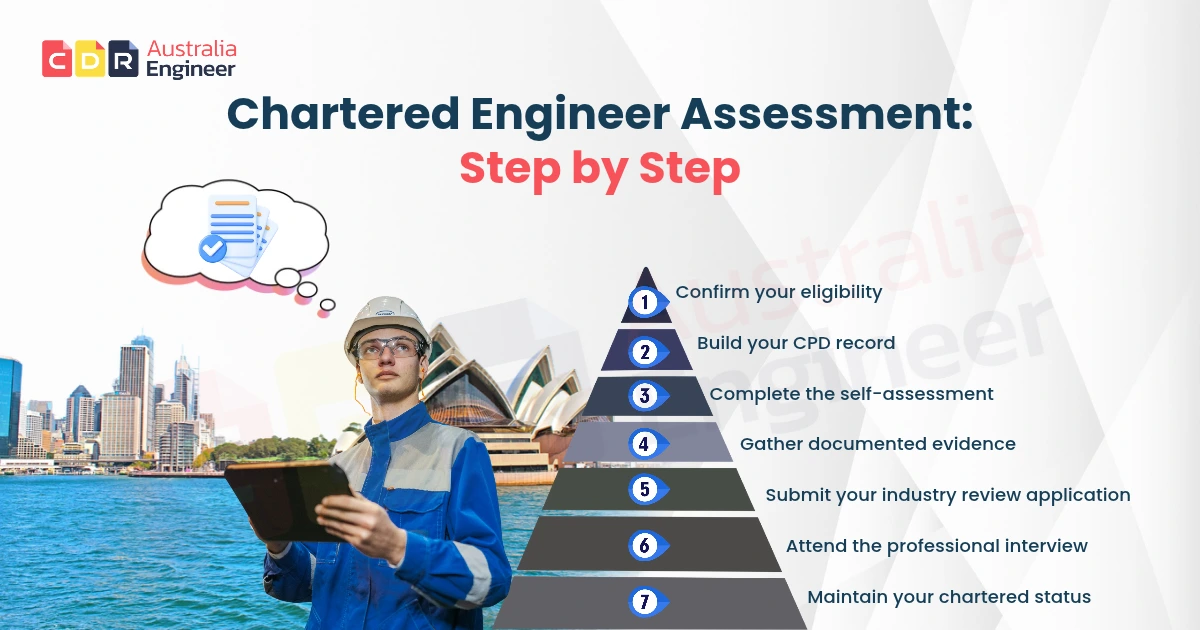
Check that your membership grade, years of experience, and occupational category meet the requirements for the standard or streamlined pathway before committing time to the rest of the process.
Ensure at least 150 hours of CPD are documented across the previous three years. Gaps here can delay an otherwise strong application, so this is worth addressing early rather than at submission.
Identify your area of practice and map your engineering experience against the relevant competency elements. This step shapes everything that follows, since the evidence you gather later needs to directly support the claims made here.
Collect reports, drawings, calculations, risk assessments, and project documentation that demonstrate the competencies claimed. Where material is confidential, obtain employer permission or redact appropriately before submission.
This includes your self-assessment, evidence, CPD record, and supporting documentation, reviewed against the applicable competency standard before you’re invited to interview.
This is where an assessor discusses your engineering work directly with you, probing the judgement, leadership, and technical depth behind the evidence submitted, not simply confirming that the paperwork exists.
Once awarded, CPEng is tied to ongoing CPD and continuing Engineers Australia membership requirements. Letting either lapse puts your chartered status at risk.
Factor | Standard Pathway | Streamlined Interview Pathway |
Experience required | 5–15 years of postgraduate engineering experience | 15+ years of postgraduate engineering experience |
Assessment format | Self-assessment, documented evidence, industry review, interview | Interview-focused, still competency-based |
CPD requirement | At least 150 hours over the previous 3 years | Ongoing CPD obligations apply |
Governing body | Engineers Australia | Engineers Australia |
Application fee | $2,170 (incl. GST); membership fees additional | $2,170 (incl. GST); membership fees additional |
Result | CPEng credential, not a state license | CPEng credential, not a state license |
Prices may vary—confirm current fees directly with Engineers Australia before applying. The assessment fee covers the Chartered application itself; ongoing Engineers Australia membership and CPD obligations continue separately after Chartered status is awarded.
There is no direct salary correlation with charter status; rather, it marks the independent-practice proficiency to employers, a criterion that is often essential for senior technical leadership positions. While there is no set percentage difference in earnings between non-chartered engineers and CPEng holders, salary is still a function of the engineer’s discipline, industry, geographic location, employer, and his or her level of responsibility. The chartered designation is not a ticket that pays for itself right away when it’s granted, but it does mean access to senior positions and higher risk/reward opportunities.
Our expert consultants will assess your profile and recommend the best pathway for your Australian migration goals.

RPEQ is Queensland’s statutory registration (state registration) under the Professional Engineers Act 2002 and is required by law to practice as a professional engineer in Queensland, whereas CPEng is not. CPEng may support an RPEQ application, as Engineers Australia is a listed BPEQ assessment entity; however, the RPEQ registration process and requirements are separate from that of CPEng, as are the fees and the renewals. CPEng does not replace the other RPEQ application and documentation requirements for engineers in Queensland.
Migration skills assessments (entry-to-practice competency) are conducted separately and are run through different processes such as Engineers Australia’s MSA stream, ACS, VETASSESS, or TRA, depending on the applicant’s occupation. These assessments do not test the same level of independent-practice competency as this assessment tests. There is no obligation to obtain CPEng before passing a migration assessment, and likewise, an engineer may hold a migration assessment without a CPEng, and many migrating engineers will opt to take up CPEng at a later stage in their careers when they have gained the postgraduate experience necessary for the Chartered pathway.
To apply for chartered status, you must first be a member of Engineers Australia (member grade), which is a much simpler process, as it is evidence of your qualifications and professional standing, but not the same process as applying for chartered status. Most engineers join the profession as members for several years before they are ready to sit the Chartered Engineer Assessment and have the necessary postgraduate training and experience to become a Chartered Engineer, so membership is the starting point, not the end.
Timelines vary depending on how prepared your evidence and CPD record are at submission and on Engineers Australia’s current processing volumes. Applicants with well-organized evidence typically move through the process more predictably than those assembling documentation reactively.
No, not through the standard pathway. Engineers Australia recommends building documented experience and CPD in the meantime, so the eventual application is stronger.
No. CPEng can support an RPEQ application since Engineers Australia is an approved BPEQ assessment entity, but RPEQ remains a separate statutory registration.
Gaps in the required 150-hour CPD record over the previous three years can delay or block eligibility. It’s worth auditing your CPD history before submitting an application, not after.
The interview is tailored to the applicant’s documented evidence and area of practice, though all interviews assess the same underlying competency standard.
Start with a free consultation. We assess your profile at no cost and guide you every step of the way.

Scan to Connect With Our Experts ⤴︎