
Online

Engineering project arrangement is the reason two engineers can work on the same project and walk away with two very different CDR outcomes. One writes their career episode the way the project actually happened, starting with the client, the budget, the timeline, and what the team achieved together. It’s accurate. It’s also not what gets assessed.
The CDR comes back flagged, not because the work wasn’t real or wasn’t good, but because Engineers Australia isn’t assessing what the project delivered. It’s assessing what that one engineer personally did.
Engineering project arrangement is how you structure a career episode so your own contribution is visible, separate from everything the team or organization did around you. It’s not about rewriting the project or exaggerating your role; it’s about organizing genuine information so the parts that were yours are not mistakeable.

Engineering project arrangement is the deliberate organization of a project’s information in a CDR so an assessor can follow exactly what you did, not just what happened. Done properly, it creates a clear thread running from the project itself, through the engineering problem, to your action, your decision, and the result. Miss that thread, and an assessor is left guessing at your competency instead of seeing it directly.
A well-arranged project typically covers:
Think of arrangement as the difference between describing a project and documenting your involvement in one. Two engineers can work on the exact same system and produce completely different career episodes, simply because one arranges the information around their own decisions and the other arranges it around the project’s timeline. This is also why arrangement can’t really be bolted on at the end—it has to shape how you select details from the start.
CDRs are based on the individual assessment of individuals, not teams. The team redesigned the power distribution system, which may be entirely accurate but is of no use to anyone reviewing your report. Have you completed load calculations? Select from design options? Determine failure vulnerability. That’s where you have to see it, not to brag about yourself, but just to demonstrate the engineering judgment that you used.
This is what makes the most competent engineer receive a mediocre CDR, even though they did an excellent job: they did not separate their contribution from the surrounding issues in their writing.
The frustrating part is that this mistake rarely comes from a lack of technical ability. It comes from writing the report the same way you’d describe the project to a colleague or a manager, where “we” is the natural word to use and nobody expects you to separate out individual credit. That habit doesn’t translate to a CDR, where every sentence is being read with one question in mind: what did this specific person do, decide, or figure out?
Without that shift in thinking, even a genuinely strong project can end up reading like a summary of events rather than a record of your own engineering competency.
Our expert consultants will assess your profile and recommend the best pathway for your Australian migration goals.

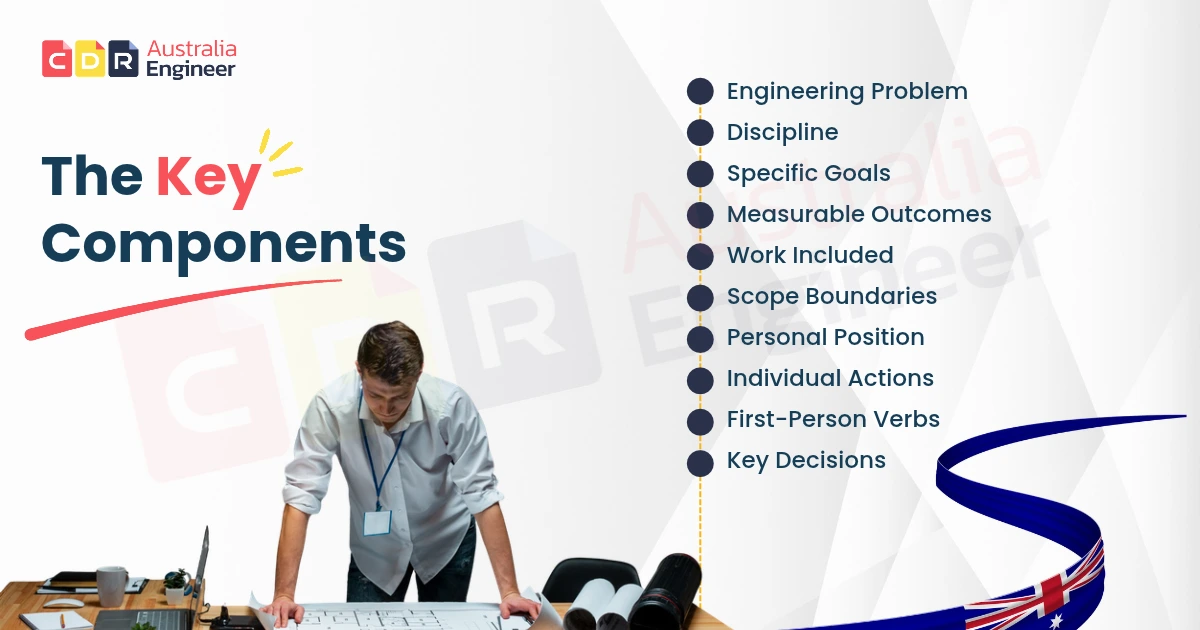
What the project was, the engineering discipline, and the problem or requirement that started it. Skip company history—only include what helps a reader understand the engineering situation.
What the project was meant to achieve, stated specifically enough that you can later say whether it worked. “Improve system performance” is weak. ” Reduce peak load failures on an aging distribution network” gives you something to actually measure against.
What the work covered—design, analysis, testing, commissioning—and just as importantly, what it didn’t. This stops your career episode from claiming credit for work that wasn’t yours.
The most important part. Your position, your specific responsibilities, what you personally did, and where you were involved in decisions. Write in first person throughout: “I analyzed,” “I calculated,” “I selected,” and “I tested.” This is what makes your contribution unmistakable against everyone else’s.
The strongest project write-ups don’t just state that a problem existed and got solved—they show the reasoning that connected the two:
Problem → Investigation → Options Considered → Decision → Implementation → Result
If a system had a performance issue, the value is in showing how you traced the cause, what alternatives you weighed, why you landed on the solution you chose, and how you confirmed it worked. That reasoning, more than the outcome itself, is what separates a genuine engineering account from a description of something that simply happened to turn out fine.
Calculations only earn their place in a career episode when they’re tied to a purpose. Naming a structural, electrical, load, or thermal calculation without saying what it was for reads as padding, even when the work behind it was genuine.
Weak | Strong |
Software used: AutoCAD | Used AutoCAD to produce and revise design drawings as load requirements changed |
Performed thermal calculations | Ran thermal load calculations to confirm existing HVAC capacity could absorb a 20% increase in server density |
An electrical engineer working on a power distribution system for an industrial facility finds that his system is experiencing frequent reliability problems during peak load conditions. The goal: improve reliability with desired load growth. Their task: evaluate and participate in the design of the upgraded system.
They have reviewed drawings, performed updated load calculations, assessed equipment options, created new drawings, and assisted in the commissioning process. The actual challenge was posed when the current switchgear was not capable of safely managing the anticipated load increase—they analyzed three switchgear reconfiguration choices to cost, downtime, and capacity and chose the most appropriate option. The system was tested and commissioned, and its capacity and reliability were met.
This is just an example of the structure it should have; your CDR should be based on real project work and not a made-up scenario.
Discipline | Typical Focus |
Civil | Structural design, construction, infrastructure |
Machinery, manufacturing, thermal systems | |
Electrical | Power systems, design, control systems |
Electronics | Embedded systems, circuits, communications |
Computer | Software systems, networks, cloud/computing |
Chemical | Process design, optimization, production |
Telecommunications | Communication networks and systems |
The structure stays the same across disciplines—only the technical content changes, and it should always reflect your actual field and experience.
Engineering project arrangement is the reason two engineers can work on the same project and walk away with two very different CDR outcomes. One writes their career episode the way the project actually happened, starting with the client, the budget, the timeline, and what the team achieved together. It’s accurate. It’s also not what gets assessed.
The CDR comes back flagged, not because the work wasn’t real or wasn’t good, but because Engineers Australia isn’t assessing what the project delivered. It’s assessing what that one engineer personally did.
Engineering project arrangement is how you structure a career episode so your own contribution is visible, separate from everything the team or organization did around you. It’s not about rewriting the project or exaggerating your role; it’s about organizing genuine information so the parts that were yours are unmistakable.
The two engineers in that opening example likely had comparable technical experience and did work of similar quality. What separated their outcomes wasn’t the project itself, but the lens each one used to write about it — one described events, the other documented decisions. That difference sounds small on paper, but it’s usually the single factor that decides whether a career episode gets accepted, queried, or rejected outright.
The way you structure a project’s information in a CDR—background, objectives, scope, your role, the problem, and the outcome—so your individual contribution is clear to an assessor.
Assessors are evaluating you, not your project or your team. A well-arranged account makes your contribution visible; a poorly arranged one leaves it buried, no matter how strong the underlying work was.
No. Only include what shows technical knowledge, reasoning, and decision-making. A full activity log dilutes the parts that actually matter.
Sometimes, if it genuinely demonstrates the competency required and reflects real work you did—not an idealized or reconstructed version of it.
Yes. “I designed,” “I calculated,” “I “evaluated”—that’s what makes clear which parts of the work were yours.
Start with a free consultation. We assess your profile at no cost and guide you every step of the way.

Scan to Connect With Our Experts ⤴︎