
Online

P.Eng Competency Canada is the competency-based assessment process Canadian engineers must complete to earn the Professional Engineer (P.Eng) designation, the legally protected title that authorises independent engineering practice across Canada. Unlike the Australian CDR, which relies on career episode narratives, the Canadian P.Eng competency system requires engineers to write structured Situation-Action-Outcome (SAO) examples under specific competency indicators, demonstrating not what their team achieved, but what they individually decided, designed, and delivered.
Experience requirements vary by province and changed for two major regulators during 2026. PEO reduced its minimum experience threshold from four years to two years, effective 1 July 2026, though PEO’s own guidance notes most applicants still need three to four years to genuinely demonstrate all 34 competencies. APEGA and EGBC continue to require approximately 48 months. Across every province, the most common reason engineers receive deficiency notices is not lack of experience, it is the quality and structure of their competency writing. P.Eng Competency Canada assessors across PEO, APEGA, and EGBC consistently report that engineers describe team outcomes instead of their own decisions.

P.Eng Competency Canada refers to the formal process by which provincial engineering regulators assess whether an applicant has demonstrated the knowledge, skills, and professional judgment required to practise engineering independently and responsibly. The P.Eng designation is not simply a title; in Canada, it is a legal requirement for signing and sealing engineering drawings, taking professional responsibility for engineering work, and practising in regulated engineering roles.
The shift from experience-log-based assessment to competency-based assessment (CBA) has made the process significantly more rigorous. Under the CBA model, years of experience alone are not sufficient, what matters is the quality, depth, and clarity of your written competency evidence.
Detail | Information |
Designation | Professional Engineer – P.Eng |
Administered By | Provincial engineering associations (PEO, APEGA, EGBC, APEGS, Engineers PEI, etc.) |
Experience Required | Approximately 48 months (4 years) of relevant post-graduation engineering experience |
Assessment Format | Competency-Based Assessment (CBA) – Situation-Action-Outcome (SAO) examples |
PEO (Ontario) | 34 competency indicators – structured evidence-based evaluation |
APEGA (Alberta) | 22-competency framework – numerical scoring system (0 to 5 scale) |
EGBC (British Columbia) | Provincial competency standards – confirmatory measures if gaps identified |
Referee Requirement | Referees must have direct knowledge of the work described in your SAO examples |
Professional Practice Exam | Required in most provinces before P.Eng is granted |
Source: PEO Ontario, APEGA Alberta, EGBC British Columbia published competency frameworks 2026. Each province uses its own framework, the number of competency indicators, the scoring method, and the specific evidence requirements differ between PEO, APEGA, and EGBC. Always confirm your provincial body’s current requirements before preparing your submission.
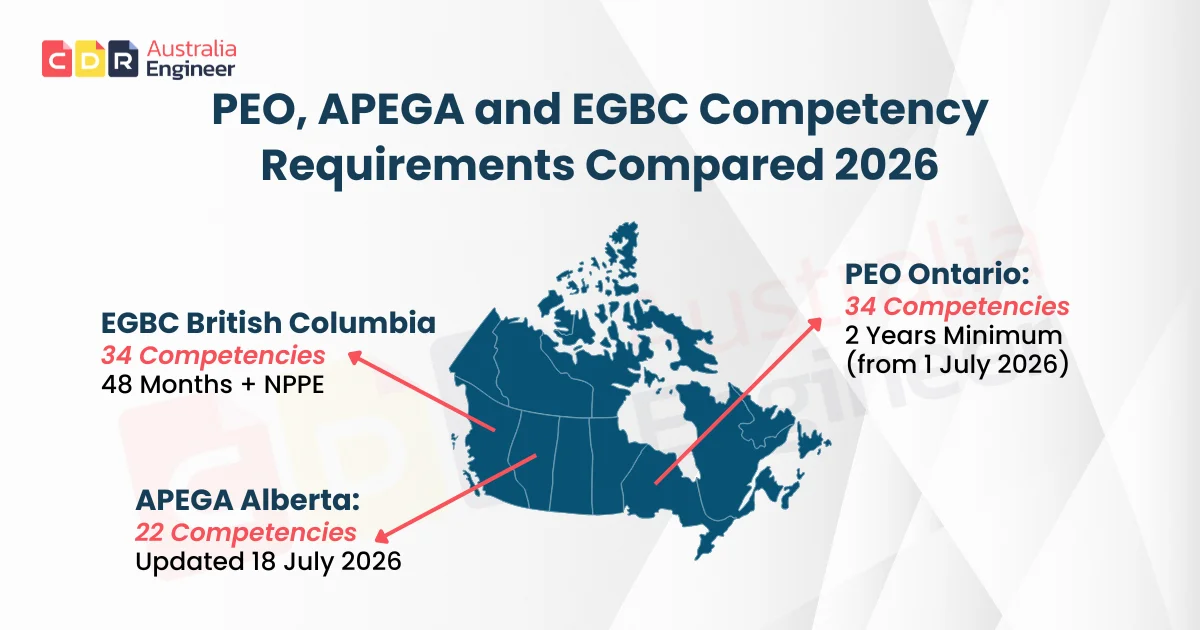
The three largest provincial engineering associations each operate a distinct competency framework. Understanding your province’s specific requirements before writing is essential, a response structured for APEGA will not satisfy PEO requirements, and vice versa.
PEO uses a structured competency model with 34 competencies across seven categories, six of which are professional standards competencies with their own rating criteria. From 1 July 2026, the minimum experience threshold dropped from four years to two, though PEO is explicit that this does not make applicants automatically eligible after two years, most still need three to four years to build demonstrable competence across all 34 areas. PEO assessors evaluate whether the evidence is specific, first-person, and traceable to actual engineering work, not just descriptions of what the project involved.
APEGA uses a 22-competency framework with a numerical scoring system, assessors score each competency on a 0 to 5 scale, with a minimum category average of 3.0 required. From 18 July 2026, APEGA integrated 8 mandatory Canadian work-environment equivalency competencies directly into the existing 22-competency framework, removing the previous requirement for a separate year of Canadian-based experience before applying. APEGA places particular emphasis on engineering judgment, professional accountability, and communication competencies, areas where overseas-trained engineers most commonly receive low scores or deficiencies.
EGBC assesses applicants against the same 34-competency structure used by PEO, evaluated against BC-specific regulatory and professional standards. Applicants need 48 months of acceptable engineering experience, at least 12 of which must be gained in a Canadian context, along with a pass on the National Professional Practice Exam, a 110-question test covering Canadian engineering law, ethics, liability and contracts.
Regardless of province, the underlying principle of P.Eng Competency Canada is the same: assessors want to see your individual engineering judgment, not a description of your employer’s project outcomes. The engineering contribution must be yours, the decision must be yours, and the professional responsibility must be demonstrably yours.
CDR australiaengineer specialises in high-quality CDR, RPL and VETASSESS reports for engineers. We offer low-cost, customized and reliable services in diverse engineering disciplines.
The Situation-Action-Outcome (SAO) format is the foundation of all P.Eng Competency Canada submissions. Each competency indicator requires one or more SAO examples drawn from your engineering experience. The format has three components:
The action section is where most P.Eng Competency Canada deficiencies originate. Engineers frequently write what the project team did, using ‘we’ language, rather than what they individually contributed. Assessors cannot credit competency evidence that describes team achievements without clearly isolating the applicant’s personal engineering decision-making.
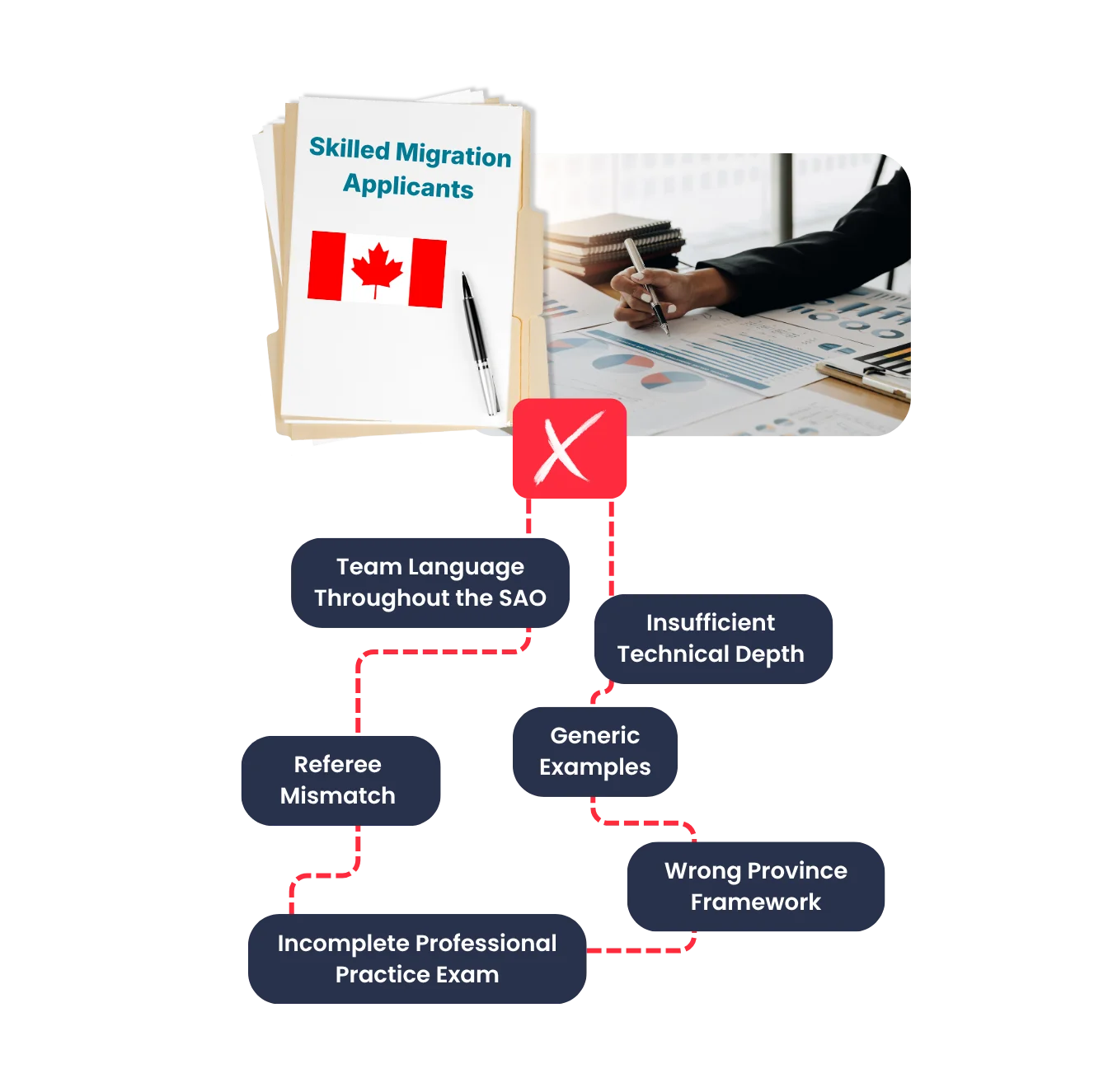
Deficiency notices are more common than most engineers expect. Here are the most consistent causes across PEO, APEGA, and EGBC assessments in 2026:
A deficiency notice does not mean rejection; it means your file is returned for additional evidence or revised responses. However, each revision cycle adds 3 to 6 months to your P.Eng timeline. Getting the competency writing right the first time is the most effective strategy.
Engineers who have completed or are considering both the Canadian P.Eng and Australian CDR processes often ask how the two systems compare. The underlying goal is the same, demonstrating engineering competency, but the format, structure, and evidence requirements differ significantly.
Factor | P.Eng Competency Canada | Engineers Australia CDR |
Format | SAO examples per competency indicator | Career Episodes (narrative format) |
Length | Structured responses per indicator | 1,000–2,500 words per episode |
Number of Projects | One per indicator – multiple projects acceptable | 3 career episodes required |
Competency Framework | PEO 34 indicators / APEGA 22 competencies | EA Competency Elements (3 categories) |
Referee Requirement | Mandatory for each SAO example | Employment references required |
Processing Time | 4 to 12 months depending on province | 8 to 12 weeks (EA) |
Fee | Varies by province – typically CAD $300 – $700 | Increased 3 – 4% from July 2026 |
Engineers who hold or are pursuing both the P.Eng Canada and an Engineers Australia skills assessment are well-positioned for international mobility. Canada and Australia have a bilateral recognition arrangement for engineering qualifications through Engineers Canada and Engineers Australia, engineers who are already registered as P.Eng in Canada may qualify for an expedited EA assessment pathway without submitting a full CDR.
Our expert consultants will assess your profile and recommend the best pathway for your Australian migration goals.
CDR Australia Engineer provides professional P.Eng Competency Canada writing support for engineers applying through PEO (Ontario), APEGA (Alberta), EGBC (British Columbia), and other provincial associations. We have worked alongside civil, mechanical, electrical, software, and structural engineers providing clear, simple methods of understanding precisely what a provincial review body panel assessor needs to see before judging.
Our P.Eng competency writing service includes:
Whether you’re seeking a PEO submission, a submission through APEGA, or an application through EGBC; or planning and writing a P. Eng competency submission simultaneously alongside an Engineers Australia CDR, we can support you in both processes.
The competency-based assessment (CBA) process required to earn the P.Eng designation. Applicants submit SAO examples proving individual engineering competency to their provincial regulator: PEO, APEGA, EGBC, or others.
PEO: 2 years minimum from 1 July 2026 (3–4 years typical in practice). APEGA and EGBC: approximately 48 months.
PEO uses 34 competencies across 7 categories. APEGA uses 22 competencies scored 0–5, updated 18 July 2026 with 8 Canadian equivalency competencies. EGBC uses the same 34-competency structure as PEO, plus the NPPE exam.
Often yes, through the mutual recognition arrangement between Engineers Canada and Engineers Australia. Confirm eligibility directly with Engineers Australia.
Team language. Writing “we designed” instead of “I designed” fails to isolate your individual engineering decision.
Free consultation & document collection.
ANZSCO code & category assessment.
Expert CDR writing by engineers.
Quality check & plagiarism test.
Delivery + free revisions support.
Start with a free consultation. We assess your profile at no cost and guide you every step of the way.

Scan to Connect With Our Experts ⤴︎