
Online

Learn about the meaning of the acronym MIEAust and the fees, along with eligibility and CPD requirements. Engineers, when asking themselves the question of Engineers Australia membership, may find that they repeatedly return to the same set of questions. What is this qualification actually, what does it cost, is it a qualification to CPEng, and what does it do with the National Engineering Register? These are the questions you’d have once you’ve passed the graduate phase and wish to become a full member of the corporation. This grade sits between a graduate recognition and chartered grade and is often linked to fees, CPD hours, and the national register (the information people consult when they are budgeting and charting their course). It is not a permanent objective but is one of the stages to be overcome to become chartered and registered by NER. It is based on accredited qualifications and verified professional experience and comes from Engineers Australia, the national association of engineers. As if knowing what the letters mean wasn’t enough, it’s equally as important to understand the fee structure, eligibility criteria, and CPD requirements, because they will dictate the cost of maintaining Engineers Australia membership and will be a requirement for membership to be maintained each year. It explains what it is, who can access it, the cost, the relation to CPEng, CPD requirements, and how OQEs can access it and fit in via the skills assessment and CDR pathway.

The post-nominal MIEAust is used after the name of a full corporate member in the Professional Engineer occupational category, denoting membership of the Institution of Engineers, Australia. It signals that Engineers Australia has endorsed the engineer’s qualification and recognized independent operating experience, distinguishing those still developing toward independent practice from those who’ve already demonstrated it. It is not a ‘license to practice’ and doesn’t automatically mean a person is on the NER—these remain separate processes, each with its own requirements. It is a membership grade, and Engineers Australia also recognizes MIEAust (Technologist) and AIEAust (Technologist and Associate), awarded in the Engineering Technologist and Engineering Associate categories, respectively, and follow parallel but distinct pathways based on qualification type.
Typically, applicants must hold a nationally recognised engineering qualification (accredited by Engineers Australia) and have a certain amount of relevant and verifiable professional experience after completing the engineering qualification. This experience must demonstrate the student’s ability to work independently, and not be superfluous, because the assessors are interested in the evidence of independent judgement, technical decision-making, and accountability for outcomes rather than merely time spent within a role. Two applicants with the same number of years in the field can present very differently—one having genuinely led decisions and owned outcomes, the other having worked largely under direction—and assessors look past the years alone to find that difference. Engineers trained in another country and/or who achieved a qualification through the Washington Accord (+) are also acceptable, provided their qualification and experience can be matched to the Australian standards.
Typically these would include the following documents:
These documents enable Engineers Australia to develop a full picture of your technical experience and practical independent engineering experience before awarding this membership grade, cross-checking your own account against independent corroboration to reduce the chance of gaps holding up your application.
Perhaps one of the most common questions asked about this qualification is about how much membership Engineers Australia is. Membership is paid on a financial year basis (from 1 July to 30 June), and fees vary according to occupational category. Generally, professional engineer members make more money than engineering technologist members or engineering associate members and sometimes have a one-time membership fee upon initial enrollment. Frequently the fees are reviewed on an annual basis and usually adjusted according to the CPI and WPI, so please note that the fees will not be a fixed amount that remains unchanged for a long period of time but will fluctuate with each year’s review.
Engineers can also plan for any additional expenses and requirements that arise in their professional life, such as registering for technical societies, continuing education, or participation in registration organizations, if applicable—expenses that can easily be forgotten when just considering the main membership fee. Fees are subject to annual change, so please make sure to check the Engineers Australia membership fees page for current rates instead of relying on a fee indicated in an older article, as this may not always be up to date when you apply.
A lot of engineers get confused between these two, so let’s clear it up.
Aspect | MIEAust | CPEng |
What it confirms | Satisfies qualification and experience requirements for full corporate membership | Statement of current, demonstrated competency in one or more practice areas, based on a competency standard |
Level | Standard membership grade | Different, higher-level qualification |
Prerequisite | Required prior to applying for CPEng | Not a requirement for becoming chartered on its own—typically pursued after this grade |
Basis for assessment | Qualification and experience | Further evidence—usually career episodes and a career interview or assessment |
Renewal | Standard membership renewal | Renewed at regular intervals to ensure continued competency |
Who typically needs it? | Most mid-career engineers as a baseline | Engineers in senior technical and client-facing positions, or those registering in a state other than NSW (e.g., RPEQ) |
In reality, this grade of membership is typically required prior to being able to apply for CPEng, so the two aren’t competing options—one is the pathway into the other.
The NER is a voluntary, national list of engineers who have achieved a level of competency that meets a national standard and is growing in significance as various states have adopted legislation or policy that requires or strongly recommends that certain types of engineering work must be performed by an engineer listed on the NER. This membership grade does not automatically register you on the register; it is a separate process with an annual subscription rate, which is usually less for Engineers Australia members than for non-members. Some engineers assume NER listing follows automatically once they reach full membership, but it requires its own application and ongoing subscription.
Where engineers are planning in advance, it’s typically full membership, followed by CPEng and NER registration, which are conditions that are likely to be listed. This register is not the only register that may satisfy the requirement for professional registration in your state (e.g., RPEQ in Queensland), so it’s worth checking your specific state’s requirements separately.
One of the most common ‘how to’ questions after becoming a member of Engineers Australia is this grade and higher, where members are required to undertake Continuing Professional Development (CPD). The national requirement is for engineers to take 150 hours of CPD in the previous three years. Some of these hours must be technical CPD that’s relevant to your practice, and the rest should be spent on other professional development activities like postgraduate programs, workshops, conferences, or workplace learning. Accurate CPD records are important for the following reasons:
Our expert consultants will assess your profile and recommend the best pathway for your Australian migration goals.
Many of the engineers undergoing training for this qualification are moving to Australia from overseas and normally commence this process by presenting a Competency Demonstration Report (CDR) to Engineers Australia for assessment. This report sets out your qualification and career history against the competencies Engineers Australia expects of a professional engineer. If your overseas qualification and experience are found to satisfy the Australian competency level in a positive CDR, it will likely give you good prospects of gaining skilled migration and being accepted at the graduate entry level of membership by Engineers Australia.
That said, the CDR assessment, the membership application, and entry in the register are three separate processes, each with its own costs, timelines, and documentation requirements. Qualified engineers from overseas have the advantage of professional guidance to help sequence these correctly, since mixing up what’s needed for each stage can lead to delays.
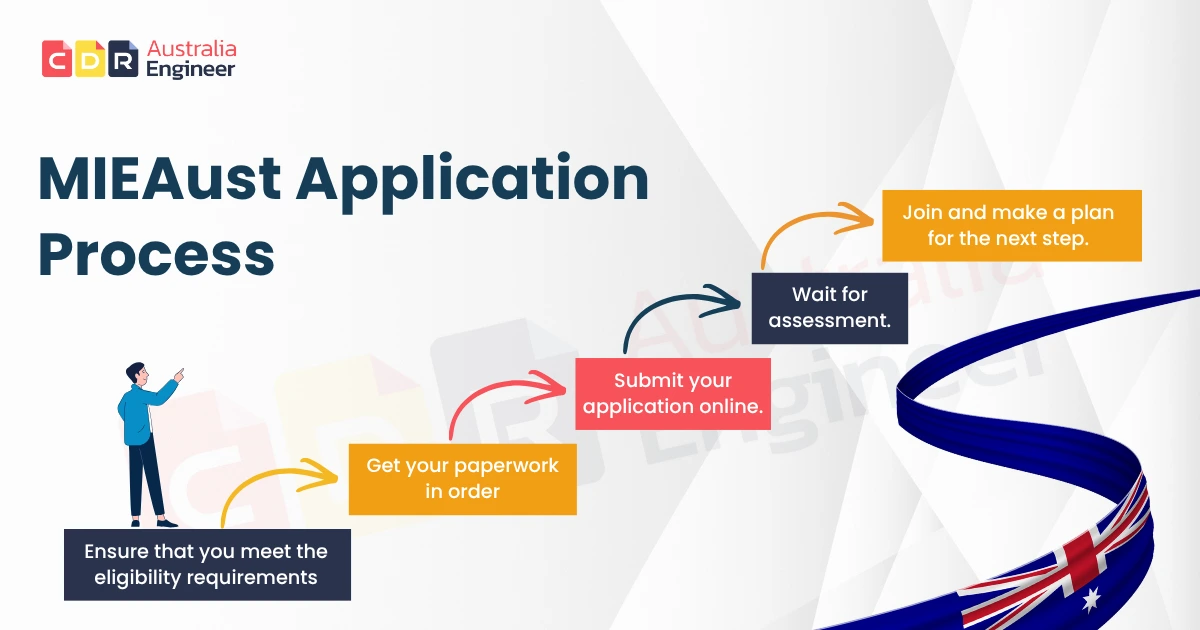
See if your qualification is accredited or has a positive skills assessment result; verify you have the appropriate verifiable, independent, professional experience.
Create your career episode reports, competency or outcome assessment letter, photo ID, and supervisor references.
Please make sure you have an Engineers Australia account and upload all supporting documents through the member portal.
The processing times will vary depending on whether a competency assessment is necessary, which Engineers Australia will inform you of if it’s required that you send more documents.
Once approved, this post-nominal will be included on your CV/profile, and you may start your planning for CPEng/NER registration (if relevant to your career plans).
Yes, for most mid-career engineers, particularly for the ones desiring to become a CPEng or NER in the long term. This is the normal grade level accepted as a starting point for both, and not losing grades is generally not time-saving. The advantages are typically
Combined, these tend to outweigh the yearly fee for an engineer working to establish a career in Australia.
It is the post-nominal of a full corporate member of the Institution of Engineers, Australia (IEAust) in the occupation category of Professional Engineer.
Fees are levied annually (on a financial year basis) and are different depending on the occupation—you can find out the current fees on Engineers Australia’s official fees page, as they will be different every year.
No. It is a confirmation of qualification and experience, and CPEng is a confirmation of current, demonstrated competency and is usually taken after achieving this membership grade.
Not automatically. The NER registration is an independent, voluntary process and charges, but is mandatory for some licensed engineering jobs in some states.
The national requirement is 150 hours over the past three years, although this is reduced if you have taken a break while working towards a career.
Start with a free consultation. We assess your profile at no cost and guide you every step of the way.

Scan to Connect With Our Experts ⤴︎