
Online

One of the first things you have to do if you’re a physiotherapist from overseas wanting to register in Australia is to acknowledge the Australian Physiotherapy Council (APC). Australia is renowned for its highly skilled workforce, and the health workforce is one of the most skilled in the world. Applicants with overseas training will be required to show that their knowledge, clinical reasoning, and practical skills are equivalent to those of a registered physiotherapist in Australia by the APC.
The Australian Physiotherapy Council takes the time to review your documents but also evaluates your clinical skills, decision-making, and professional judgment against the Physiotherapy Board of Australia standards. Many overseas-trained candidates have years of clinical experience and have difficulty navigating through the APC exam process, which can result in delays, resits, or further documents. A well-planned approach at each step could go a long way in making your registration process smoother.
We are able to help internationally qualified professionals understand the assessment process and requirements of the Australian assessment bodies, including physiotherapists preparing for assessment by the APC at CDR Australia Engineers. We make sense of each step and guide you through a logical documentation and approach.
APC is a national organization that is responsible to the Physiotherapy Board of Australia to determine the competency of physiotherapists trained overseas who wish to register in Australia. It’s in charge of:
Ultimately, that’s how we can safeguard patients and ensure that only qualified physiotherapists are entering into the profession.
Overall, the APC serves as the link between a physiotherapist’s overseas qualification and their right to practice safely and legally in Australia.
The Australian Physiotherapy Council (APC) and the PBA provide essential services for physiotherapists in Australia. The Australian Physiotherapy Council (APC) and the PBA are vital services to physiotherapists in Australia.
Sometimes, candidates do not recall the difference between these two bodies. The Physiotherapy Board of Australia is the regulatory authority responsible for the standards for registration as a physiotherapist, registration of physiotherapists, and final decision on who is allowed to register as a physiotherapist in Australia. APC is also the entity that performs a candidate’s qualifications assessment, administers the APC exam, and ensures that a candidate is competent at the expected level of the board.
In practical terms:
All this because sometimes the person asking the query on registration refers it to the wrong body or thinks that they have been registered. The Physiotherapy Board of Australia does the actual registration when the assessment process by APC is complete.
The Australian Physiotherapy Entry Pathway (APEP) is the official pathway of the Australian Physiotherapy Council (APC) to facilitate the process of registering overseas-trained physiotherapists. It superseded the previous Standard Assessment Pathway and shortened many of the procedures, making them more viable options to be carried out remotely.
The typical progression for the APEP pathway is the following steps:
The APEP is a developmental process where candidates must show evidence of logical thinking in the sequence of steps they undertake, not just individual technical details.
The total cost of the APEP pathway is estimated at AUD $7,814 and is divided across each stage of the pathway:
The fees for resits for a stage are at present:
The fees are determined by the Australian Physiotherapy Council and will be reviewed periodically and, in most cases, adjusted in line with the CPI in January every year. Before budgeting an APC fee, always refer back to the official source of the APC fee schedule to see if the fee has changed.
The examination for APC is a test of knowledge and clinical reasoning in three connected clinical areas, and the topics for professional practice are
Musculoskeletal Physiotherapy
Neurological Physiotherapy
Cardiorespiratory Physiotherapy
Professional Practice
Students are evaluated throughout their lifespan (pediatric, adult, and geriatric care) and across various health care settings such as acute hospitals and community-based health care practices.
For most physiotherapists, if they are trained overseas and wish to become registered with the Physiotherapy Board of Australia, they must obtain a prior assessment from the Australian Physiotherapy Council (APC). This is particularly important for clinicians who must demonstrate that their qualifications and experience are comparable to Australia’s competency requirements. These include:
Applicants with an accredited entry-level qualification from an Australian university or a current practicing certificate from an Australian or New Zealand physiotherapy registration board may be exempt from some of the requirements of the APC exam process.
Our expert consultants will assess your profile and recommend the best pathway for your Australian migration goals.
Unfortunately, many of the otherwise well-qualified physiotherapists are experiencing unnecessary delays at the Australian Physiotherapy Council level during the assessment process. The most common issues encountered are
Too much emphasis placed on clinical aspects: Candidates focus more on the clinical aspects and neglect the aspects related to the healthcare system, ethics, and risk management in Australia and as part of the APC exam questions.
Employing the “how we do it back home” approach: The APC exam is designed to be based on information and evidence relating to the Australian context, not the international context.
Time management on the exam paper: If there is a set number of questions per paper, candidates who have not practiced timed scenarios might not be able to complete more difficult case scenarios.
Not reading the official written assessment booklet: The APC publishes what is tested, and many candidates do not read the booklet; if they do not read it, they will not mark the booklet.
Not mapping the sequence of the APEP pathway: Some candidates write the written assessment without having completed the knowledge base tasks in the pathway, so as a result, candidates may not perform well on the knowledge base tasks.
Underprepared for the capability assessment: It is a live, remote oral exam, and candidates who are not prepared to point out clinical reasoning during the exam may not perform as well as they would in the real world.
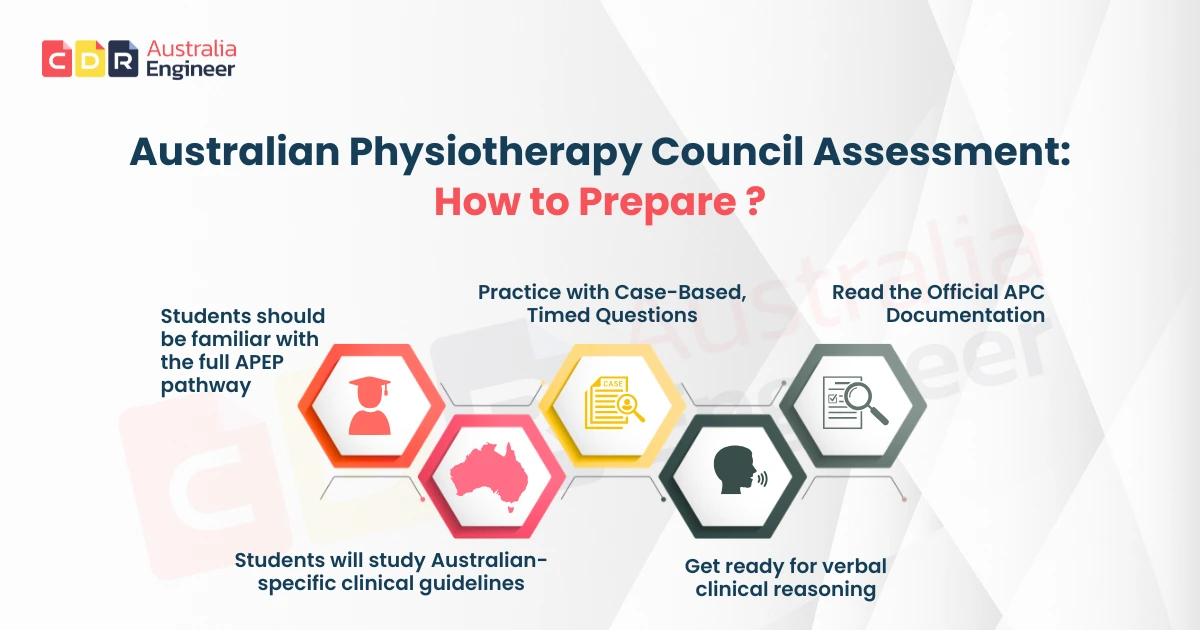
Students need to be aware of the entire APEP pathway. Take some time to understand what is involved in each stage of the APEP, from Eligibility Assessment to Clinical Workshop, to enable you to plan your time realistically.
In Step 2, students will learn about Australian-specific clinical guidelines. Use current Australian evidence-based practice for revision, not general physiotherapy knowledge. Understand the role of Medicare and NDIS and the interprofessional care model in the clinical practice of physiotherapy according to board standards.
Because the APC exam is a clinical test based on case scenarios with multiple-choice questions, you should practice timed questions as you get used to answering the questions accurately and on time.
In the Capability Assessment part of APEP, practice verbalizing your clinical thinking, which is a skill different from knowing the right answer.
APC provides detailed booklets on exam format, scoring, and expectations. Follow these as your trusted sources, not blog summaries or second-hand advice.
The assessment process provided by the Australian Physiotherapy Council (APC) may be confusing, especially for candidates who are processing from overseas, and there may be some confusion regarding the documentation and expectations from the Physiotherapy Board of Australia (PBoA).
We help internationally qualified professionals at CDRAustraliaEngineers, such as physiotherapists, with the following:
We don’t want to replace your clinical preparation; this is just to hopefully help you approach your APC assessment with a clear and organized plan.
Passing the Australian Physiotherapy Council (APC) assessment is as much about knowing the APEP pathway as it is about being a skilled clinician, preparing for the APC exam, and understanding the influence of the board (PBOA) standards on each of these stages. The registration process will be smoother and with fewer setbacks and delays for the candidates who will make an effort to understand the whole process, prepare in Australia with relevant contexts, and structure the documentation accordingly.
The right information and guidance can make all the difference from the initial research of the APC to preparing for APEP. We realize you are here to make your life easier, to help you get through each step confidently and clearly, and to concentrate on the most important thing—being a registered physiotherapist in Australia.
The Australian Physiotherapy Council (APC) was established by the Physiotherapy Board of Australia to evaluate internationally trained physiotherapists who wish to become registered to work in Australia.
The APC exams are the Written Assessment and the Capability Assessment (with the exception of the written component), which are designed to test your knowledge, reasoning, and decision-making clinically.
APEP is the current official pathway for physiotherapists trained overseas to complete their assessment with the APC, which is mainly conducted remotely, prior to assessors completing the registration on behalf of the Australian Physiotherapy Council.
No. The APC assessment, including the APC exam, is conducted by the APC, which has responsibility for setting standards for registration and issuing registrations on behalf of the Physiotherapy Board of Australia.
APEP allows for re-application and re-taking the written assessment with a new application and payment of the corresponding fee.
Start with a free consultation. We assess your profile at no cost and guide you every step of the way.

Scan to Connect With Our Experts ⤴︎