
Online

Becoming an overseas qualified engineer who would like to migrate, work, or be professionally recognized in Australia is the first true step in that journey, and that’s the CDR Australia Engineers applicant. Each year, thousands of engineers (mechanical, civil, electrical, chemical, or software) submit Engineers Australia (EA) with a Competency Demonstration Report for the skilled migration or professional registration process. But few know what really makes the difference between a “go” and a “no go.”
This page is designed to change that to be a one-stop source of information for any applicant eager to avoid confusion rather than clarity prior to submitting. We have worked with engineers from India, Pakistan, Nepal, Philippines, Nigeria, Egypt, China, and countless other nations to create CDR reports that are compliant with EA’s strict requirements and are competency-mapped. Our CDR report writing services are designed to ensure that each of your visa applications (Subclass 189, 190, or 491 skilled visa) and any CDR reports you submit for Chartered status recognition are as successful as you can possibly make them.
This is because Engineers Australia does not use your job title or the number of years you have experienced to determine if you will be assessed; it is based on whether the competencies you have documented in your work are those expected for your nominated engineering category. Everything that comes after on this page is dictated by that one fact; from the way we draft your career episodes to the way we itemize our fees, it’s all shaped by that one fact.

We use this term for any engineering professional from overseas applying to Engineers Australia via the CDR pathway, someone who needs to demonstrate to Engineers Australia that their qualifications and experience are equivalent to a recognised Australian engineering qualification. This proof takes the form of a Competency Demonstration Report (CDR). Engineers from Accord signatory countries may be able to bypass this process; most applicants from non-signatory countries will not have that option. The CDR is not optional paperwork; it is the process Engineers Australia (the national assessing body recognised by the Department of Home Affairs) uses to determine whether your training is equivalent to Australian engineering competency standards.
Determining whether you need to lodge a CDR isn’t always obvious, since the requirement applies across a range of different circumstances. You need to lodge a CDR if any of the following apply to you:
The first step, regardless of category: No matter which category applies to you, the first step is always the same: a thorough self-assessment of your skills, experience, and the correct ANZSCO occupation code for your field. This step is often underestimated, yet it shapes everything that follows from the structure of your career episodes to your visa eligibility itself.
A common and costly mistake: One of the most frequent and costly errors we see is a job description mismatched to the wrong occupation code, even when the career episodes themselves are otherwise solid. This usually isn’t obvious to the applicant, since real engineering work can genuinely resemble more than one ANZSCO category on paper. But EA assesses your CDR strictly against the competencies defined for the specific code you’ve nominated, so even a well-written career episode can be marked non-compliant if it’s mapped against the wrong benchmark.
Migration and professional recognition in Australia rarely rest on a single document. Depending on your profession, you may require a submission to one of the following assessing authorities, each governed by its own distinct competency framework, evidentiary requirements, and formatting standards:
A comprehensive Competency Demonstration Report encompassing Career Episodes, a Summary Statement, and CPD documentation, prepared for engineers pursuing skilled migration or Chartered Professional Engineer status.
A full Recognition of Prior Learning report or Closely Related assessment for ICT professionals, mapped against the ACS CBOK framework and covering all major ANZSCO codes within the ICT sector.
A complete skills assessment report addressing over 360 occupations across Groups A through E, including accountants, nurses, teachers, social workers, and a broad range of trade occupations.
A documentation prepared for the Provisional Skills Assessment (PSA), Job Ready Program (JRP), and Offshore Skills Assessment Program (OSAP), tailored to qualified tradespeople migrating to Australia.
The assessment support is built around the National Standard of Competency for Architects (NSCA), including summary statement mapping and portfolio structuring for overseas-qualified architects.
Competency documentation covering the full breadth of project experience for quantity surveyors across every sector of the built environment, including buildings, infrastructure, and utilities.
Formal skills assessment support for overseas-trained teachers, structured to satisfy the evidentiary requirements of the Australian Institute for Teaching and School Leadership.
Qualification and experience documentation prepared in accordance with the framework of the Australian Children’s Education and Care Quality Authority for early childhood educators applying under the skilled migration program.
Leadership competency documentation for management and leadership occupations, prepared to meet the specific assessment criteria of the Institute of Managers and Leaders.
As a CDR Australia Engineers specialist, we don’t limit ourselves to engineering CDRs alone. Our team supports applicants across every major Australian skills assessment pathway, backed by discipline-matched writers, rigorous plagiarism screening, and full compliance with each authority’s current guidelines.
Below is a detailed breakdown of everything we offer, organized by assessing body and service type.
Complete competency demonstration reports for engineers migrating under skilled visa categories. Career Episodes, Summary Statements, CPD, Stage 1, Stage 2, and NER.
ICT professional skill assessments for Subclass 189, 190, and 491 visas. Full RPL reports and closely related assessments written to ACS CBOK standards.
Professional skills assessments for 360+ occupations, including accountants, nurses, teachers, social workers, and trade occupations. All groups A through E.
Professional Trades Recognition Australia (TRA) Skills Assessment Services for qualified tradespeople migrating to Australia. Documentation prepared to meet current TRA assessment standards.
Beyond the major assessing bodies covered above, we also support applicants across a range of profession-specific authorities recognized by the Department of Home Affairs for skilled migration and registration purposes.
Beyond core skills assessment reports, we provide supporting documentation and application services to strengthen every stage of your visa and migration journey.
Our expert consultants will assess your profile and recommend the best pathway for your Australian migration goals.

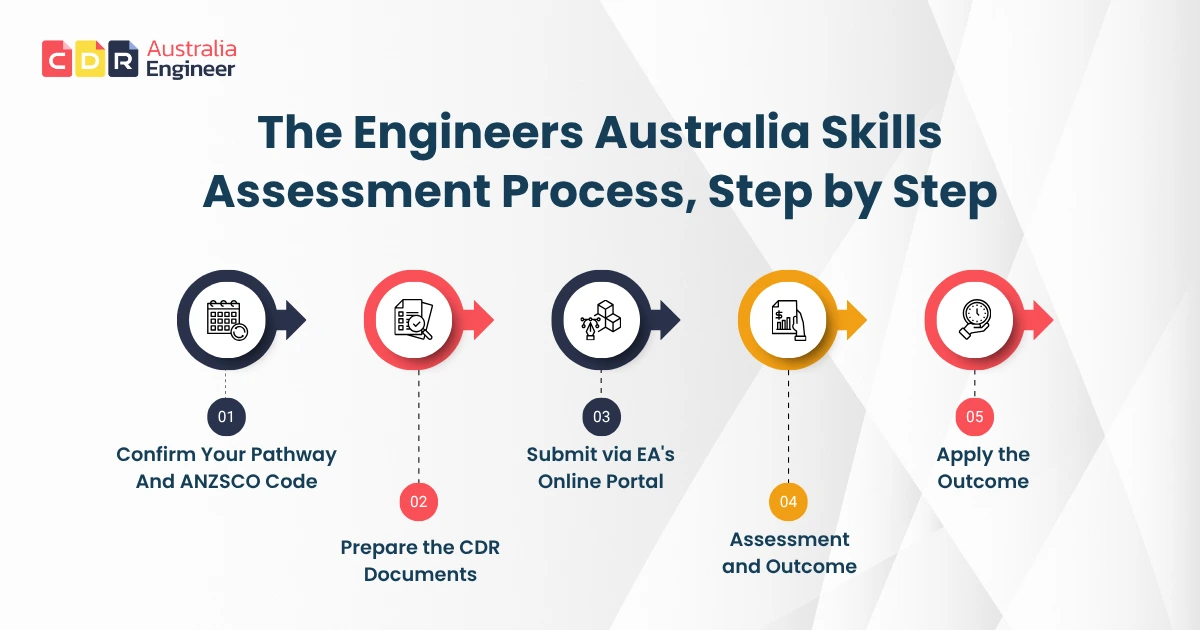
Determine whether you qualify for the Accord pathway (no CDR required) or the CDR pathway. Most non-signatory-country graduates fall into the latter and must proceed as a full CDR Australia Engineers applicant. At the same time, confirm the correct ANZSCO occupation code for your field. Your entire assessment and visa eligibility hinge on this, and it’s one of the most common causes of rejection if chosen incorrectly.
Draft your three career episodes, summary statement, and CPD list. This is where most engineers turn to professional CDR report writing services, since EA rejects a significant share of self-written reports for vague or generic content.
Upload your CDR, academic transcripts, English test results (IELTS 6.0 / PTE-A 50 minimum, or equivalent), employment references, and identity documents.
EA assessors typically take several weeks to months depending on whether you choose the standard or fast-track service. A positive outcome letter confirms your occupation code and competency level, which remains valid indefinitely from EA’s perspective. However, the Department of Home Affairs requires your assessment to still be within its three-year validity window at the time you use it for a visa invitation.
Use your positive assessment to lodge an Expression of Interest for skilled migration, apply for Chartered status, or pursue state-based registration such as RPEQ. Many clients return to us at this stage for résumé rewriting or recommendation letters, since a strong assessment outcome is far more valuable when paired with equally strong supporting documents for the visa or employer application that follows.
These fees are reviewed every year and, in general, increase each financial year. Please check the latest fee schedule on the Engineers Australia website before payment. As a general rule, for financial year 2026–27:
Assessment Category | Estimated Cost (AUD, incl. GST) |
Standard CDR skills assessment | ~$1,034 |
Fast-track priority processing (add-on) | ~$396 |
International Accord pathway (Washington/Sydney/Dublin) | ~$539 |
Australian-accredited qualification pathway | ~$335 |
CPD documentation (if purchased separately) | ~$40–$60 |
Beyond the EA fee, budget for professional writing assistance, document translation/certification if needed, and a contingency for resubmission if your first result is a rejection, which usually costs more than getting it right the first time. Since EA’s fees only rise annually, early preparation of your ANZSCO code, evidence, and career episode writing is also a cost-saving move.
Note: All fees listed on this page are indicative and based on the 2026–27 Engineers Australia fee schedule at the time of writing. Fees are reviewed annually and are subject to change without notice. Always confirm the current, exact fee for your assessment type directly on the official Engineers Australia website before making payment.
At CDR Australia Engineers, we take pride in assisting engineers worldwide in securing a positive Skill Assessment result from Engineers Australia. Trust our expertise to enhance your migration success with precise and high-quality CDR reports.
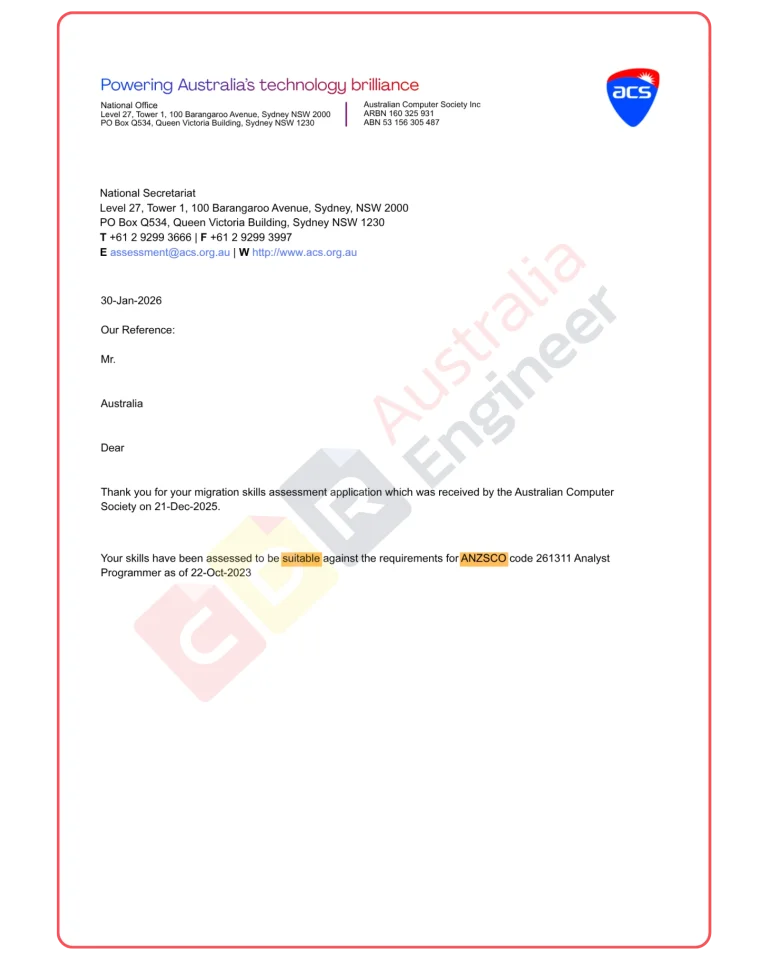
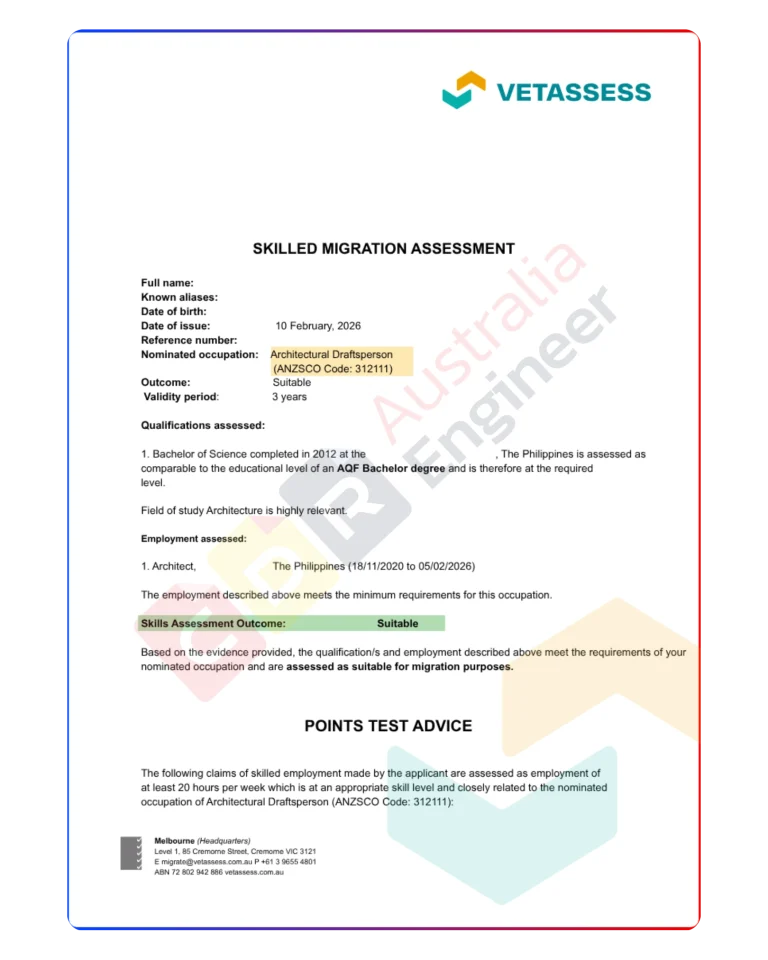
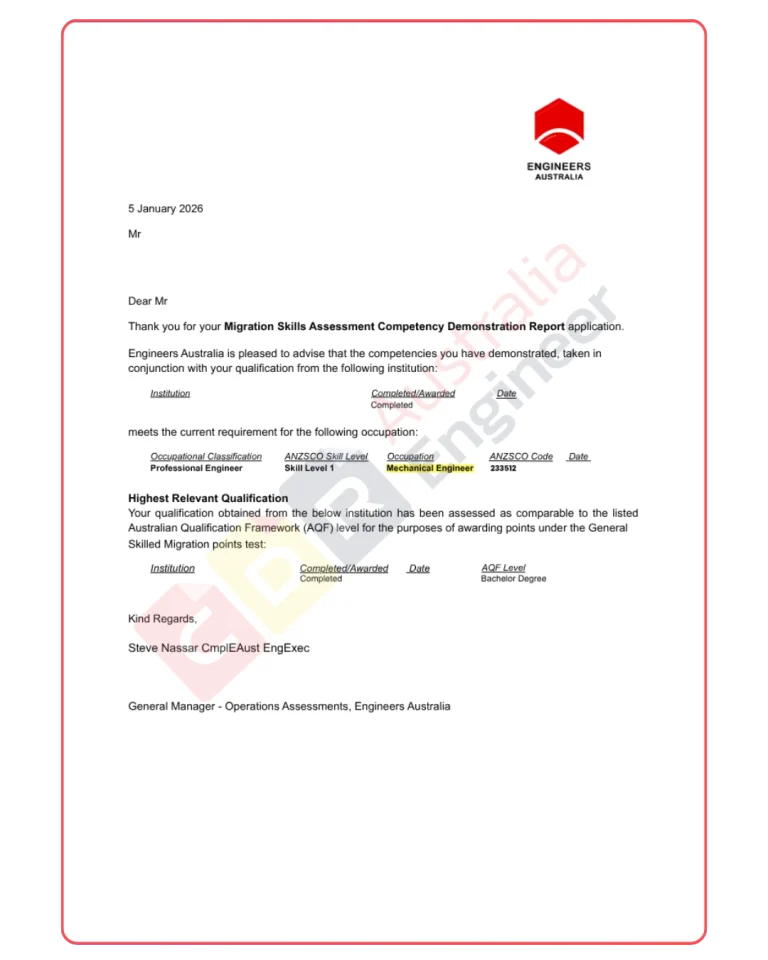
A positive outcome from Engineers Australia is not just a box-ticking exercise for visa requirements. As for one of the CDR Australia engineers, recognition gives you:
None of these outcomes are guaranteed by submitting a CDR alone; they depend on the competency alignment, originality, and quality of your report. That’s exactly the gap we help candidates bridge when writing their Engineers Australia skills assessment report, the gap between eligibility on paper and a real opportunity.
At CDR Australia Engineers, we are familiar with the documentation requirements expected of Australian migration and skills assessments. We have a proven track record helping professionals across all major assessment authorities, including Engineers Australia.
We offer engineers the following services:
We work with applicants to make their engineering experience clearer, more accurate, and appropriate for assessment.
From the most seasoned engineer to your first CDR submission, we strive to make the documentation process easy and professional, yet with close attention to detail.
You can secure expert guidance early on, whether you’re just confirming your ANZSCO code or ready to submit your final documents, to become a successful CDR Australia Engineers. Our CDR report writing services have been created to meet Engineers Australia’s competency requirements, and our team has helped engineers in all disciplines to navigate a compliant and structured Engineers Australia skills assessment from career episode writing right through to report submission and outcome.
No. In some cases, a qualification from a Washington Accord, Sydney Accord, or Dublin Accord signatory institution may exempt you from the CDR process by following the International Accord pathway. The typical requirement is a full CDR for everyone else.
Standard processing time is usually a few weeks to a few months, and fast-track priority processing can reduce this at an extra cost.
You may, but EA’s assessors are very good at spotting generic, template, or AI-generated stories. Many self-prepared reports fail to show a level of personal engineering judgement that is adequate to pass.
The result is valid indefinitely from Engineers Australia’s perspective, but the Department of Home Affairs applies a 3-year currency window from the date you use the result in a visa application, so timing your migration steps matters.
It is possible to appeal the decision or resubmit with additional evidence. This is where a professional CDR review service can help, since it identifies which competency elements were not met.
Start with a free consultation. We assess your profile at no cost and guide you every step of the way.

Scan to Connect With Our Experts ⤴︎