
Online

Consider an engineer three years into their career, asked in an interview, “So you’re a member of Engineers Australia?” They answer without hesitation, assuming their earlier student membership simply carried through to the full Engineers Australia membership. In practice, student, graduate, and full member status are distinct grades, each with its own requirements, and the distinction matters more than it may first appear. It can mean unmet CPD obligations, a membership grade that no longer reflects the engineer’s actual experience, or a fee bracket they were never aware they had moved into.
Engineers Australia membership is not a single, generic qualification. It is a tiered system—Student, Graduate, Member, Fellow, and Honorary Fellow layered across three occupational categories, each with its own fee structure and CPD requirements, and each carrying direct implications for further progression toward Chartered status, RPEQ, and the National Engineering Register (NER).
Membership is the professional body’s core credentialing system, distinct from state-based registration such as RPEQ and from chartered status (CPEng). An engineer’s membership grade is determined by qualification and experience, while their occupational category is determined by the nature of the engineering work they perform. Misclassifying either is not simply a matter of unnecessary cost—it can delay every subsequent credential built upon it.

Engineers Australia is the national professional association of engineers, and your membership signifies your formal recognition of qualification level and professional status. It is not a legal license—it does not give the right to practice anywhere, like RPEQ or RPEV do. It’s a professional credential and a national network, and it’s the on-ramp for many engineers to chartered status (CPEng) or to be listed on the National Engineering Register (NER).
There are currently five levels of membership in Engineers Australia: Student, Graduate, Member, Fellow, and Honorary Fellow. You should not be judged on your job title or the organization you work for, but on the qualifications you have and your professional experience.
In addition to the grade, Engineers Australia recommends and classifies an engineering occupation as an engineering professional, engineering technologist, or engineering associate, depending on the nature of the engineering work and the level of the engineering qualification. There is another category of skills that are reserved exclusively for migration skills assessment. Your grade and occupational category are both different classifications, and they have to be together in order to determine your fees, your competency requirements, and the pathways (chartered, NER, state registration) to which you can advance later.
Our expert consultants will assess your profile and recommend the best pathway for your Australian migration goals.

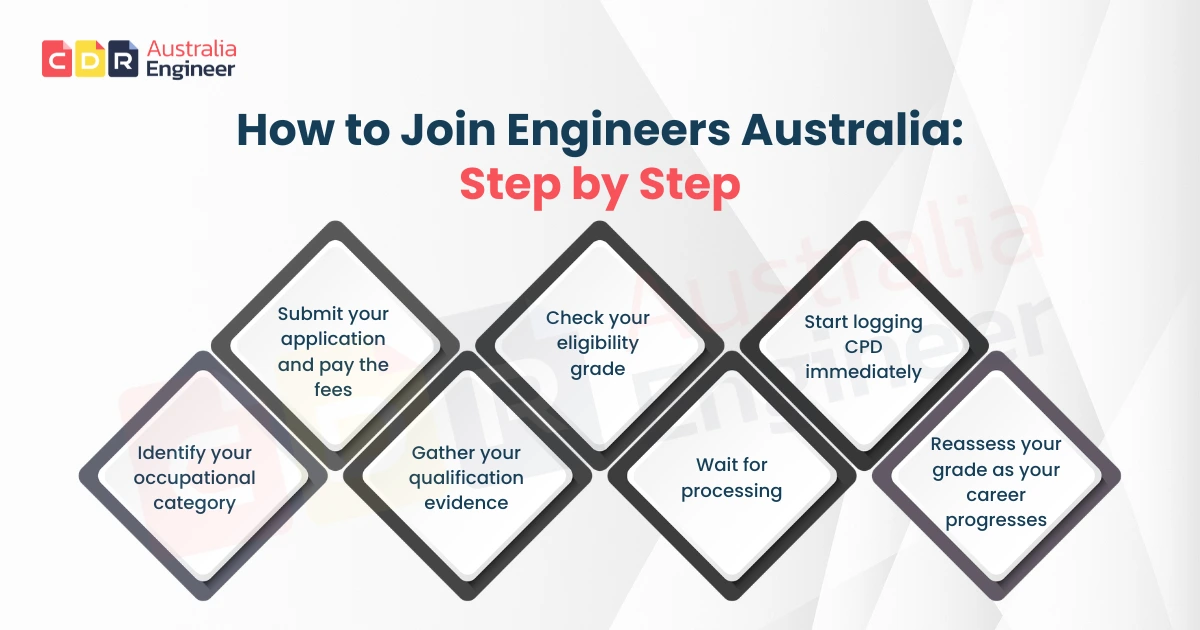
Determine whether your qualification and work fall under Professional Engineer, Engineering Technologist, or Engineering Associate. Getting this wrong at the outset is one of the most common causes of delayed or rejected applications, so it’s worth confirming carefully before moving on.
Confirm whether your qualification and experience place you at the graduate or member level; this determines your assessment pathway and fee bracket. If you’re unsure which side of the threshold you fall on, it’s better to check directly with Engineers Australia than to assume.
If your degree is Washington, Sydney, or Dublin Accord-accredited, this step is usually straightforward. If not, you’ll likely need a Competency Demonstration Report (CDR) that maps your engineering experience against the relevant competency standards.
This includes the membership fee for your grade and, on first joining or rejoining, a one-off administration fee (currently waived for applications submitted by 30 September 2026). Double-check your fee bracket before submitting, since occupational category and grade both affect the amount owed.
Straightforward applications typically process in three to four business days; applications requiring a competency assessment take longer, particularly during peak periods, so it’s worth planning ahead if you’re working toward a deadline.
Even at the graduate level, building a CPD habit early makes every later credential—member, chartered, NER—considerably easier to support. Keeping a running log, rather than reconstructing years of activity later, saves significant time down the track.
Moving from graduate to member isn’t automatic; you need to apply once you meet the experience threshold. Leaving this too long can mean your membership no longer reflects your actual seniority, which can matter when applying for chartered status or senior roles.
Grade | Who it’s for | Typical annual fee (2026–27, incl. GST) |
Student | Enrolled in an accredited engineering program | Free |
Graduate (GradIEAust) | Accredited degree, under 3 years’ experience | Free for recent graduates until the end of the financial year; otherwise, a lower fixed fee |
Member (MIEAust) | Accredited degree plus qualifying experience | Roughly $200–$855, depending on occupational category and assessment |
Fellow (FIEAust) | Senior members with significant professional contribution | Set by Engineers Australia; higher than standard member fee |
Honorary Fellow | By invitation only | Not applicable |
A one-off $110 administration fee applies when you first join or rejoin, in addition to the annual membership fee currently waived for applications submitted by 30 September 2026.
Membership runs on a financial year basis (1 July to 30 June); joining mid-year gets your fee pro-rated monthly, so you only pay for the months you’re actually a member.
Assuming membership is a license: Engineers Australia membership doesn’t grant legal authority to practice anywhere—that’s the job of state registration schemes like RPEQ or RPEV.
Sitting in the graduate grade too long: The upgrade to Member isn’t automatic; you need to apply once you’ve accumulated the required experience.
Letting CPD lapse: CPD isn’t just a chartered requirement—falling behind can affect your standing at any grade and makes later applications harder to support.
Confusing occupational category with grade: Your category (Professional Engineer, Engineering Technologist, or Engineering Associate) and your grade (Graduate, Member, or Fellow) are assessed separately, and mixing them up leads to the wrong fee bracket or a rejected application.
Assuming membership replaces a migration skills assessment: It doesn’t; migration assessments follow their own process, even though they draw on overlapping competency evidence.
Membership itself doesn’t set your salary: what it does is open doors. It’s often a prerequisite for chartered status, certain state registration pathways, and NER listing, all of which correlate with more senior, better-paid roles, and plenty of senior job ads simply list membership as a baseline filter before anyone looks at your actual experience. But the grade matters here: Student and graduate membership won’t move the needle on pay at all, since they’re entry credentials rather than markers of seniority, while full member and fellow status carry more weight because reaching them requires the years of experience employers are genuinely paying for.
Salary itself still comes down to the usual factors—discipline, industry, location, and responsibility level—so the honest way to think about membership is as infrastructure for your career, not a credential that pays for itself directly, though skipping it or sitting in the wrong grade too long can quietly close off the roles where the raises actually happen.
Membership vs CPEng. Chartered status (CPEng) is a separate, more senior credential built on top of membership—you generally need to be an Engineers Australia member before you can apply for Chartered.
Membership vs RPEQ. RPEQ is Queensland’s separate legal registration. Engineers Australia is one of BPEQ’s approved assessment entities, so your membership evidence can support an RPEQ application, but membership alone doesn’t satisfy the legal requirement.
Membership vs NER. The National Engineering Register is a separate, though related, listing—also run by Engineers Australia—and increasingly used as a pathway into other states’ mandatory registration schemes.
No. Membership is a professional credential, not a legal license. Legal requirements to practise come from state or territory legislation, such as Queensland’s RPEQ scheme.
Grade (Student, Graduate, Member, Fellow) reflects your qualification and experience level. Occupational category (professional engineer, engineering technologist, or engineering associate) reflects the type of engineering work and qualification involved. Both are assessed separately.
No. Chartered status and NER listing are separate assessments that membership can support, but neither is automatic on joining.
Student membership is free. Graduate membership is currently free for recent graduates until the end of the financial year. Full member fees range roughly from $200 to $855 per year depending on occupational category and assessment requirements, plus a one-off $110 administration fee on first joining or rejoining.
Only if your qualification isn’t automatically recognized, typically because it wasn’t earned under a Washington, Sydney, or Dublin Accord program. Where required, a Competency Demonstration Report (CDR) is the usual pathway.
Start with a free consultation. We assess your profile at no cost and guide you every step of the way.

Scan to Connect With Our Experts ⤴︎